During the 80s and 90s, R.E.M. was one of the most popular and influential bands to come out of the U.S. In this week's isolated track, we'll listen to the isolated guitar from one of the band's most beloved songs "It's The End Of The World As We Know It."
The song is from the R.E.M.'s 1987 Document album, which spent 33 weeks on the Billboard Hot 200 album chart, peaking at #10. Here's what to listen for.
1. Peter Buck has a different guitar sound in every section, with a relatively clean electric on the verse, a bigger distorted one on the B sections and choruses, and another on the last part of the chorus and the bridge. An acoustic guitar enters on the next to last chorus and the very last chord of the song.
2. The guitar goes from mono in the verses and bridge to doubled in B sections and chorus. The acoustic guitar also leans to the left a little.
3. The playing is not perfect, but the timing is. It keeps that indie feel and stops the song from feeling too slick.
4. Listen to the hard mute at 2:28. You can hear a brief click of the beginning of next chord being cut off, something that would be easy to fix today in a DAW, but not so easy in the console/tape days.
Help Support This Blog
Friday, September 11, 2015
REM "End Of The World" Isolated Guitars
Thursday, September 10, 2015
"Big Mick" Hughes On Mixing Metallica Live
Here's a video that features Metallica's long-time front of house mixer "Big Mick" Hughes. He's mixed over 1,500 of the band's shows over the years and is a legend in live sound.
It's a bit of a commercial for Meyer Sound, but there's still some good insights into how important the low end is in a live situation (sometimes too important if the engineer isn't careful).
Labels:
Big Mick Hughes,
Metallica,
Meyer Sound,
video
Wednesday, September 9, 2015
Using the 1176 - The Bones Howe Setting
The Universal Audio 1176 limiter is a perennial favorite compressor limiter, but there are some standard settings that work especially well.
Here’s one used by the famous Los Angeles engineer Bones Howe, who engineered so many great hits of the 60s and 70s by Elvis, Frank Sinatra, Mama’s and Papas, Johnny Rivers and many more.
This is one of the bonus tricks from my 101 Mixing Tricks coaching program. Get 4 more killer tricks at 101MixingTricks.com.
Here’s one used by the famous Los Angeles engineer Bones Howe, who engineered so many great hits of the 60s and 70s by Elvis, Frank Sinatra, Mama’s and Papas, Johnny Rivers and many more.
Labels:
101 Mixing Tricks,
101mixtrix.com,
1176,
Bones Howe,
compression,
limiter,
Universal Audio,
video
Tuesday, September 8, 2015
Mastering Engineer Colin Leonard On My Latest Inner Circle Podcast
This week's guest on my Inner Circle Podcast is mastering engineer Colin Leonard of Sing Mastering, who's become the go-to mastering guy for uber-mixers like Dave Pensado and Phil Tan. Colin describes how he got into mastering, his unusual and proprietary signal path, and his overall mastering philosophy.
On the intro we'll look at what's becoming known as "Playola," or the practice of paying to be included on an influential playlist, as well as maybe getting an answer to the perennial question "What is the best driving music?".
Also, I'm happy to announce that the podcast has been selected as one of the Top 10 music industry podcasts by Indie Connect.
On the intro we'll look at what's becoming known as "Playola," or the practice of paying to be included on an influential playlist, as well as maybe getting an answer to the perennial question "What is the best driving music?".
Also, I'm happy to announce that the podcast has been selected as one of the Top 10 music industry podcasts by Indie Connect.
How To Select A Live Vocal Mic
In this video, Dave Rat from Rat Sound shows an easy way to test a variety of vocal microphones, then make the best choice for your application.
Beware, a single mic rarely fits all applications, as you'll see.
Labels:
Dave Rat,
live sound,
Rat Sound,
Shure SM58,
video,
vocal mic
Monday, September 7, 2015
New Music Gear Monday: PrimeAcoustic VoxGuard VU
The only thing worse than having a noisy room when your recording a vocal or voiceover is having a bad sounding room. One easy and temporary solution is to surround the mic with what's become known as an "ambient noise attenuator," and that's exactly what the Primacoustic's VoxGuard VU is.
The VoxGuard VU takes this concept one step further though, and adds a 3 inch by 7 inch Plexiglass window so that the vocalist can see the rest of the band or receive cues from the producer (among other things).
The unit fits on to a common microphone stand and an extender clamp allows you to fit the microphone holder. It's also adjustable so that you can move the mic closer or further from the vocalist.
It's always better to have a good sounding quiet iso room to record in, but when that's not available, try Primeacoustic's VoxGuard VU instead. It retails for only $99. Here's what it looks like.
The VoxGuard VU takes this concept one step further though, and adds a 3 inch by 7 inch Plexiglass window so that the vocalist can see the rest of the band or receive cues from the producer (among other things).
The unit fits on to a common microphone stand and an extender clamp allows you to fit the microphone holder. It's also adjustable so that you can move the mic closer or further from the vocalist.
It's always better to have a good sounding quiet iso room to record in, but when that's not available, try Primeacoustic's VoxGuard VU instead. It retails for only $99. Here's what it looks like.
Labels:
isolation,
New Music Gear Monday,
Primacoustic,
VoxGuard VU
Friday, September 4, 2015
A-ha "Take On Me" Isolated Vocals
It's always cool to hear inside a song that you've heard so much over the years and today's isolated track is no exception. It's the lead vocal track from the new-wave classic "Take On Me" by the Norwegian synth-pop band A-ha.
The rotoscoped music video was a huge hit on MTV back when the song was released in 1985, but you still hear this record played a lot on the radio. Here's what to listen for:
1. The vocal range of singer Morton Harket is pretty evident, as he goes from his full voice in a lower register to a strong falsetto with ease (and no punches, as far as I can tell).
2. There's a lot of grunts, sing alongs and breaths between phrases, which we'd probably clean up if the song was recorded today.
3. Listen to the medium length delayed reverb. It sounds like it's band-passed using a technique like the Abbey Road Reverb Trick. The song was actually recorded at Pete Townshend's Eel Pie Studios (sadly now defunct).
4. You can hear the the 100Hz test tone as the song begins at 0:21 if you listen on headphones.
The rotoscoped music video was a huge hit on MTV back when the song was released in 1985, but you still hear this record played a lot on the radio. Here's what to listen for:
1. The vocal range of singer Morton Harket is pretty evident, as he goes from his full voice in a lower register to a strong falsetto with ease (and no punches, as far as I can tell).
2. There's a lot of grunts, sing alongs and breaths between phrases, which we'd probably clean up if the song was recorded today.
3. Listen to the medium length delayed reverb. It sounds like it's band-passed using a technique like the Abbey Road Reverb Trick. The song was actually recorded at Pete Townshend's Eel Pie Studios (sadly now defunct).
4. You can hear the the 100Hz test tone as the song begins at 0:21 if you listen on headphones.
Labels:
A-ha,
Eel Pie Studios,
isolated vocal,
video
Thursday, September 3, 2015
A Tour Of Universal Audio
I'm a big fan and user of Universal Audio gear and plugins, so I was fascinated by this video tour of the UA facility. It was shot by Vintage Audio and narrated by CEO Bill Putnum Jr, the son of the legendary engineer and inventor Bill Putnum. Check it out.
Labels:
Bill Putnam,
Universal Audio,
video,
Vintage King
Wednesday, September 2, 2015
A Guide On Where To Find Acoustic Panel Materials
I posted this about 4 years ago (has it been that long already?) but the question keeps popping up so here it is again. Where do you find ridged fiberglass (like Owens Corning 703) so you can build your own acoustic panels?
Most of the excellent acoustic materials won't be found at your local Home Depot, unfortunately, so you have to search a little. Here's an excerpt from The Studio Builder's Handbook that covers what material is available and where to find it.
"Acoustic panels can be made from a few different materials, some more effective than others. The difference in materials is not only the amount of absorption, but the absorption ability at different frequencies.
Owens Corning 703
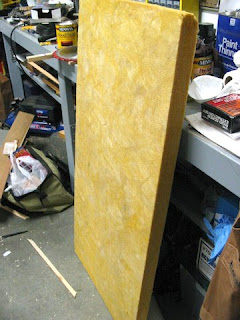
As said in the previous chapters of the book, the standard for acoustic panels is Owens Corning 703, which you won’t normally find at Home Depot (see the graphic on the left).
Instead, look for a local supplier of “Industrial Insulation,” or an HVAC supplier, who should normally carry it. When asking for it at a specialty supplier, sometimes it’s called “industrial furnace insulation board.”
You can also find it online at a number of places including readyacoustics.com and gikacoustics.com among others.
703 costs approximately $12 a panel (sometimes more and sometimes less, depending on where you buy it) and comes in packs of six. Knauf ECOSE, Johns Manville, Roxul Safe and Sound, and Certainteed are the same kind of ridged fiberglass, and can be even cheaper than their Owens Corning equivalent. Just be sure that the thickness and density is the same. Try buyinsulationproducts.com.
Handling fiberglass can irritate your skin, eyes and respiratory tract, and the dust particles are so small that they can get trapped in the lungs and become carcinogenic in some people. That’s why it’s important to always wear gloves and a mask when handling it.
Mineral Wool
Mineral wool is another mineral fiber insulation product that works as a 703 or R 13 alternative.
It’s a lot less expensive than 703, and even has better absorption characteristics, but it can be a little harder to work with because it’s not as rigid.
Try Rockwool RWA45, RW3 or the ridged Rockboard 60, which costs about $35 for a package of 6 panels (see the figure on the left).
You may find Rockwool or mineral fiber at your local lumber supplier, or try online at atsacoustics.com, among other places.
Mineral wool is easily handled and does not cause any irritation to the skin, eyes or respiratory system like fiberglass does.
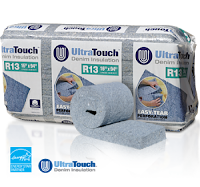
Ultratouch Cotton
Yet another alternative is Ultratouch cotton, which you might be able to find at Lowes or Home Depot. It’s about the same cost as rockwool and works almost as well, yet has none of the irritant properties of fiberglass.
You can also use it in place of R 13 or R 19 in your walls. It can also be found at sensiblesolutions.com online. What's interesting about this material is that it's basically recycled denim blue jeans.
Frames
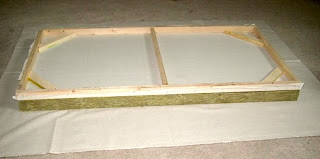
Frames for acoustic panels can be made using 2 inch by 2 inch wood and then covering them with cloth to give them a very pleasant appearance (see the graphic on the left). This doesn’t have to be an expensive wood (pine will work), as it can be stained, covered with a wood trim or just covered with fabric.
The wood trim can be standard wall molding that can be purchased quite easily at any hardware store or big-box discount hardware store. Typically hardwood molding can be very expensive and run from $8 to $40 and up per linear foot, but try high quality pine molding, which is both affordable and looks fantastic once it’s lacquered.
You can rent a pneumatic air hammer at your local tool and building supply company for not much money on a daily rental. If you use this nail gun with very small one inch finish nails to attach the trim to the wall panels, you’ll have a very nice look on your finished work.
Fabric
Covering acoustic panels is pretty easy in that all you need is a material that easily passes audio. This can be almost anything from burlap (probably the cheapest) to even speaker grill cloth.
The best way to test it is to blow into it, and if you feel your breath coming through the other side, it should work.
Maybe the most expensive covering is by Guilford of Maine, but it has the advantages of being acoustically transparent and flame retardant as well as being available in a wide variety of colors. You can find it online at soundaway.com, acousticalsolutions.com, noisecontrolproducts.com, as well as many others.
All that being said, cloth is available in many thicknesses and densities and there should be lots of local outlets in your area where you can purchase it at a discount. Sometimes it works better if you have thinner cloth that’s wrapped several times for a few more layers.
Try doing a test panel first to see how the cloth will work for you. You may find it best to use the thinner more affordable cloth even though you probably will have to take the extra time to attach multiple layers."
To read additional excerpts from The Studio Builders Handbook and my other books, check out the excerpts section on my website.
Most of the excellent acoustic materials won't be found at your local Home Depot, unfortunately, so you have to search a little. Here's an excerpt from The Studio Builder's Handbook that covers what material is available and where to find it.
![]() |
| Owens Corning 703 compressed Fiberglass |
Owens Corning 703
As said in the previous chapters of the book, the standard for acoustic panels is Owens Corning 703, which you won’t normally find at Home Depot (see the graphic on the left).
Instead, look for a local supplier of “Industrial Insulation,” or an HVAC supplier, who should normally carry it. When asking for it at a specialty supplier, sometimes it’s called “industrial furnace insulation board.”
You can also find it online at a number of places including readyacoustics.com and gikacoustics.com among others.
703 costs approximately $12 a panel (sometimes more and sometimes less, depending on where you buy it) and comes in packs of six. Knauf ECOSE, Johns Manville, Roxul Safe and Sound, and Certainteed are the same kind of ridged fiberglass, and can be even cheaper than their Owens Corning equivalent. Just be sure that the thickness and density is the same. Try buyinsulationproducts.com.
Handling fiberglass can irritate your skin, eyes and respiratory tract, and the dust particles are so small that they can get trapped in the lungs and become carcinogenic in some people. That’s why it’s important to always wear gloves and a mask when handling it.
![]() |
| Rockwool acoustic material |
Mineral wool is another mineral fiber insulation product that works as a 703 or R 13 alternative.
It’s a lot less expensive than 703, and even has better absorption characteristics, but it can be a little harder to work with because it’s not as rigid.
Try Rockwool RWA45, RW3 or the ridged Rockboard 60, which costs about $35 for a package of 6 panels (see the figure on the left).
You may find Rockwool or mineral fiber at your local lumber supplier, or try online at atsacoustics.com, among other places.
Mineral wool is easily handled and does not cause any irritation to the skin, eyes or respiratory system like fiberglass does.
![]() |
| Ultratouch denim insulation |
Yet another alternative is Ultratouch cotton, which you might be able to find at Lowes or Home Depot. It’s about the same cost as rockwool and works almost as well, yet has none of the irritant properties of fiberglass.
You can also use it in place of R 13 or R 19 in your walls. It can also be found at sensiblesolutions.com online. What's interesting about this material is that it's basically recycled denim blue jeans.
Frames
![]() |
| Acoustic Panel Frame |
The wood trim can be standard wall molding that can be purchased quite easily at any hardware store or big-box discount hardware store. Typically hardwood molding can be very expensive and run from $8 to $40 and up per linear foot, but try high quality pine molding, which is both affordable and looks fantastic once it’s lacquered.
You can rent a pneumatic air hammer at your local tool and building supply company for not much money on a daily rental. If you use this nail gun with very small one inch finish nails to attach the trim to the wall panels, you’ll have a very nice look on your finished work.
Fabric
Covering acoustic panels is pretty easy in that all you need is a material that easily passes audio. This can be almost anything from burlap (probably the cheapest) to even speaker grill cloth.
The best way to test it is to blow into it, and if you feel your breath coming through the other side, it should work.
Maybe the most expensive covering is by Guilford of Maine, but it has the advantages of being acoustically transparent and flame retardant as well as being available in a wide variety of colors. You can find it online at soundaway.com, acousticalsolutions.com, noisecontrolproducts.com, as well as many others.
All that being said, cloth is available in many thicknesses and densities and there should be lots of local outlets in your area where you can purchase it at a discount. Sometimes it works better if you have thinner cloth that’s wrapped several times for a few more layers.
Try doing a test panel first to see how the cloth will work for you. You may find it best to use the thinner more affordable cloth even though you probably will have to take the extra time to attach multiple layers."
To read additional excerpts from The Studio Builders Handbook and my other books, check out the excerpts section on my website.
Labels:
acoustic material,
acoustic panels,
book excerpt,
OC 703,
Rockwool,
Studio Builders Handbook,
Ultratouch cotton
Tuesday, September 1, 2015
Does Songwriter Vocabulary Matter?
In a study looking at the largest vocabularies in the music industry, it seems that rappers take the cake. The Musixmatch lyric site found that 4 out of the top 5 largest songwriter vocabularies come from rap. Here's what they found.1. Eminem - 8,818 unique words
2. Jay Z - 6,899
3. Tupac - 6,569
4. Kenye West - 5,069
5. Bob Dylan - 4,883
It should be noted that many artist/writers like Bruce Springsteen don't make the list because they haven't granted permission for Musixmatch to use their lyrics.
There have been other studies that have looked at parameters like lyric density and intervals between new words, but this is the first to check overall vocabulary size.
The study looked at 93 top artists across 25 different genres that ranged from pop to new age.
Personally, I'd just prefer to listen and not analyze. Do you think songwriter vocabulary matters?
Labels:
Bob Dylan,
Eminem,
Jay-Z,
musixmatch,
songwriter vocabulary
Monday, August 31, 2015
L.A. Session Guitarist Gary Solt On My Latest Inner Circle Podcast
If you're ever been in the studio with a large orchestra, you know that it's an experience you'll not soon forget.
This week's guest Gary Solt has been the favorite guitar player for orchestra dates for dozens of movies and television shows, and he'll tell us what it's like to play with an orchestra both in the studio and live.
On the intro I'll take a look at the interesting answers coming from a Billboard survey of music industry execs, and the latest Logic Pro X update and what that might mean for Pro Tools users.
Remember that you can find the podcast at BobbyOInnerCircle.com, or either on iTunes or Stitcher.
This week's guest Gary Solt has been the favorite guitar player for orchestra dates for dozens of movies and television shows, and he'll tell us what it's like to play with an orchestra both in the studio and live.
On the intro I'll take a look at the interesting answers coming from a Billboard survey of music industry execs, and the latest Logic Pro X update and what that might mean for Pro Tools users.
New Music Gear Monday: Moog Music Animoog App
The iPad is becoming more and more powerful to the point where many are using it as a legitimate music creation device. Moog Music has further added to this capability with its new Animoog iPad app.
Animoog is powered by Moog's new Anisotropic Synth Engine (ASE), making it fully polyphonic and capable of dynamically moving through an X/Y timbre space.
It features a Timbre page, which provides a wide range of classic Moog synth and pedals sounds that are generated by ASE and not via sample playback.
It also features polyphonic modulation, polyphonic pitch shifting, a classic ping pong delay module, a "Thick Module" that provides bit crushing to unison voice detuning and drive, and the classic Moog 4 point filter.
That's not all. Animoog also has a Record Module that allows you to record your performance and overdub new layers on top, then transfer the recordings via the pasteboard. There's also a flexible modulation matrix, and MIDI In so Animoog can be controlled from a MIDI controller.
Moog Music's Animoog is available from the App Store for $24.99. Check out the video below for an example of Animoog at work.
Animoog is powered by Moog's new Anisotropic Synth Engine (ASE), making it fully polyphonic and capable of dynamically moving through an X/Y timbre space.
It features a Timbre page, which provides a wide range of classic Moog synth and pedals sounds that are generated by ASE and not via sample playback.
It also features polyphonic modulation, polyphonic pitch shifting, a classic ping pong delay module, a "Thick Module" that provides bit crushing to unison voice detuning and drive, and the classic Moog 4 point filter.
That's not all. Animoog also has a Record Module that allows you to record your performance and overdub new layers on top, then transfer the recordings via the pasteboard. There's also a flexible modulation matrix, and MIDI In so Animoog can be controlled from a MIDI controller.
Moog Music's Animoog is available from the App Store for $24.99. Check out the video below for an example of Animoog at work.
Labels:
Animoog,
iPad,
Moog Music,
synthesizer app,
video
Subscribe to:
Posts (Atom)


