Get This Free Cheat Sheet Guaranteed To Help Your Next Mix

Showing posts with label AKG. Show all posts

Monday, August 10, 2015

New Music Gear Monday: UAD AKG BX-20 Reverb Plugin

Universal Audio AKG BX 20 plugin image
It may be hard to believe but in the days before hardware digital reverbs and plugins there were few inexpensive ways to generate ambience during a mix. Not many studios had the room or the expertise to build a live chamber and plate reverbs were expensive, leaving the lowly spring reverb as the only low cost alternative.

That being said, there was a very well made high-end version of the spring reverb that found its way into many studios - the AKG BX 20.

Many an engineer loved the BX 20 sound, but there weren't many originally made and there are even fewer around today. That's all been changed with the introduction of Universal Audio's plugin version of the famous reverb. UA emulated what they felt was the best currently working example of unit, one owned by producer Jon Brion.

While the plugin has all the parameter controls of the original unit, UA also included a few "digital-only" features like decay, volume and pan, link, dry/wet blend, predelay and low cut filter, none of which are found on the hardware version.

The UAD BX 20 spring reverb plugin works on UAD-2 hardware and Apollo interfaces and is endorsed by AKG Acoustics, the original maker of the hardware unit from the 60s. The price is $199. Check out the video below to hear what it sounds like and go to the UA site for more info.


Monday, July 20, 2015

New Music Gear Monday: AKG M90Q Quincy Jones Headphones

Quincy Jones AKG N90Q Headphones image
There are a number of speaker systems, monitor controllers and stand-alone apps that will analyze the listening environment and tune your monitors to it accordingly. This used to be something akin to voodoo but it's so widely and inexpensively available now that we hardly blink an eye.

What is different is the new AKG N90Q by Quincy Jones headphones that feature something called TruNote, that uses the same analysis technology to customize the headphone's to the shape of the wearer's ear. Of course, Q himself was heavily involved with designing these phones, hence the name.

The N90Q is truly a work of engineering. Besides tuning themselves to your ear via a pair of tiny mics in each earcup, they also provide a built-in 96k DAC and a USB port so you can plug in directly to your computer's digital stream and bypass the limited internal DACs for a better sound.

Then there's the fact that they're noise canceling, have bass and treble controls on the left earphone and volume, On-Off, and DSP settings (Normal, Studio, Surround Sound) on the right cup.

The phones carry about an 8 hour charge, and can be rejuiced via the USB connection or via a supplied backup battery called a Powerbank that connects via USB as well, for much more control of the audio than the normal headphone.

The AKG N90Q by Quincy Jones headphones comes with a travel case, travel pouch, Powerbank battery, and various cables and adaptors so that the phones will work in just about any setting. These aren't for everybody however, thanks to the $1,500 price tag, which puts them out of the range of most studios. That said, if you're looking for the best and money is no object, they'll be worth checking out when available in early September.


Monday, October 13, 2014

AES Show New Gear Wrap Up - Part 2

Yesterday I discussed new loudspeakers and software from this year's AES show. Today we'll look at microphones and consoles (yes, they're back - in a way). Here we go.

Microphones
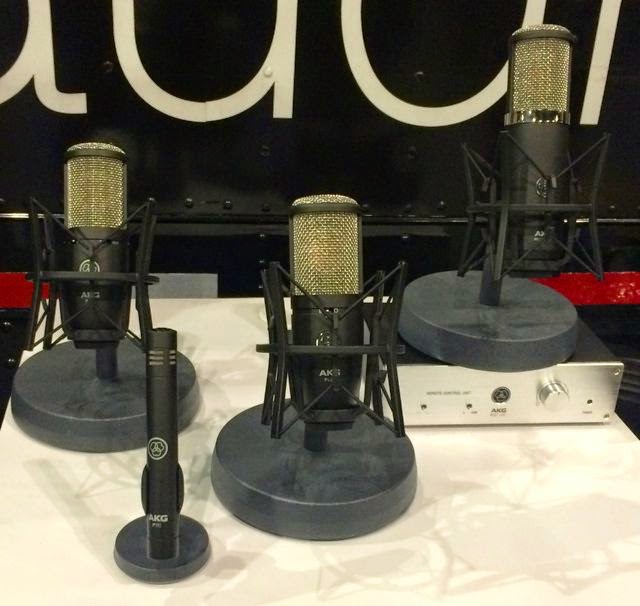
AKG Perception mics
AKG Perception mics
AKG launched some new mics in its Perception series. First is the small diaphragm P170 ($80), then there are a 3 large diaphragm entries - the P820 based around a tube ($700), the P420 ($200) and P220 ($150). I wasn't able to listen to them (not that it would have told me anything) and there was no literature readily available, so can't say much more.
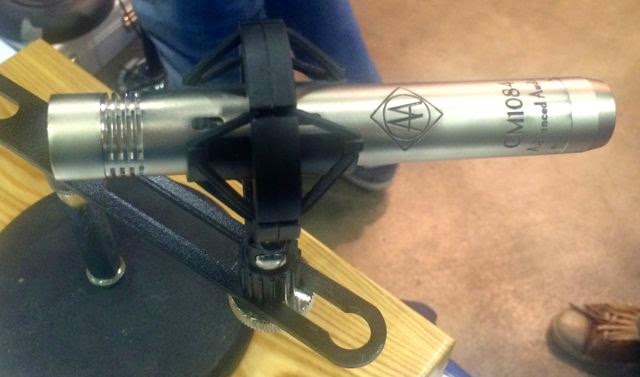


Advanced Audio CM1084
My friends at Advanced Audio released a KM84 style CM1084, which appears to be very versatile and is only $399. They also showed their 251 close, called the CM251, which sells for a very reasonable $995. I own a couple of AA U87 clones and they're great, so I can't wait to try these new ones.


Cathedral Pipes Mic
Cathedral Pipes Mic


One of the coolest variation on the U47 comes from Cathedral Pipes. Owner and designer Charles Dickenson told me he put an LED beneath the grill as a joke when he was continually asked to make the mic brighter. It was only when people started to order it with different colored LEDs did he realize that was something that people really dug. These mics are very meticulously hand-built in Southern California and sell for around $1500. There's also a cool version of the RCA 77 as well for only $800.
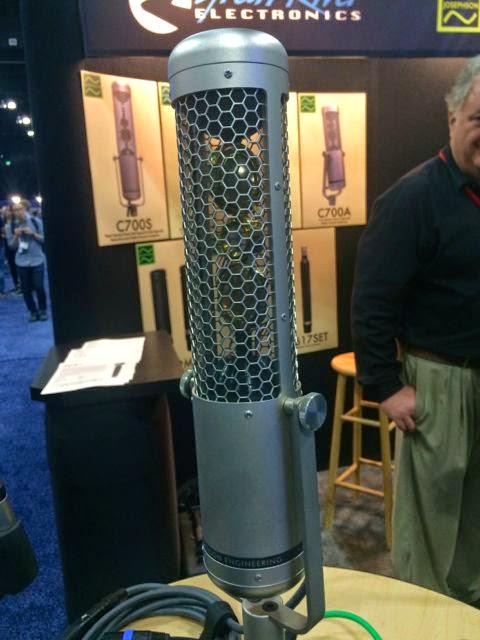


Josephson C700
Josephson C700


Josephson Engineering showed their very cool C700 series. It's been around for a while but it never caught my eye. It's a combination Blumlein (2 figure 8 capsules) and MS mic (with a third omni capsule) rolled into one so you can change the directional pattern of the mic after you've recorded. Price is around $8k.
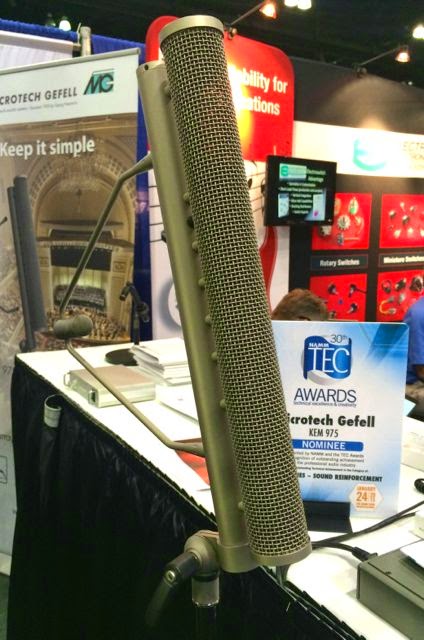


Gefell KEM975
Gefell KEM975
Another unique mic along the same lines was the Microtech Gefell KEM975 line array mic. Just like a line array sound system you see at concert venues everywhere, this mic has 8 capsule elements. The idea is to make the mic very directional in a vertical plane so the mic only picks up what's in front of it, not above or below. A 9th mic at the rear of the main body is to extend the frequency response below 200Hz. It's up for a Tech Award and costs around $11k.
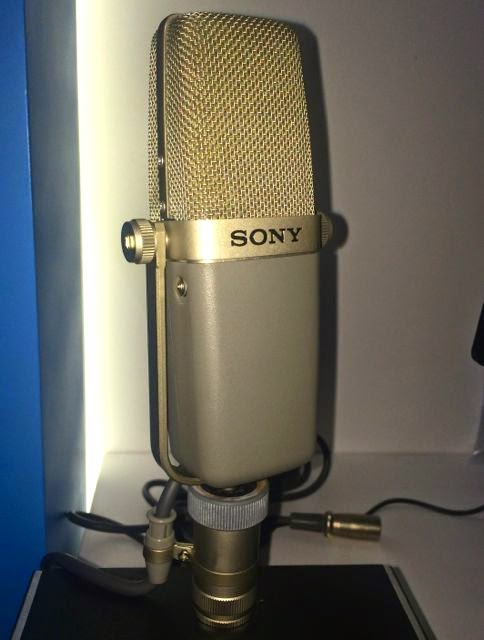


Sony C38B
Reissue Sony C38B
Sony showed its C38B, a reissue that's been around for a couple of years but also skipped my attention. This was the FET followup to the amazing C37A. Sony says it's an exact reproduction and sells it for around $2200.


Reissue Neumann U47FET
Speaking of exact reproductions, Neumann has reintroduced its famous U47FET. Once again, it's supposed to be identical to the original version. It's around $4k. There are other very good reproductions around, but none of them say Neumann on the body.
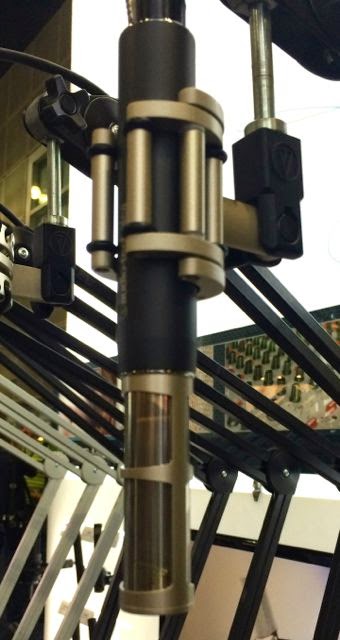


AT 5045
AT 5045
Audio Technica showed its brand new 5045, a side-address mic made especially for high SPL instrument capture. Despite its shape, AT says it has the largest diaphragm area of any mic it sells. The price is around $1600.


MXL Giga Mic
MXL Giga Mic
Here's an interesting mic from MXL called the Giga Mic. It has the largest body of any mic I've every seen; probably twice as long as the biggest U47. No info on the mic though.
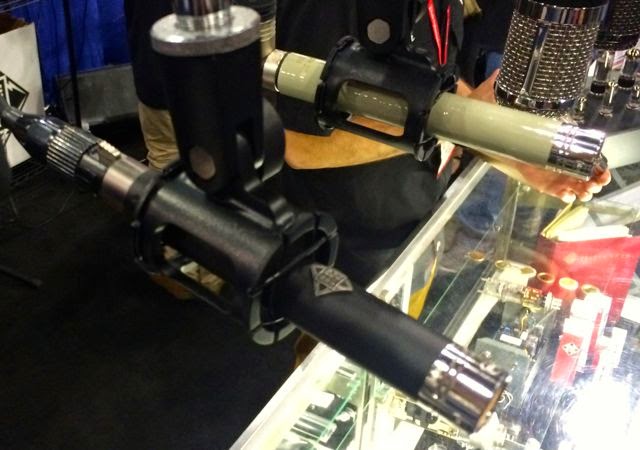


Telefunken USA M60FET
Finally, Telefunken USA brought out a new small diaphragm condenser called the M60 FET. It's the company's first FET mic. No price yet.


Consoles
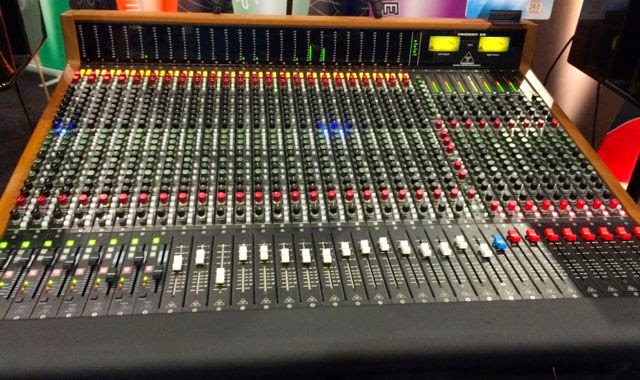
Trident Series 88
Trident Series 88
Recording consoles made a bit of a comeback at this show. Trident finally showed a shipping version of its Series 88. This one has 24 input strips with a 24 channel monitor section. The inputs are also dual inline so there's 72 inputs for your mix. All this for around $25k.


Daking Console
Daking Console
Geoff Daking showed his currently unnamed console, which was very cool indeed. It came complete with his Trident A-Range-style mic amps and EQ, plus dynamics on each channel and a cool routing with parallel compression in mind. It also has a very complete monitor section. Around $65k for the 24 input version.
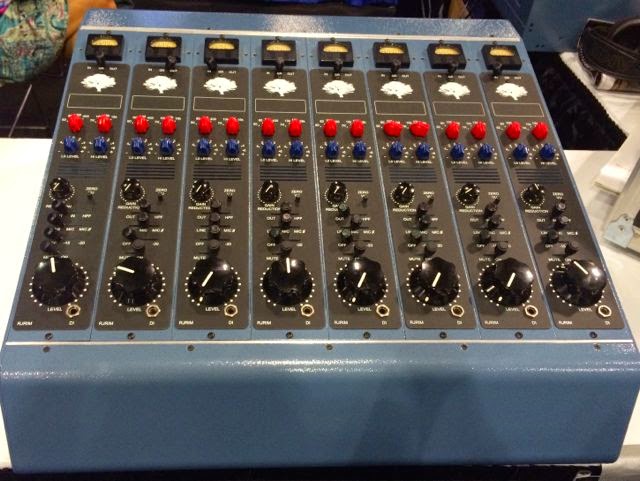


Tree Audio The Roots Jr.
This Tree Audio The Roots Jr is basically The Roots console without the master section. Each channel has a direct out only. Around $16k for all tube retro audio.


SSL XL-Desk
SSL XL-Desk
Finally, SSL showed its XL console, which is basically a mixer attached to a 500 Series rack. It comes with 8 SSL mic pres, 16 input channels, 4 stereo channels, the famous SSL buss compressor, 18 500 series slots and much more. The price is only $20k with empty slots. It's one of the more brilliant things I've seen in a long time.


That's it for today. Tomorrow we'll look at outboard gear and miscellaneous audio stuff.

----------------------------------

Sunday, February 23, 2014

My Top 10 Microphones

It's time for another top 10 list, and this time we'll be looking at the mics I use. Now once again keep in mind that I've excluded lots of great microphones only because I don't have frequent access to them. Mics are such a personal choice because it has to do with how your ear matches up to what the mic is capturing. That said, here's what I find myself using over and over when I record if they're available, but you could ask me again next week and the order might be different and some models would be replaced with something else.

1. Neumann U87: I've had a love/hate relationship with the 87 over the years, but I have to say that it's back on the love side of things. Without getting into splitting hairs on the models, I know what I'm going to get and the sound is always up to the high standard that I expect from the model. I love using it on toms, percussion, guitar and bass amps and vocals (especially in omni).

Royer R-121 image
Royer R-121
2. Royer R-121: What a wonderful mic! It sounds great on most anything, takes EQ incredibly well, and is as rugged as a ribbon mic can get. I'll use it on electric and acoustic guitars, overheads, percussion from a distance, and even on vocals occasionally.

3. AKG C414: Once again, you can split hairs over the models (there's no doubt that the older versions sound better), but I know what to expect from the mic and it generally does not disappoint. I'll use this most anywhere I'd use an 87 where the sound might need a bit more edge.

4. Neumann KM84: This is one of the best small diaphragm mics ever, in my opinion. I'll use a 184 if I can't get the real thing, but once again, it's not the same. I love it on the snare, hat and acoustic guitars.

Shure SM-7B image
Shure SM-7B
5. Shure SM-7B: One of the most overlooked mics ever, it's really an SM 57 on steroids with a much bigger and bolder sound. This is a great vocal mic, especially for singers with an edge to their voice. It's also a great mic for voice-overs, which I do a lot of.

6. Electro-Voice RE-20: This is one of my favorite kick drum mics. There's no hype involved, just a nice big bottom if the drum has it in the first place. It also makes a great vocal mic on some singers.

7. Shure Beta 57: While many engineers swear by the regular old SM57 for guitars and snare, I like the newer Beta 57 better. It has a tighter pickup pattern so the isolation is better, and it's a little crisper. I'll use it on snare, guitar amps (along with a R-121), and hand drum percussion. I do prefer the older Beta 57 to the new 57A a little, but they're much harder to find these days.

Mojave MA-200
8. Mojave MA-300: David Royer is a smart fellow and his tech knowledge extends beyond ribbon microphones, as his Mojave condenser mics testify. The MA-300 is a multi-pattern large diaphragm condenser that can be used anywhere I'd normally use a U87. I'd have to say that it's a bit smoother sounding, although sometimes that's not what you want. I've used it on acoustic guitars, strings, and percussion. I'd love to try it on toms, but there's usually never enough of them around for an entire kit.

9. AKG C12: I have this down lower on my list not because it's not a favorite mic, but because you can't always find one. I love it on vocals, it's magic on overheads and with strings, and it's great on a bass amp (thanks Ken Scott, who uttered the words seared into my brain - "This is what I used to use on Paul.").


ADK 3 Zigma C-LOL-12 
10. ADK 3 Zigma C-LOL-12: That's a mouthful of a model, but it's basically an AKG C12 emulation and it's a really good one. I like it on toms and bass. It's very impressive for the price.

Once again, you might find some of the choices unusual. I'm not trying to say that other mics don't deserve to be on a top 10 list somewhere, but these are the ones I find myself reaching for if they're available.

What mics are on your list?
----------------------------------

You should follow me on Twitter and Facebook for daily news and updates on production and the music business.

Don't forget to check out my Music 3.0 blog for tips and tricks on navigating social media and the new music business.

Tuesday, December 3, 2013

The Evolution Of The AKG 414 Microphone

Just like anyone who works in a studio, I have a soft spot in my heart for vintage microphones. Not only because they sound so good if they're working well, but because they look so cool. I've made sure to include a section on vintage microphones in The Recording Engineer's Handbook that covers a brief history of most of the beloved mics that we see in major studios (and would love to have in our own studios as well).

One of the most interesting mics to me has always been the AKG 414 because it's undergone so many changes and updates over the years. Here's an excerpt from the book that covers the history of the 414, starting with its predecessor the C12A.

AKG C12A image
AKG C12A
"AKG, which stands for Akustische und Kino-Gerate (Acoustic and Film Equipment), developed the original C 12 condenser microphone in 1953 where it remained in production until 1963.

The original CK 12 capsule membrane was 10-micron-thick PVC but was later changed to 9-micron-thin mylar. The amplifier design was based around a 6072 tube. The C 12 had a remotely controlled pattern selection from omni to bi-directional via the selector switch located in a box between the microphone and the power supply. 


In 1965 AKG developed the C 12A (see the photo on the left), which shared the capsule design with the original C 12 (but not the electronics), but had a whole new body style; one that would foreshadow what was to become the 414 series. 

Basically the transistor version of the C 12A, which used a nuvistor miniature tube, the 414 has gone through many updates and changes through the years. Starting off as the model 412 in the early 70’s, the mic was the first to use phantom power (12 to 48V DC) instead of an external supply. This version was susceptible to radio frequency interference if not modified, and since the gill housing was made out of plastic, was prone to cracking.

The C 414 EB (Extended Bass) was introduced in the late ‘70s and consisted of an all metal silver housing. Early versions had the original brass CK 12 capsule while the later ones had a plastic injected type. This mic was able to operate on phantom power of 9 to 48 volts. Of all 414 versions, this one seems to be the most desirable.

AKG 414 XLS
The C 414 EB/P48 appeared sometime in the early ‘80s and is a 48V-only phantom power version of the C 414 EB. The housing is black. 

C 414 B-ULS stands for Ultra Linear Series and has been in production since the late ‘80s. This mic has a redesigned preamp that provides a flatter frequency response. 

C 414 B-TL is the exact same mic as the C 414B-ULS except it uses a transformerless output stage which gives the mic a slightly lower frequency response

C 414 B-TLII is the same mic as the C 414B-TL except it uses the TL-II version of the CK 12 plastic injected capsule, which was designed to give a high-end boost to emulate the sound the original brass CK 12.

C 414B-XLS is the latest version in the 414 family, featuring a slightly larger grill and body, and decreased handling noise and higher sensitivity. It’s also incorporates an entirely new electronics section that does away with the old mechanical switches and replaces them with flush-mounted electronic pushbuttons for pattern, attenuation, and lowpass filter. The XLS has five pattern choices including a new wide cardioid position, attenuation choices of 0, -6, -12 or -18 dB, and lowpass filter positions of flat, -12 dB at 40Hz, -12 dB at 80Hz and -6 dB at 160Hz.

C 414B-X II is the same as the XLS version except for a pronounced presence peak at 3kHz.

All 414’s feature a multi-pattern switch on the front and a 10 dB pad and high pass filter switch on the rear of the casing."

Read additional excerpts from The Recording Engineer's Handbook and my other books at bobbyowsinski.com.
----------------------------------

You should follow me on Twitter and Facebook for daily news and updates on production and the music business.

Don't forget to check out my Music 3.0 blog for tips and tricks on navigating social media and the new music business.

Tuesday, July 10, 2012

How Headphones Are Made

Every wonder how headphones are made? Here's a segment from the television show How It's Made that shows the making of some AKG K702 phones. As you'll see, there's quite a bit done manually. Fascinating!


----------------------------------

You should follow me on Twitter for daily news and updates on production and the music business.

Don't forget to check out my Music 3.0 blog for tips and tricks on navigating social media and the new music business.

LinkWithin

Related Posts Plugin for WordPress, Blogger...