Get This Free Cheat Sheet Guaranteed To Help Your Next Mix

Showing posts with label Shure. Show all posts

Monday, January 25, 2016

Winter NAMM 2016 Overview - Part 1

Winter NAMM has come and gone once again, and left us with a lot to talk about. Once again there was nothing so new and revolutionary that everyone at the show was talking about (as expected), but there were some cool new things that were shown, as well as some disappointments, and some that were downright absurd.

Here are a few things that jumped out at me during my walk around NAMM. I covered it from a slightly different angle and more in depth on my Inner Circle podcast.

Shure KSM8 Dualdyne - This is a dual diaphragm condenser mic that reportedly gets rid of the 3.5kHz bump and the proximity response. The problem is that after 50 years of SM58s, I think we all like that sound. It's expensive at $499.


Manley Nu Mu - Here's a less expensive alternative to Manley's famous VariMu compressor with a new HIP control that allows lots of compression without losing any detail. Around $2,300 on the street.


Mackie AXIS - This is a remote controllable mixer with remote preamps that's intended for installed sound systems. It can use up to 3 iPads as displays. Available in 16 and 32 input versions. No word on prices yet.


Dave Smith OB6 - One of the sounds of the 80s is the Oberheim OB6 synthesizer and now Dave Smith Instruments has brought the unit back in collaboration with Tom Oberheim. Complete with effects and a sequencer, it sells for around $3k


Slate Raven MTi2 - I think I'm softening on my position to touchscreen controllers after playing with the new Raven MTi2. All of the most used parameters are at the bottom of the screen so you don't have to lift your arm that much. Plus, there are a ton of useful add-ons that will work with any DAW. A bargain for a 27" touchscreen monitor/controller at $1k


Solomon LoFreQ -  Many engineers won't record a drum kit without using a subkick mic, but up until now the commercial ones have used 8 inch drivers instead of the 6 1/2" NS10 driver that we all grew to love. The LowFreQ uses that same diameter driver, and compensates for the level differences between subkick and regular kick mic as well. Priced very reasonably at $199.


Subwoofer Pros - There hasn't been a company since M&K that specialized in subwoofers, but that's exactly what Brad Lunde's new Subwoofer Pros does. The cabinets are not ported so there's a smoother frequency response, they have a lot of power, and a built-in crossover and bass management. Two models available, either a 12" or 18" starting at around $2k


GTC Revpad - This is one of the coolest things I saw at the show. It's a wireless touchpad that velcros to a guitar's pickguard. From there you can wirelessly control and crossfade between a variety of onboard or external effects with the greatest of ease. Around $1200.


Fostex Headphones - I love Fostex headphones and have used T20s in various versions for more than 20 years. Now the T models are back in circulation. From about $120.

Part 2 tomorrow.

Sunday, February 23, 2014

My Top 10 Microphones

It's time for another top 10 list, and this time we'll be looking at the mics I use. Now once again keep in mind that I've excluded lots of great microphones only because I don't have frequent access to them. Mics are such a personal choice because it has to do with how your ear matches up to what the mic is capturing. That said, here's what I find myself using over and over when I record if they're available, but you could ask me again next week and the order might be different and some models would be replaced with something else.

1. Neumann U87: I've had a love/hate relationship with the 87 over the years, but I have to say that it's back on the love side of things. Without getting into splitting hairs on the models, I know what I'm going to get and the sound is always up to the high standard that I expect from the model. I love using it on toms, percussion, guitar and bass amps and vocals (especially in omni).

Royer R-121 image
Royer R-121
2. Royer R-121: What a wonderful mic! It sounds great on most anything, takes EQ incredibly well, and is as rugged as a ribbon mic can get. I'll use it on electric and acoustic guitars, overheads, percussion from a distance, and even on vocals occasionally.

3. AKG C414: Once again, you can split hairs over the models (there's no doubt that the older versions sound better), but I know what to expect from the mic and it generally does not disappoint. I'll use this most anywhere I'd use an 87 where the sound might need a bit more edge.

4. Neumann KM84: This is one of the best small diaphragm mics ever, in my opinion. I'll use a 184 if I can't get the real thing, but once again, it's not the same. I love it on the snare, hat and acoustic guitars.

Shure SM-7B image
Shure SM-7B
5. Shure SM-7B: One of the most overlooked mics ever, it's really an SM 57 on steroids with a much bigger and bolder sound. This is a great vocal mic, especially for singers with an edge to their voice. It's also a great mic for voice-overs, which I do a lot of.

6. Electro-Voice RE-20: This is one of my favorite kick drum mics. There's no hype involved, just a nice big bottom if the drum has it in the first place. It also makes a great vocal mic on some singers.

7. Shure Beta 57: While many engineers swear by the regular old SM57 for guitars and snare, I like the newer Beta 57 better. It has a tighter pickup pattern so the isolation is better, and it's a little crisper. I'll use it on snare, guitar amps (along with a R-121), and hand drum percussion. I do prefer the older Beta 57 to the new 57A a little, but they're much harder to find these days.

Mojave MA-200
8. Mojave MA-300: David Royer is a smart fellow and his tech knowledge extends beyond ribbon microphones, as his Mojave condenser mics testify. The MA-300 is a multi-pattern large diaphragm condenser that can be used anywhere I'd normally use a U87. I'd have to say that it's a bit smoother sounding, although sometimes that's not what you want. I've used it on acoustic guitars, strings, and percussion. I'd love to try it on toms, but there's usually never enough of them around for an entire kit.

9. AKG C12: I have this down lower on my list not because it's not a favorite mic, but because you can't always find one. I love it on vocals, it's magic on overheads and with strings, and it's great on a bass amp (thanks Ken Scott, who uttered the words seared into my brain - "This is what I used to use on Paul.").


ADK 3 Zigma C-LOL-12 
10. ADK 3 Zigma C-LOL-12: That's a mouthful of a model, but it's basically an AKG C12 emulation and it's a really good one. I like it on toms and bass. It's very impressive for the price.

Once again, you might find some of the choices unusual. I'm not trying to say that other mics don't deserve to be on a top 10 list somewhere, but these are the ones I find myself reaching for if they're available.

What mics are on your list?
----------------------------------

You should follow me on Twitter and Facebook for daily news and updates on production and the music business.

Don't forget to check out my Music 3.0 blog for tips and tricks on navigating social media and the new music business.

Monday, February 17, 2014

Recording Electric Guitar With Ross Hogarth

Recording electric guitar can be so easy and yet so hard at the same time. Sometimes sticking a single mic in front of the speaker cabinet can yield excellent results, while other times it takes a lot of time and experimentation to get it to properly fit into the track.

Here's an excellent video featuring Grammy-winning engineer Ross Hogarth and top LA session guitarist Tim Pierce showing how to use two microphones (an SM57 and Royer R-121) to get a bigger sound from a typical guitar amp setup. This combo has become the standard in guitar studio recording all over the world.


----------------------------------

You should follow me on Twitter and Facebook for daily news and updates on production and the music business.

Don't forget to check out my Music 3.0 blog for tips and tricks on navigating social media and the new music business.

Monday, January 20, 2014

Burning In Headphones: Myth Or Fact?

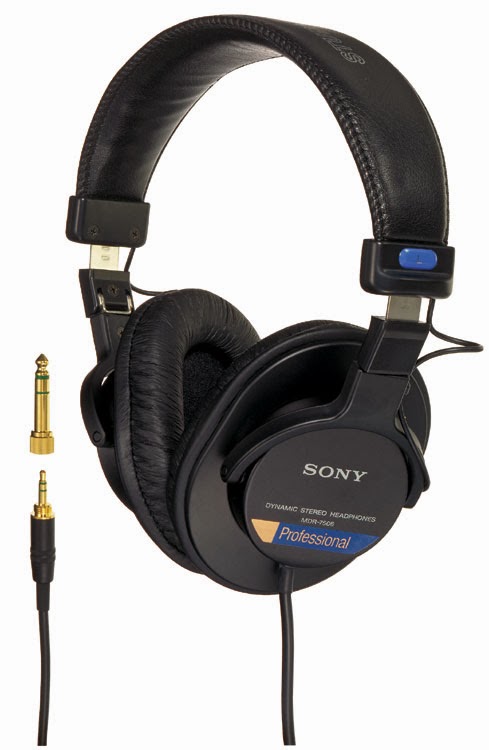
Sony 7506 Headphones image from Bobby Owsinski's Big Picture Blog
Have you ever burned in your headphones before you used them? Yeah, me neither. That's why I was surprised to read about the more or less common practice of burning in headphones for as much as 400 hours before using them. Want to guess who does that? Right - audiophiles, of course.

It seems that many audiophiles have extensive rituals for burning in phones, from playing music continually through them for 24 hours, to blasting them with 40 hours of pink noise, to a large dose of Lou Reed's Metal Machine Music. Me - I just buy them and use them. I haven't noticed a difference between a well kept pair of older Sony 7506's or Fostex T20's (or my favorite cheap phones - the Monoprice 8323) and new ones unless the company upgraded the drivers. It all seems like a myth to me.

Shure has apparently looked into this phenomena as well and have found that if the phones haven't been abused, there's no evidence that the frequency response changes over time. Of course, if the phones are used in the studio where the musician has control over the level, chances of abuse are pretty good, as we all know too well.

Here's something else to think about on the subject. The competition in headphones in pretty fierce these days, so don't you think a manufacturer would do everything in their power to make their phones sound as good as possible right out of the box? If that meant burning them in for 400 hours before shipping, don't you think they'd do that?

To my knowledge, no headphone manufacturer uses a burn-in process yet, but if you know of one, let me know. I'm dying to hear the evidence that the practice is worth the time. If it is, I'll be getting out my pink noise generator.
----------------------------------

You should follow me on Twitter and Facebook for daily news and updates on production and the music business.

Don't forget to check out my Music 3.0 blog for tips and tricks on navigating social media and the new music business.

Sunday, September 1, 2013

New Music Gear Monday: Shure KSM9HS Microphone

Anyone who's ever been in the music business has used a Shure SM58 on a live gig somewhere along the line. That workhorse of a mic has been going strong for over 50 years and can still be found working reliably on stages all over the world. The 58 sounds good but there are times when you really need a "premium" sounding vocal mic on stage, and one of the recent go-to units has become the Shure KSM9 condenser mic. Another version of this mic has been released though, that may end up being more popular than its predecessor.

The KSM9HS is unique in a few different ways, but the big one for me is that it's a dual pattern mic, just like the condenser mics that you use in the studio. But here's where it gets cool. The two patterns are hypercardioid (great for feedback rejection) or subcardioid.

So what the heck is subcardioid? It's basically a cross between a cardioid pattern and an omni pattern, where it has greater back end rejection than your normal omni mic. The reason why this is cool is that it greatly decreases proximity effect, so you don't get as much bass boost when a vocalist eats the mic.

The KSM9HS has a street price of around $699, which is pretty expensive for a live mic. On the other hand, there are some vocalists that will find this mic to be a worthy match. Check out the video below for more about the KSM9HS and its subcardioid pattern.


----------------------------------

You should follow me on Twitter for daily news and updates on production and the music business.

Don't forget to check out my Music 3.0 blog for tips and tricks on navigating social media and the new music business.

Monday, November 8, 2010

AES 2010 Report Part 2 - Mics And Pres

For Part 2 of my AES 2010 Report, we'll be looking exclusively at microphones, mic preamps and speakers. To be clear, these are some of the things that caught my eye, and weren't necessarily the most talked about items at the show. After all these years going to these shows, the quirky things excite me more than anything, so take what you see with a grain of salt because they may be interesting to only me.


Shure
had a number of rather small mics aimed at recording drums or fitting into small places. Among these are some side addressable models, which I don't ever remember seeing from Shure before.

I overheard the Shure sales guy telling an attendee that the gooseneck of the mic on the right was specially made so it wouldn't make noise. I'll believe it when I hear it.


And speaking of small mics, Shure also had some of the smallest "face mics" I've seen for vocalists or on-air personalties. These things should blend in so well you'll never see them, unlike some of the popular models in use today.


One of the cooler mic introductions came from AEA, the company that specializes in RCA ribbon mic reproductions. This one is a repro of the ultra-rare RCA KU3A (sometimes known as the "shoebox mic"), which was a cardioid ribbon mic, which you almost never see (except for the Beyer M160).

This is supposed to be a phenomenal mic. Can't wait to try it.


2009 was the year for the 500 series Lunchbox modules but there was always something missing in that of the major console companies, only API was represented. This year AMS-Neve jumps in the game and released an official 1073 module for the lunchbox named the 1073LB.

The Lunchbox is one of the best audio ideas in years, and it's great to see that almost every manufacturer thinks so too.


Hard to see here, but this is a Neumann speaker. Yes, Neumann the mic company is now also Neumann the speaker company. Makes sense since they're into transducers, but these aren't internally developed by the company, as it turns out. These are actually rebranded Klein & Hummel speakers, a company that the Neumann parent company recently purchased.

K&H speakers have always sounded great, but they never really got much exposure in the US. Now maybe they will.


Here's an interesting mic preamp from Studio Blade Electronics. It's based around some exotic (yet supposedly easy to find) tubes, but what made this jump out at me is the fact that it puts out so much voltage (almost 1 watt!!) that you didn't even need a amplifier to hear what it sounded like. The headphones were connected right to a transformer on the output. I don't know why you'd need that much output unless you were feeding a DAW a couple miles away, but it's there if you needed it. The preamp also had a level control of both gain stages, just like a guitar amp with a master volume control, so you could easily control the color of the sound.

Much more tomorrow in part 3.

----------------------------------
Follow me on Twitter for daily news and updates on production and the music business.

Don't forget to check out my Music 3.0 blog for tips and tricks on navigating the music business.

Thursday, April 8, 2010

4 Steps To A Cleaner Smelling Microphone

There's currently a post on Pro Sound Web that was derived from a Shure article about cleaning your microphone. After reading it, I thought that I could break it down more clearly into just a few steps.

This is more for a mic used in live performance that the studio, although any mic that's used for vocals is naturally somewhat contaminated by the saliva, spittle, and in many clubs, smoke. It's a good idea to clean those mics if for no other reason that simple hygiene. Keep in mind that what we're talking about is a microphone with a removable grill, like our old friend the SM58 or Beta 58.

1) Unscrew the grill from the microphone and remove anything stuck on it with a toothbrush.

2) Now clean both the grill and foam windscreen with some plain water and mild dishwashing detergent. This should be enough to chase any unwanted smells away.

3) Let grill air-dry, but if you're in a hurry, you can use a hair dryer set on low. Don't put the grill back on the mic if it's still wet, since this can cause damage to the capsule if any moisture sifts into it.


4) For mics with grills that aren't removable like an SM57, turn the mic upside down and scrub with a toothbrush soaked in a weak solution of water and detergent. Don't turn it right-side up until it's dry.

Want a quick solution for a stinky mic? Get a very diluted solution of mouthwash and water, turn the mic upside down, and gently scrub. As in #4 above, don't turn it over until it's dry.

Be especially careful with condenser mics, since any moisture at all equals disaster. In fact, don't even think about it unless you can take the windscreen completely off and leave it over-night to dry.

Once again - be careful, be careful, be careful. Moisture and electronics do not mix. That being said, if you're careful your mics will now smell nice and clean and be good for you too.

----------------------------------------------------------------
Don't forget to check out my Music 3.0 blog for tips and tricks on navigating the music business.

Follow me on Twitter for daily news and updates on production and the music business.

LinkWithin

Related Posts Plugin for WordPress, Blogger...