Get This Free Cheat Sheet Guaranteed To Help Your Next Mix

Showing posts with label Fender. Show all posts

Wednesday, August 20, 2014

Fender Going Direct Via The Web?

Fender sign image
We all have a love/hate relationship with our local music retailer. In some cases, they're a most valuable resource, loaning gear when needed, allowing us to try different products before we decide to buy, and providing last-minute help to get us through the next gig.

In other cases that have been well-documented here, they have been cold, hard to connect with, money-grabbing, inexperienced and unknowledgeable, and generally unhelpful. And anywhere in between. Still, most of us wouldn't trade a relationship with a good dealer for anything in the world.

That's why it's more than disturbing about the news of Fender planning to sell direct via its website (as reported by Music and Sound Retailer - thanks for the heads-up Rob Carty). Fender announced the fact at a recent dealer meeting at it's factory in Corona, CA, and I'm sure it went over like a lead balloon with that group.

Actually Fender dipped its toe in the water last year when it offered custom-designed guitars from its Custom Shop via its website. Other manufacturers like Taylor have a similar program, but at least the final transaction is done through a dealer.

We all buy music gear online because sometimes it's just faster and easier. Some types of audio gear and music accessories typically don't require trying the item before you buy it, so there's little risk of getting something unexpected. That said, I can't imagine someone buying a guitar online (except for a vintage instrument, and even then....).

As music pros out there know, line up a dozen identical instruments and one or two will just have some magic that the others don't have. That's one thing a dealer can provide that's a crucial factor for the serious musician.

I suppose it's the wave of the future for all manufacturers to go direct in some form, but if that happens, they shouldn't lament the fact that the local dealer is becoming a dying breed, and the ones that are left show no brand loyalty. Who can blame them?
----------------------------------

Tuesday, January 28, 2014

Bobby O's NAMM 2014 Report - Part 2

This is the last installment of my 2014 NAMM report, and it consists of a number of miscellaneous products that I found interesting, none of which I'd consider earth shattering, but worth mentioning all the same.

Alpine Ear Plugs At NAMM 2014 image
Alpine Ear Protection - There's nothing more precious than your ears, so go buy a good set of ear protectors now. I've used Etymonic Research ER20's for quite a while now and love them, but these new ones from Alpine just might be a leg up. They're a bit softer, and allow you to replace the internal filter to tailor the response. I have a pair but haven't tried them yet, but I'll report soon. They're cheaper than the already inexpensive ER20's, which is always a good thing.

Chauvet Big LEDs At NAMM 2014 image
Big LEDs - It took professional stage lighting a while to finally adopt LEDs but now the ball is quickly rolling downhill. Only a few years ago, the size of a lighting LED topped out at 5 watts. The ones in the picture by Chauvet are 15 watts, but they now have fixtures with LEDs as large as 40 watts! That means they're really, really bright. Goodbye incandescent bulbs.


Big Marshall Stack At NAMM 2014 image
The Biggest Marshall Stack - Marshall Amplifiers used to be in the Korg booth, but now they're in a large booth by themselves. They still trot out the huge stack featuring all of their products though, and it's as impressive as ever.


Marshall Tattoo Series At NAMM 2014 image
Marshall Tatoo Series - Speaking of Marshall, they now have a series of amps from their custom called the Tatoo Range, which says all you need to know.


Pioneer Professional Stack At NAMM 2014 image
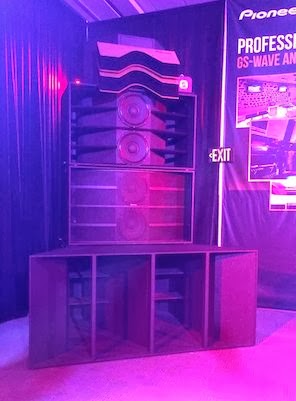
Pioneer Professional - Probably the most baffling room at the show was that of Pioneer Professional. They had this huge 10 foot speaker system of horn loaded cabinets. The woofer cabs are built like the old RCA Ubangi's that we loved so much, and a detachable horn on the front like the old Community Light and Sound scoops. On the other side of the room there was a DJ setup, and that's it. No one around to explain the system, very little information, and a big question mark in general. I dug a little deeper online to find that this is called the GS-Wave series.


Sony Music Video Camera At NAMM 2014 image
Sony Music Video Recorder - Sony came out with a video camera dedicated to music that has a lot of potential. It has a wide-angle lens and stereo X/Y mics, but it's meant to be stationary as it's not zoomable. That said, the next generation will be linkable so you can switch multiple cameras wirelessly from an iPad. That would be hot. The price is $299.


Fender Vaporizer At NAMM 2014 image
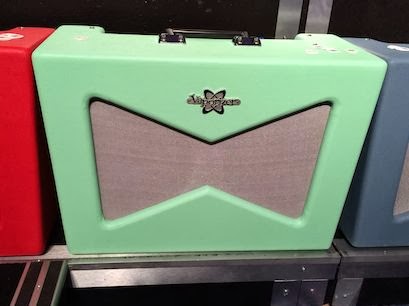
Fender Vaporizer - Fender continues its retro trend with a line of amps called the Vaporizer. This is definitely old school, with just volume, tone and reverb controls. It's 12 watts into two 10 inch speakers, and about $399 on the street.


Gretsch 12 string bass At NAMM 2014 image
Gretsch 12 String Bass - For some reason, 12 string basses were back in a big way at NAMM this year, like this Gretsch White Falcon 12. I don't know who's playing them other than Tom Peterson from Cheap Trick, but there were a lot of them on the floor.

That's it for this year. I can't wait for NAMM 2015 already.
----------------------------------

You should follow me on Twitter and Facebook for daily news and updates on production and the music business.

Don't forget to check out my Music 3.0 blog for tips and tricks on navigating social media and the new music business.

Wednesday, October 17, 2012

The Money Behind Fender

Fender logo image from Bobby Owsinski's Big Picture blog
It's funny how the music economy works. In the 50's through the 70's Wall Street could care less about the music business, but when the CD came out in 1981 and the labels began to resell their catalogs at a big profit, every major label but one (BMG) was gobbled up by a conglomerate. The recorded music business hasn't been the same since.

The same thing sort of happened in the musical instrument business. When every kid bought a guitar through the 60's thanks to the popularity of the British Invasion, suddenly there was a great deal of money in that end of the business. Fender, who was the revenue leader at the time, attracted a buy-out from CBS in 1965, which eventually ended in disaster. In trying to streamline the business, Fender's quality took a dive and it took a long time for guitar players to regain confidence in the company.

What's not known is that Fender was almost out of business by 1980 and had a $10 million loss on only $40 mil of revenue, but then-president Bill Schulz organized a plan for CBS to inject some cash for a new five year product development plan. Three years later, CBS lost interest, and Schulz was able to organize a leveraged buyout for only $12.5 million, but the company was seriously bootstrapped, since it didn't even own a factory at this point. It was still a great brand though, and within 3 years, Fender was in black again.

In 2001 a private investment company, Weston Presidio, bought 50% of Fender, with the idea of eventually taking it public, which is the goal of any venture investor. That almost happened earlier this year, but it was cancelled on the eve of the initial public offering. The company was trying to raise almost $400 million, but there was so little interest from the investment community that the IPO would've looked even worse than the Facebook offering. When investors looked at the MI market, they saw it shrinking, with no room for growth and Fender's market segment saturated.

Fender isn't the only major MI company with a big venture investor though. Did you know that Mitt Romney's Bain Capitol owned Guitar Center until earlier this year? The interesting thing is that this had been a very bad investment for Bain, as they'd been losing money like crazy with GC since the buy-out. You know who owns it now? Weston Presidio! That means the same company owns both Fender and GC.

Here's the thing - the record industry was ruined by Wall Street investors, and it could happen again in the MI part of the business. The one good thing about the fact that the business is shrinking and that means it's less attractive to the Wall Street bunch now. This is a business where love of music and art comes first. It's a place where big money interests doesn't mix.

----------------------------------

You should follow me on Twitter for daily news and updates on production and the music business.

Don't forget to check out my Music 3.0 blog for tips and tricks on navigating social media and the new music business.

Thursday, March 8, 2012

Fender's Plan To Go Public

Fender logo image from Bobby Owsinski's Big Picture production blog
Yesterday came the news that Fender Music Instruments has filed the paperwork for an Initial Public Offering (IPO), meaning that they intend to sell stock in the company or "go public." Most MI companies aren't large enough to be considered a candidate for an IPO, but Fender's gross income last year was a healthy $700 million, and it is the largest guitar maker in the world by far. What's more, the key is the potential for growth, and Fender has plans to hit the huge untapped Chinese market with a vengeance, which must have lit up the eyes of the Wall Street investment bankers.

Fender hopes to raise about $200 million from the offering, and will use it to pay down it's debt load of about $242 million, and hopefully mean a payday for it's biggest investors; private investment firm Winston Presidio owns 43%, and Japanese distributor Yamano Music holds a 14% stake in the company. The estate of Fender's savior Bill Shultz owns 6%.

Fender president Shultz saved the company from almost certain death by arranging for a seat-of-the-pants buyout from CBS in 1984. CBS had bought it from Leo Fender in 1965 and proceeded to run the company into the ground, by changing some of the great products that they had (they thought they were "improving" them), introducing some ill-fated new ones, and having some very poor quality control. Shultz and a group of investors bought only the Fender name, the patents, and some leftover parts, and basically started the company over again from scratch since none of the buildings or equipment was part of the deal.

I remember going to the very small (maybe 30 people) celebration party in a small Anaheim hotel room during the 1985 NAMM show. I happened to get to talking to a visibly nervous and unsure Shultz.

"Do you think we can make it?", he asked.
"Of course you will. You're Fender. People want you to succeed," I replied.
"I hope you're right," came the not-too-confident reply.

Bill lived long enough (he died in 2006) to see Fender restored to it's former heights and beyond, way beyond. I'm not entirely sure he'd be pleased that the company will no longer be privately controlled, but I bet he'd be thrilled that the company has grown enough in stature to be respected by Wall Street. Let's hope that the IPO doesn't change Fender the way CBS did.

----------------------------------
Help support this blog. Any purchases made through our Amazon links help support this website with no cost to you.


You should follow me on Twitter for daily news and updates on production and the music business.


Don't forget to check out my Music 3.0 blog for tips and tricks on navigating social media and the new music business.

Monday, October 31, 2011

Speaker Cabinet Construction Materials

It's surprising just how important the material that a speaker cabinet is made from is to the sound. Here's an excerpt from The Ultimate Guitar Tone Handbook that describes just how great a factor the construction material really is.
---------------------

"The type of wood used for building a cabinet contributes to its tone. Cabinets, like guitars, can be built out of just about any kind of wood. But just like guitars, just a few kinds of wood are used because of their sound or cost.

Baltic Birch
Marshall cabinets are built out of 11 ply Baltic birch, a wood that’s known for its strength and light weight. This is one of the reasons (besides the speakers and the closed back) that nothing else sounds quite like a Marshall cabinet. Other manufacturers also use birch, but some use the cheaper and thinner 3 or 5 ply, which compromises the sound. Others use 13 ply birch to make the cabinet more robust in transport, but heavier as well (see the graphic on the left).


Pine Plywood
Early Fender cabinets were made of pine (see the figure on the left), which is light and has it’s own tone. Pine was inexpensive, easy to get, but it wasn’t the strongest wood, which was a negative for the gigging musician. Like most manufacturers, Fender slowly but surely changed their cabinet wood, first to marine plywood, and then particle board (known as MDF - medium density fiberboard). MDF is very strong and inexpensive, but contributes is somewhat neutral sounding at best, and harmonically dissonant at worst.


Medium Density Fiberboard (MDF)
Today, most manufacturers (even Fender and Marshall) use MDF for their inexpensive cabinets, and birch or birch composite for their more expensive or vintage cabinets. (see the figure on the left) That’s why you can have two cabinets from the same company loaded with the same speakers, yet they can sound completely different.

Plywood and MDF has less cabinet resonance than solid woods like pine, cedar and birch. The resonance is what contributes to the “warmth” of the sound, but can also be responsible for blurring the notes because of the slight absorption of sound. That means that the sound coming out of a pine cabinet may be full and round, but it won’t project as well as a cabinet made of plywood. Baltic birch is chosen because of its musicality, although it’s not quite as resonant as pine although it does have a bit harder edge. The resonance that occurs with MDF is described as “dead” and “atonal.” Anything that adds color actually wastes a bit of the speaker output since some of the energy vibrates the wood instead of the air.

Sometimes cabinets were designed out of necessity instead of a grand tonal design. In the case of the famous Marshall 1960 4x12, the cabinet was built as a way to contain the four Celestion G12 speakers, which were cheap and plentiful at the time. These speakers were rated at just 15 watts and were prone to flapping on hard hit low notes, so the closed back cabinet helped limit the cone travel because of the air suspension, and having four speakers kept the amp from blowing them out."

You can read additional excerpts on this and all my books on the excerpts page at bobbyowsinski.com
----------------------------------
Help support this blog. Any purchases made through our Amazon links help support this website with no cost to you.

You should follow me on Twitter for daily news and updates on production and the music business.

Don't forget to check out my Music 3.0 blog for tips and tricks on navigating social media and the new music business.

Sunday, January 17, 2010

Winter NAMM 2010 Overview - Part 1


Winter NAMM 2010 has come and gone and like the shows before it, has left us with lots of good memories, a few less dollars in our bank accounts, and a number of trends and new products to discuss.


If I had to take the market temperature of the show this year, I'd say it was both hopeful and optimistic. A number of manufacturers and distributors told me that 2009 was outright bad (like we didn't know already), but the end of 09 and beginning of 10 were great for business. This must've been the case for dealers as well since the crowds seemed to be up from last year, and any doom and gloom was noticeably absent. Here's hoping that reality follows that optimism.

That being said, there were fewer exhibitors this year, the booths were noticeably smaller, and many of the smaller manufacturers shared booth space. Roland moved into the arena dome, and the lighting manufacturers that usually reside there moved onto the floor, which was a lot better for all concerned.

Perhaps the biggest surprise was that Gibson did not exhibit this year, and rumors of their demise ran rampant through the show. They did have a minor presence in the Monster Cable booth (an odd choice), but even that booth was a small 20 x 20.  Meanwhile, Fender increased it's presence by taking over most of the 3rd floor.


Speaking of Fender, they had a bunch of interesting hybrid guitars, meaning different variations of traditional models like the Jaguar and Jazzmaster. They even had a bunch of interesting double necks like the Bass VI and Jazzmaster like on the left. At first I thought this was a Jag and a Jazz together, which would've really been a visually interesting (though not very practical) combination.


While we're on the subject of guitars, Moog showed the new Moog guitar, which had most of the famous Moog effects built-in. I'm not sure who the instrument is aimed at, but I played it for 5 minutes and walked away scratching my head. Is it a synthesizer or guitar? Or both? It probably does some pretty cool things, but I couldn't dial them up.


Instruments with composite bodies were more and more in evidence this year, and they're starting to sound pretty decent. Blackbird (on the left) likes to state that theirs is the only guitar that's able to survive the Antarctic weather. Maybe so, but I don't see them replacing wood instruments any time soon.


Another trend that seems on the rise is body-less stringed instruments. I can't say that every manufacturer had one, but more manufacturers showed them than ever before. I'm not sure why this is supposed to be cool, but I guess you can't get a more modern look.


There were also a couple of neat things on the guitar tuner front. TC Electronic showed "Polytune," a multi-string tuner that tunes all the strings at the same time. The demo looked like it worked pretty well, but who can say until you get it on a gig? You can tune by just strumming the open strings, then go into a more detailed single string mode like most other tuners. For $100 street, it looks like a definite upgrade from those cheap $20 tuners that everyone is using these days.


Speaking of cheap tuners, the Peterson Strobotuner has always been the holy grail of tuners, but at a cost of 3 to 4 times what a normal hi-end tuner costs, it was left to the guitar techs. Now you can have one on your iPhone for only 10 bucks. This is almost too cheap. I would've paid a lot more for it.

Speaking of the iPhone, it's amazing how many musicians and industry pros have one. It's almost an industry standard now, just like the Mac. It's now noteworthy if someone is using something other that a Mac or iPhone.


Here's something I wish I had last month during guitar overdubs - a single or dual string  capo. I'd want to use it not so much for the capo action, but to mute a particular string to make the performance cleaner. Either way you use it, this is a product that's been overlooked for too long.


We'll cover much more of the show in the next post, but first I leave you with an observation. I know that electronic music is huge and that thousands of people turn out to a typical event by a superstar DJ, but according to what I've seen at NAMM, this whole DJ fad has long since peaked. Case in point, a almost no-name guitar player from a near no-name metal band had a line of around a hundred people waiting in line for a meet and greet, while right across the hall Crystal Method (who I really like, by the way) had maybe a dozen people in the Pioneer room. Even Kenny G (on left) drew a larger crowd. Yay for music!

Next post, amplifiers, keyboards and various other instruments.

LinkWithin

Related Posts Plugin for WordPress, Blogger...