Get This Free Cheat Sheet Guaranteed To Help Your Next Mix

Showing posts with label marshall. Show all posts

Tuesday, January 28, 2014

Bobby O's NAMM 2014 Report - Part 2

This is the last installment of my 2014 NAMM report, and it consists of a number of miscellaneous products that I found interesting, none of which I'd consider earth shattering, but worth mentioning all the same.

Alpine Ear Plugs At NAMM 2014 image
Alpine Ear Protection - There's nothing more precious than your ears, so go buy a good set of ear protectors now. I've used Etymonic Research ER20's for quite a while now and love them, but these new ones from Alpine just might be a leg up. They're a bit softer, and allow you to replace the internal filter to tailor the response. I have a pair but haven't tried them yet, but I'll report soon. They're cheaper than the already inexpensive ER20's, which is always a good thing.

Chauvet Big LEDs At NAMM 2014 image
Big LEDs - It took professional stage lighting a while to finally adopt LEDs but now the ball is quickly rolling downhill. Only a few years ago, the size of a lighting LED topped out at 5 watts. The ones in the picture by Chauvet are 15 watts, but they now have fixtures with LEDs as large as 40 watts! That means they're really, really bright. Goodbye incandescent bulbs.


Big Marshall Stack At NAMM 2014 image
The Biggest Marshall Stack - Marshall Amplifiers used to be in the Korg booth, but now they're in a large booth by themselves. They still trot out the huge stack featuring all of their products though, and it's as impressive as ever.


Marshall Tattoo Series At NAMM 2014 image
Marshall Tatoo Series - Speaking of Marshall, they now have a series of amps from their custom called the Tatoo Range, which says all you need to know.


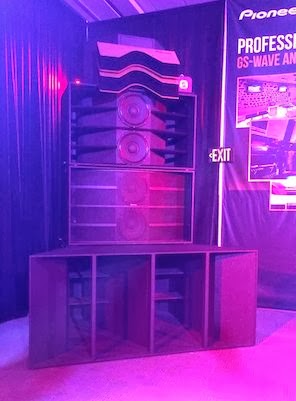
Pioneer Professional Stack At NAMM 2014 image
Pioneer Professional - Probably the most baffling room at the show was that of Pioneer Professional. They had this huge 10 foot speaker system of horn loaded cabinets. The woofer cabs are built like the old RCA Ubangi's that we loved so much, and a detachable horn on the front like the old Community Light and Sound scoops. On the other side of the room there was a DJ setup, and that's it. No one around to explain the system, very little information, and a big question mark in general. I dug a little deeper online to find that this is called the GS-Wave series.


Sony Music Video Camera At NAMM 2014 image
Sony Music Video Recorder - Sony came out with a video camera dedicated to music that has a lot of potential. It has a wide-angle lens and stereo X/Y mics, but it's meant to be stationary as it's not zoomable. That said, the next generation will be linkable so you can switch multiple cameras wirelessly from an iPad. That would be hot. The price is $299.


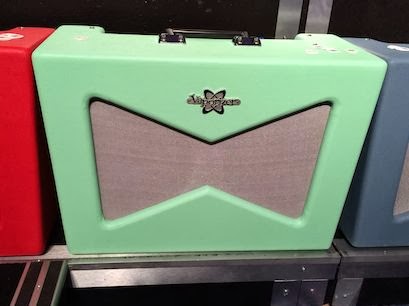
Fender Vaporizer At NAMM 2014 image
Fender Vaporizer - Fender continues its retro trend with a line of amps called the Vaporizer. This is definitely old school, with just volume, tone and reverb controls. It's 12 watts into two 10 inch speakers, and about $399 on the street.


Gretsch 12 string bass At NAMM 2014 image
Gretsch 12 String Bass - For some reason, 12 string basses were back in a big way at NAMM this year, like this Gretsch White Falcon 12. I don't know who's playing them other than Tom Peterson from Cheap Trick, but there were a lot of them on the floor.

That's it for this year. I can't wait for NAMM 2015 already.
----------------------------------

You should follow me on Twitter and Facebook for daily news and updates on production and the music business.

Don't forget to check out my Music 3.0 blog for tips and tricks on navigating social media and the new music business.

Sunday, October 13, 2013

New Music Gear Monday: Marshall Stanmore iPhone Speaker

Marshall Stanmore Bluetooth Speaker image
This is just about the coolest thing I've seen in a long time. It's the Stanmore speaker by Marshall Headphones (yes, that Marshall of guitar amp fame). The Stanmore is an extension amp/speaker system for your Bluetooth phone, but it also has 1/8th inch, optical and RCA inputs as well.

Powered by a Class D amp (I can't find a real power stat anywhere), the Stanmore is stereo with two 3/4 inch dome tweeters and a 5 1/4 inch woofer in the middle. The unit has the standard Marshall amp setup of volume, bass and treble, two standby modes to save power, two push buttons for source and Bluetooth pairing, and the same on/off switch found on their guitar amps.

It's available in black or cream color, and retails for $400, which also includes a coiled 1/8th inch input cable as well. Why settle for just any Bluetooth speaker setup when you can have a Marshall and be cool?
----------------------------------

You should follow me on Twitter and Facebook for daily news and updates on production and the music business.

Don't forget to check out my Music 3.0 blog for tips and tricks on navigating social media and the new music business.

Monday, October 31, 2011

Speaker Cabinet Construction Materials

It's surprising just how important the material that a speaker cabinet is made from is to the sound. Here's an excerpt from The Ultimate Guitar Tone Handbook that describes just how great a factor the construction material really is.
---------------------

"The type of wood used for building a cabinet contributes to its tone. Cabinets, like guitars, can be built out of just about any kind of wood. But just like guitars, just a few kinds of wood are used because of their sound or cost.

Baltic Birch
Marshall cabinets are built out of 11 ply Baltic birch, a wood that’s known for its strength and light weight. This is one of the reasons (besides the speakers and the closed back) that nothing else sounds quite like a Marshall cabinet. Other manufacturers also use birch, but some use the cheaper and thinner 3 or 5 ply, which compromises the sound. Others use 13 ply birch to make the cabinet more robust in transport, but heavier as well (see the graphic on the left).


Pine Plywood
Early Fender cabinets were made of pine (see the figure on the left), which is light and has it’s own tone. Pine was inexpensive, easy to get, but it wasn’t the strongest wood, which was a negative for the gigging musician. Like most manufacturers, Fender slowly but surely changed their cabinet wood, first to marine plywood, and then particle board (known as MDF - medium density fiberboard). MDF is very strong and inexpensive, but contributes is somewhat neutral sounding at best, and harmonically dissonant at worst.


Medium Density Fiberboard (MDF)
Today, most manufacturers (even Fender and Marshall) use MDF for their inexpensive cabinets, and birch or birch composite for their more expensive or vintage cabinets. (see the figure on the left) That’s why you can have two cabinets from the same company loaded with the same speakers, yet they can sound completely different.

Plywood and MDF has less cabinet resonance than solid woods like pine, cedar and birch. The resonance is what contributes to the “warmth” of the sound, but can also be responsible for blurring the notes because of the slight absorption of sound. That means that the sound coming out of a pine cabinet may be full and round, but it won’t project as well as a cabinet made of plywood. Baltic birch is chosen because of its musicality, although it’s not quite as resonant as pine although it does have a bit harder edge. The resonance that occurs with MDF is described as “dead” and “atonal.” Anything that adds color actually wastes a bit of the speaker output since some of the energy vibrates the wood instead of the air.

Sometimes cabinets were designed out of necessity instead of a grand tonal design. In the case of the famous Marshall 1960 4x12, the cabinet was built as a way to contain the four Celestion G12 speakers, which were cheap and plentiful at the time. These speakers were rated at just 15 watts and were prone to flapping on hard hit low notes, so the closed back cabinet helped limit the cone travel because of the air suspension, and having four speakers kept the amp from blowing them out."

You can read additional excerpts on this and all my books on the excerpts page at bobbyowsinski.com
----------------------------------
Help support this blog. Any purchases made through our Amazon links help support this website with no cost to you.

You should follow me on Twitter for daily news and updates on production and the music business.

Don't forget to check out my Music 3.0 blog for tips and tricks on navigating social media and the new music business.

Monday, January 10, 2011

CES 2011 Report - Part 2 Audio Products

Here's Part 2 of my CES 2011 report, but this time it's strictly on the audio products that I saw. Keep in mind that everything below was seen on the main floor of the convention center and not at the hi-end audio-only Venetian.

Wireless Speakers
Wireless speaker technology was another thing under the radar at the show. Polk Audio came out with a wireless subwoofer (makes sense since you only need a limited bandwidth), and there was some talk that they'd have an entire 5.1 wireless system available in a few years.

Actually the technology for a full bandwidth wireless speaker system is already available, it's just incredibly expensive. The whole trick is to keep the quality high while keeping the cost down, which isn't so easy with high quality wireless products. We'll see what the next year brings.

The speaker on the left was one of the best sounding wireless laptop speakers that I've heard. Unfortunately, the picture that I took of the speakers details didn't come out so I don't know the make or model.

Samson's Laptop Mic
This was pretty cool. Samson's Go Mic clips to your laptop's screen and connects via USB. It's inexpensive ($59 retail) and gives you a better sound quality than you can get from most laptop mics and cameras.


Car Audio
It's hard to believe but after-market car audio is still alive and well. The extent that some people will go to in order to hurt themselves and bother their neighbors never ceases to amaze me. It's one thing if fidelity were an issue, but it's not. SPL is what counts.

Take a look at the picture of the pickup truck on the left, which can only be devised in order to announce it's presence from as far away as possible.

Ipod Docks
They're everywhere, and some of them are even starting to care about fidelity a little. Of course, most of them are still just a fashion statement, as evidenced by the picture on the left (yes, they are iPod docks).


Marshall Headphones
Marshall (yes, that one) was at the show rolling out their headphone series. Now this is a company always noted for its amplifier technology, not its transducers. Nonetheless, it looks like a way to take advantage of an established brand name in another market.

The amp stacks were there strictly for shock value.


Gibson
Gibson Guitars was also at the show. Don't know exactly why they were, but their booth was busy. In fact, every booth that had musical instruments had a lot of interest.

In the past, Gibson actually had a huge tent outside in the parking lot, complete with endorsees playing signing and playing shows. They've obviously scaled back this year.


Turntables
No, I didn't see many, not even in the Dual booth (they used to be one of the largest manufacturers), but this one caught my eye. It has a USB connection so you can digitize your records. Good idea, but the tone arm and platter were made so poorly that I'm sure you'd do a lot of damage to your discs in the process. In this example, they were playing an expensive Michael Jackson picture disc, for probably the last time.


Tomorrow, Part 3. Some of the oddities of the show.

----------------------------------
You should follow me on Twitter for daily news and updates on production and the music business.

Don't forget to check out my Music 3.0 blog for tips and tricks on navigating the music business.


LinkWithin

Related Posts Plugin for WordPress, Blogger...