Get This Free Cheat Sheet Guaranteed To Help Your Next Mix

Showing posts with label Tomlinson Holman. Show all posts

Monday, September 22, 2014

Apple's New Audio System For Thin Devices

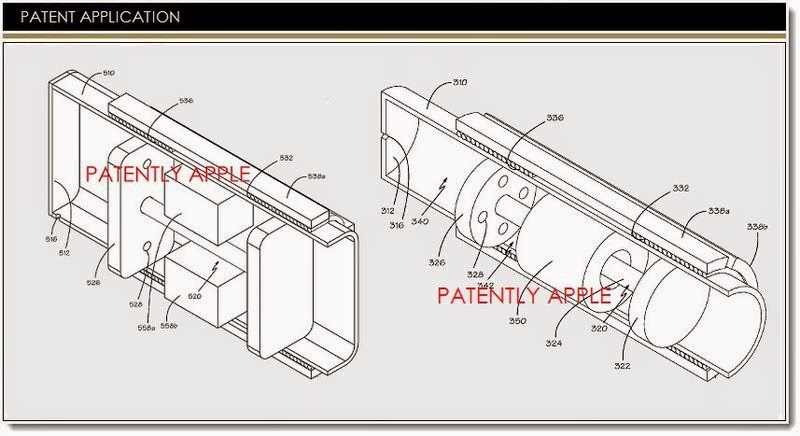
Apple Speaker Patent image
Every since Apple hired my friend and surround sound mentor Tomlinson Holman a few years ago, I knew that the company would be working towards higher audio quality in a profound way. And generally speaking, the sound of Apple products does continue to improve, even if it's hardly ever noted. I just purchased a new iMac and Macbook Pro, and could immediately tell the difference between my 3 year old versions.

iPhone 6 plus speaker imageThis recent Apple patent application was dug up that's titled "Long Throw Acoustic Transducer," and it relates to a playback element in the thin device iOS environment. The idea behind it is that it has two permanent magnets that are joined by a linkage with a high magnetic permeability to form a a piston that is inserted into a housing. There are two pole coils surround the housing with each coil adjacent to one of the magnets, and they oscillate within the housing when an electrical signal is applied. One of the magnets can have a vent passage, but that's not entirely necessary. The whole idea is to provide a greater volume of air from a compact device than was previously possible.

We don't know for sure because it's not marked, but it doesn't look like the transducer in the new iPhone 6 plus is using this technology yet. Here's a picture of it thanks to the breakdown of the phone on ifixit. Either way, the boffins at Apple haven't forgotten audio, and we Mac/iPhone/iPad fanboys should be thankful.
----------------------------------

Thursday, May 5, 2011

Apple Gets An Audio Boost

It's being reported that audio guru (at least to me) Tomlinson Holman has been hired by Apple to oversee it's audio development. This is fabulous news for musicians, engineers, film makers, and all Apple hardware users since you couldn't get a better, more knowledgeable guy for the job.

For those of you who don't know who Tom is, you certainly know a few of his creations. The famous THX standard that you see in most movie theaters today is his brainchild, and stands for Tom Holman eXperiment. Tom was the corporate technical director for LucasFilm when George Lucas asked him to create a spec to make the sound in theaters not only higher fidelity, but more consistent from theater to theater as well. You can thank him for the great sound we have the movies today as a result.

Tom was also the originator of the "5.1" surround sound concept and even coined the phrase (he later went on to 10.2). He was somewhat of a mentor to me during my years in surround sound. I can remember discussing some of the problems in surround calibration that I was having at a Grammy seminar during the early days when we were all searching for answers and tools, and generally being put down as not knowing what I was talking about. Tom was the only one who understood my problem, which lead to a number of standardized calibration test tapes that were vital in the early days of the medium.

Tom is truly an audio scientist (he's a professor at the film school at USC) and he's forgotten more than most people in the business have ever known. There are a few giants in the pro audio business (Rupert Neve and George Massenburg come to mind), but Tom stands shoulder to shoulder with them. We're all going to be better off with his association with Apple.
----------------------------------
Help support this blog. Any purchases made through our Amazon links help support this website with no cost to you.

You should follow me on Twitter for daily news and updates on production and the music business.

Don't forget to check out my Music 3.0 blog for tips and tricks on navigating social media and the new music business.

Thursday, March 11, 2010

THX Strikes Again

If you've read my blog for a while you know that I think that the THX process is sort of like unions - they were drastically needed at one time but they now have outlived their usefulness. Such as it is with THX. In fact, you might want to read The Magic and Myth of THX for a full explanation and deeper rant.

A brief overview - in the days prior to THX, movie theaters had sound systems of varying quality. A film that sounded great in one theater would sound dreadful in another (actually, none ever sounded great except at a film studio), and there was no standard as to how they should sound. Tomlinson Holman, who was George Lucas' chief scientist during the first Star Wars movies (and a mentor of mine), created a standard called THX (Tom Holman eXperiment) that would hold movie theaters to a minimum playback quality that was much higher than we were used to at the time.

All well and good, but after a great number of theaters bought into the standard, the market was saturated, yet Lucas had this profitable THX division that was about to become unprofitable unless they could come up with another income stream. So they got the idea of designing a THX standard for home playback systems, gaining their income from installers and manufacturers that felt the need to have their products "certified" for use in the home.

That always felt pretty bogus to me as a THX cert never really bought a home theater owner much more than a one up on his neighbor and a higher bill for the install. I guess they were running out of audio gear to certify, because late last year THX began to certify plasma and LED HD televisions (I'm getting to this a bit late), which kind of leaves me incredulous. What the heck is a company based on audio standards doing certifying televisions? Does it mean that a certified TV is better than a non-certified one, or just that one manufacturer happened to pay for it while the other didn't? Does that mean if you put a non-certified TV in your home theater system that you can't get it certified?

I'm still amazed that manufacturers are duped into this. Thankfully, it doesn't seem to make much of a dent on the consumer. Maybe this is one of those rare times when the customer really knows best.

I don't want to take anything away from THX's theater certification, because it's raised playback quality to the level it needed to be, but guys, let's lay off the consumer. This is an extra charge that no one except your accountants need.

Wednesday, September 16, 2009

The Magic and Myth of THX

Anyone who goes to the movies is aware of THX, but not many people are actually aware of what it is and what the logo means in relation to a theater. THX is owned by LucasFilm and the brainchild of former LucasFilm chief scientist Tomlinson Holman (my friend and mentor), who is now a professor at USC and is the man that coined the phrase "5.1" surround sound. Tom is good at coining names that stick, and in fact, THX stands for Tomlinson Holman eXperiment.

So what is it? It used to be that movies theaters varied a huge amount in audio playback quality. A movie that sounded great in one theater would sound like it was coming out of a tin can in another because there was no real standard for playback quality. This came to George Lucas' attention upon the release of Star Wars, which was a very sound-heavy movie with a great score and lots of sound effects. As they followed the release of the film across the country, Lucas and his production team were frequently appalled at how many theaters had an inferior audio playback system and how bad their movie would sound as a result. If all theaters sounded equally as bad, you could compensate for that. But if the quality was hit or miss, that was a problem.

As a result, Holman came up with THX, which is a standard for playback quality between theaters, in 1983 before the release of Return of the Jedi. A theater that is THX-certified meets a minimum level of acoustic and electronic playback quality. Only speakers and amplifiers that meet the required quality level are certified, and only those pieces can be used in the playback chain. As a result, the overall playback quality of movie theaters has gotten dramatically better, and any theater that has the THX logo ensures the highest playback standard available.

Soon the THX company found that the market for theaters to upgrade had saturated, and being a company in search of profits, began licensing the concept for home screening rooms, and in 2005, home theaters, and this is where you have to scratch your head and think, "Is this really needed?"

For the most part, a THX certified home theater is more for the videophile with more money than sense, looking for bragging rights with his friends. Any gear that is THX-approved is a lot more expensive than the same piece that's not certified, even though there's little difference between the two. It would be nice if a home theater can be built to THX acoustic standards, but the majority of the time this isn't possible, except in the case of new construction, and that defeats the purpose of spending the extra dough on certified gear right there. And the chance of a room staying calibrated after your wife buys a new couch or moves the furniture around are just about nil. And, let's face it - most high-end home theaters don't scrimp on gear and sound pretty good anyway.

For theaters, which have their share of problems because they're larger and have more people to deal with, it's certainly the way to go. For the home, I'd probably pass if my money was on the line.

By the way, Tom Holman never received a dime for his invention.

LinkWithin

Related Posts Plugin for WordPress, Blogger...