There used to be a lot of companies that offered DIY kits for audio gear at one time, and many of us in the business were introduced to electronics that way (myself included). Alas, over the years these companies mostly fell by the wayside once gear became so inexpensive that it took much of the incentive away from building your own. Then there was the liability issue of someone potentially hurting themselves either in building or operating a kit that scared many companies away.
It looks like a number of companies are now willing to get back into this market, and one of them is MOD Kit, a division of Amplified Parts. Although the company features a wide range of pedal kits, one of its cooler products is the MOD 102+ guitar amp kit.
The MOD 102+ is a simple circuit based upon the circuit design of an old Gibson GA-5 amp from the 50's. It's about as simple as you can get with just two tubes, but that will get you around 8 watts of creamy guitar heaven that's perfect for recording.
The Class A circuit is based around a standard 12AX7 preamp tube and an EL84 power tube, so it has more of a Vox "British" sound, which could be a perfect compliment to the more common 6L6 (like a Fender) or EL34 (like a Marshall) that you might have around.
The "+" version of the original MOD 102 has a number of features that customers inevitably asked for or added themselves, such as a standby switch, and push-pull switches for the bass control that provides mid-boost, the treble control for top-boost, and a "turbo" setting on the volume control.
You have to supply your own speaker, but at a cost of only $265 and a few hours of your time, this thing looks like a winner. And you'll learn a bit about electronics along the way.
Check out the other kits available, including other amp versions, at MOD Kit as well. Here's an older video from MOD Kits that doesn't feature this current product, but you'll get the feel for what they offer.
Help Support This Blog
Showing posts with label guitar amp. Show all posts
Monday, July 27, 2015
Wednesday, November 27, 2013
A Review Of This Year's Lists
We all love lists and this blog has had a lot of them over the last year. Here's a review of all the lists posted in 2013 in case you missed a few.
10 Must-See Studios Before You Die
5 Mic Placement Techniques For A Bigger Sound
5 Practice Tips To Improve Your Musical Skill
15 Steps To A Better Mix
5 Tricks For Adding Delay To Vocals
Top 10 Most Misquoted Song Lyrics
2 Tips For Bigger Sounding Background Vocals
6 Tips For Tweaking Track Timing
My Top 10 Compressors
4 Vocal Mic Placement Tips
10 Tips For Better Effects Layering
The 10 Most Significant Amps Of All Time
Top 10 DAWs For Songwriting
12 iPhone Apps For Recording And Editing Audio
Happy Thanksgiving!
10 Must-See Studios Before You Die
5 Mic Placement Techniques For A Bigger Sound
5 Practice Tips To Improve Your Musical Skill
15 Steps To A Better Mix
5 Tricks For Adding Delay To Vocals
Top 10 Most Misquoted Song Lyrics
2 Tips For Bigger Sounding Background Vocals
6 Tips For Tweaking Track Timing
My Top 10 Compressors
4 Vocal Mic Placement Tips
10 Tips For Better Effects Layering
The 10 Most Significant Amps Of All Time
Top 10 DAWs For Songwriting
12 iPhone Apps For Recording And Editing Audio
Happy Thanksgiving!
----------------------------------
You should follow me on Twitter and Facebook for daily news and updates on production and the music business.
Don't forget to check out my Music 3.0 blog for tips and tricks on navigating social media and the new music business.
Labels:
DAW,
effects,
guitar amp,
mic placement,
mixing,
review of lists,
studios,
vocals
Thursday, March 7, 2013
The 10 Most Significant Amps Of All Time
![]() |
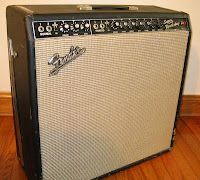
| Original Blackface Super Reverb |
59 Fender Bassman: Still the most coveted guitar amplifier more than 50 years later. Thanks to its four 10" speakers, the Bassman was originally made for the then new Precision bass, but instead found a home with discerning guitarists everywhere who loved the built-in smooth sounding and totally unintentional overdrive.
Marshall Super Lead 1987: Along with the Marshall 4x12 cabinet, the 1987 made up the famed "stack" that became the signature sound of hard rock and metal players everywhere thanks to its brilliant natural distortion and distinctive sound. The circuit was actually a copy of the Bassman, but the sound changed due to the different and more accessible parts (like tubes and transformers) used to make it affordable in the UK.
Fender Super Reverb: An updated version of the 59 Bassman specifically made for guitarists, the Super kept the 4x10 concept yet added reverb and vibrato. The early black-face versions were noted for not only their natural overdrive but also their projection, even with only 40 watts of power.
Sunn 2000S: The first of the super-power amps, the 2000S was specifically built for large outdoor concerts. Fitted with KT-88 tubes and JBL D140F bass speakers for extra headroom and low end, it was the centerpiece of Noel Redding's rig in The Experience.
Ampeg SVT: Perhaps no amplifier screams bass more than the SVT with its 8x10 cabinet and hefty 300 watt output. Still going strong 40 years later, some version of the SVT can be found at nearly every concert you go to. Also probably the heaviest amp you will ever lift (you better have help).
Fender Deluxe Reverb: The Deluxe is different from all other amps because it used a different bias method (called cathode bias) on the power tubes that's hardly used even to this day (the exception being the AC-30). That's the reason why guitar players love its creamy overdriven sound. And with a single 12" speaker, it's easy to carry around too. (UPDATE: Sorry, as was pointed out to me in the comments below, the earlier Deluxe's were cathode biased but the Deluxe Reverb was not).
Mesa Boogie Mark IV: The original Boogie Mark IV was significant because it was the first amp built with an additional gain stage and a master volume control specifically so it could distort at lower volumes. This lead the way to the now-common 4 stage amps made by virtually every amp manufacturer these days.
Ampeg B-15: Listen to any record from Motown, Nashville, and New York from the 70s and 80s and what you'll hear is the bass played through a B-15. At 30 watts with a single 15" speaker in a unique flip-top cabinet, the B-15 was and still is the perfect studio amp for bass.
Line 6 Axxess: The first modeling amplifier, the Axxess set the stage for the wide variety of modeling amps, modules and plugins to come. They all owe their existence to this amp.
That's my 10. What are yours?
If you want a really good detailed explanation about what makes an amp sound the way it does, check out The Ultimate Guitar Tone Handbook. Here's an excerpt about the tonal factors of an electric guitar.
----------------------------------
You should follow me on Twitter for daily news and updates on production and the music business.
Don't forget to check out my Music 3.0 blog for tips and tricks on navigating social media and the new music business.
Labels:
10 most significant amps,
bass amp,
guitar amp,
guitarists,
musicians
Sunday, April 29, 2012
Brian May On Vox AC-30 Amplifiers
Like most guitar players, I'm pretty much a tone freak. It was a long and sometimes painful journey to figure out how to get the sounds that I heard on so many of the records that I loved, one that I've outlined in The Ultimate Guitar Tone Handbook.
One of the things that I discovered is that you can sometimes get the best tone just by going back to basics with a good sounding guitar plugged directly into a good sounding amp with no pedals in between. With the amp cranked to a level where it breaks into a nice creamy distortion, if you turn the volume on the guitar down, you get a great clean sound. Want more distortion or any amount in between, turn up the guitar volume. No pedals required.
In this short video, Queen's Brian May shows you that's the way he does it as well, using his trusty Vox AC-30 amps. You can't argue with the great sound.
One of the things that I discovered is that you can sometimes get the best tone just by going back to basics with a good sounding guitar plugged directly into a good sounding amp with no pedals in between. With the amp cranked to a level where it breaks into a nice creamy distortion, if you turn the volume on the guitar down, you get a great clean sound. Want more distortion or any amount in between, turn up the guitar volume. No pedals required.
In this short video, Queen's Brian May shows you that's the way he does it as well, using his trusty Vox AC-30 amps. You can't argue with the great sound.
----------------------------------
You should follow me on Twitter for daily news and updates on production and the music business.
Don't forget to check out my Music 3.0 blog for tips and tricks on navigating social media and the new music business.
Labels:
Brian May,
guitar amp,
guitar tone,
Queen,
Ultimate Guitar Tone Handbook,
video
Subscribe to:
Posts (Atom)


