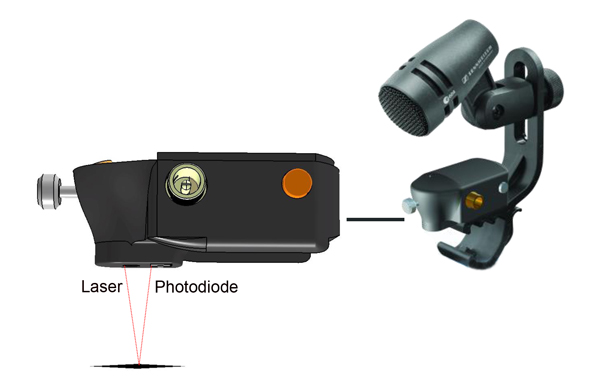
Talk about hi-tech, what if you had lasers controlling your mics? That's exactly what Sennheiser is proposing with their e904 and e604 clip-on mics.
Actually, the laser mic is a misnomer. It's actually a laser mic clip that's the innovative piece.
Everyone knows that leakage into drum mics, even from other drums in the kit, is something that we'd like to get rid of in many situations to clean up a mix. By placing a laser and a sensor in the mic clip, the laser can then precisely measure when the drum head is struck and open up a noise gate, so what you're actually hearing is a laser-controlled mic (we'll get to those real "laser mics" someday soon, as this is the just a glimpse into the future).
The laser drum clips are still in the prototype stage, so there's no pricing yet, but you can see and hear how well they work in this video.
A big shout-out to my buddy Frank Coleman for the heads up on this.
Transducer technology (microphones and speakers) hasn't changed much in the last 100 years. Sure, it's evolved as the material and part tolerances became much smaller and the efficiency of the units grew much higher as a result, but the basics are still pretty much the same. But the laser microphone might become the first new transducer breakthrough that really has a chance to revolutionize the way we capture sound.
After watching the smoke from a candle waver as his wife spoke over dinner, inventor and theorist David Schwartz got the idea for the mic, which uses the laser as a measurement tool against a gas that acts as a traditional diaphragm. This is not to be confused with the laser microphones now used in surveillance by the CIA and KGB, where a laser is projected against a window to measure the fluctuations in air pressure when someone in the room speaks. Schwartz's mic still measures pressure fluctuations, but in a more controlled manner aimed at a much higher fidelity audio capture.
Although the mic is still in the early stages of development at Schwartz's company Schwartz Engineering and Design, it holds a lot of potential. Why? Because the laser mic can have a huge dynamic range way beyond that of even the best instrumentation mics that are in use today. And it can have an absolutely flat response with no coloration, unlike every mic currently on the market (although a lot of recording engineers might find this a flaw since the flaws add "character"). Plus, the mic has the potential to have only the lowest theoretical noise floor, a problem with many of the favorite mics that we use today. This means complete realism in the sound that's captured.
Now there are still plenty of places in every stage of circuitry downstream of the mic that will color the sound, but if the source is as high a quality as promised, the sound coming out the speaker ultimately will be better than ever, and the quality of all circuitry in the signal chain will get better as the flaws are more easily seen and correct as a result of using the higher quality source material.
So here's hoping that this technology comes to market in the near future. It's about time for a real breakthrough in an industry that hasn't had one in a long, long time.
The following video of the laser mic isn't that great, but it does explain the general operating principle.


 Talk about hi-tech, what if you had lasers controlling your mics? That's exactly what Sennheiser is proposing with their e904 and e604 clip-on mics.

