Get This Free Cheat Sheet Guaranteed To Help Your Next Mix

Friday, June 20, 2014

Jamie Scott Of 3rd Power Amplifiers On Today's Inner Circle Podcast

Jamie Scott from 3rd Power amplifiers image
On today's Inner Circle Podcast features boutique amplifier maker Jamie Scott from 3rd Power Amplification. Jamie will discuss his unique amps (complete with a cabinet that garnered a patent) and his obsession with Marshall Plexi amps (he has 13 of them).

I'll also discuss the winners and losers of the Beats/Apple deal, and a look at the comeback that electric guitars seem to be making.

This is podcast #10 already, and you can hear them all at bobbyoinnercircle.com or on iTunes.

By the way, if you dig what you're hearing, be sure to leave a comment on iTunes!
----------------------------------

Thursday, June 19, 2014

Rush "Tom Sawyer" Isolated Drum Track

There are some songs that we all know because they've been a staple of AOR or classic rock radio since their release. Rush's "Tom Sawyer" (from their big Moving Pictures album) is one of these, and even if you're not a Rush fan, you sort of know the song by the osmosis process of hearing it for so long.

Here's Neil Peart's isolated drum track from the song. There's a split of opinion about Peart's playing in that some think he's the best drummer on the planet, while others feel his playing is robotic and soulless. Regardless of how you feel, this is a great drum track that's worth checking out. Here's what to listen for:

1. Check out the flange effect on the cymbals on the opening downbeat

2. You can't miss the long dark reverb on the snare. You never hear it with the rest of the instruments because it's so dark.

3. Unlike many of today's mixes, the high hat is panned to the center rather than to the right as you see it.

4. The tom fills that start at 1:00 sound like they're really tightly tuned and almost out of place with the rest of the kit. That said, the floor tom fills that start at 2:40 still sound like they're tuned high, but are more in line with the sound of the kick and snare.


You might also like my Deconstructed Hits series of books that take an X-ray look inside hits from all genres. Check out some excerpts on the excerpts section of bobbyowsinski.com.
----------------------------------

Wednesday, June 18, 2014

Should We All Be Using Ra Natural Tuning?

I've written a number of posts about tuning in the past, mostly about how our now standard A440 was arbitrarily selected. Here's a great video by composer Alan Howarth where he describes Ra tuning (which is centered around 424Hz instead of 440), which is said to be more in tune with nature. As Howarth explains, Ra resonant tuning can be found in ancient structures of the Egyptians and Mayans, and how creating in it allows you to quickly enter "the zone" where everything seems easy.

Check out the video and ramusic.com for more info. You can also convert your own music to Ra tuning on the site to have a listen for yourself, as well as some samples from The Beatles and Bob Dylan.


----------------------------------

Tuesday, June 17, 2014

5 Steps To Checking Your Drum Phase When Mixing

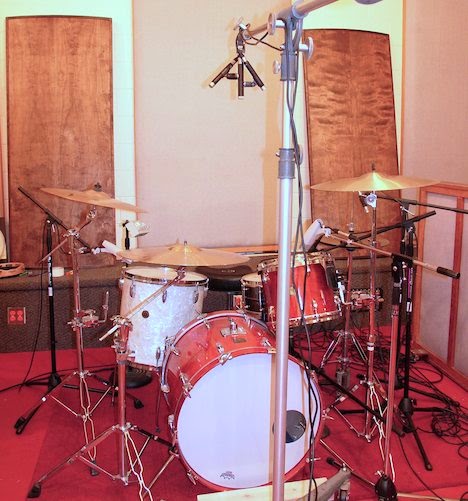
Drum kit with ORTF overheads imageOne of the most important yet overlooked parts of a drum mix is checking the phase of the drums. This is because not only will an out-of-phase channel suck the low end out of the mix, but it will get more difficult to fix as the mix progresses.

I covered how to check the polarity of the drum mics a few weeks ago, but here's an excerpt from my Audio Recording Basic Training book (also covered in the Audio Mixing Bootcamp book) that covers a way to check the phase when you're setting up for a mix as well.

"A drum mic can be out of phase due to a mis-wired cable or poor mic placement. Either way, it’s best to fix it now before the mix goes any further.

1) With all the drums in the mix, go to the kick drum channel and change the selection of the polarity or phase control. Is there more low end or less? Chose the selection with the most bottom end.

2) Go to the snare drum channel and change the selection of the polarity or phase control. Is there more low end or less? Chose the selection with the most bottom end.

3) Go to each tom mic channel and change the selection of the polarity or phase control. Is there more low end or less? Chose the selection with the most bottom end.

4) Go to each cymbal mic or overhead mic and change the selection of the polarity or phase control. Is there more low end or less? Chose the selection with the most bottom end.

5) Go to each room mic channels and change the selection of the polarity or phase control. Is there more low end or less? Chose the selection with the most bottom end."

You'd be surprised how many times that flipping the phase on one or two of the drum mic channels results in a better, fuller sounding kit, even on one that's well-recorded.

To read additional excerpts from the Audio Recording Basic Training book or any of my other books, go to the excerpts section of bobbyowsinski.com.
----------------------------------

Monday, June 16, 2014

Thinking Outside The Box With 10 Second Songs

Most musicians are pretty good at imitating another artist or style, or even two, but usually don't go much beyond that. Anthony Valbiro can do a lot more than than just a couple, and he displays it here with a video of how 19 different artists would perform Jason Derulo's "Talk Dirty." All told there are 20 different versions of the same song, each 10 seconds long.

This is a great idea of thinking outside the box both in terms of displaying your ability and doing a good piece of viral video marketing as well. Anthony has a website entitled tensecondsongs.com that has additional examples of the technique, as well as custom song offerings for fans and businesses (also a great idea). Check it out.


----------------------------------

Sunday, June 15, 2014

New Music Gear Monday: Audiofile Spectre Metering Package

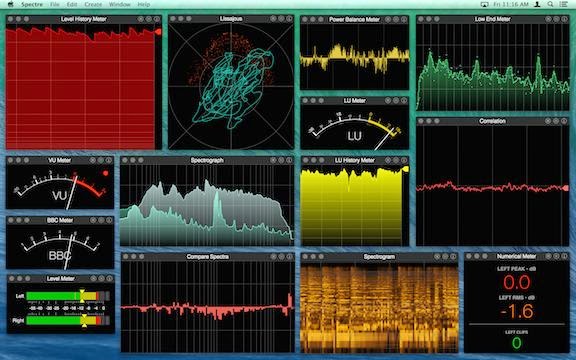
Audiofile Spectre metering package imageMetering is becoming more important than ever in just about every recording and mixing environment, but not every DAW has the metering necessary for every application. Now that deficiency can be easily and inexpensively rectified with Audiofile's latest Spectre metering package.

Spectre is filled with 20 different multichannel meters, including level, VU, spectragraph, spectrogram, oscilloscope, various phase meters, LU and more. You can have any or all meters open at once.

Spectre is a stand-alone package that sits on your desktop and can accept audio from a variety of sources, including your computer audio interface, so you always have a good idea of what's happening where it counts. The app is designed for OSX Mavericks and is Retina-ready.

Best of all, it's available right now for 50% off its retail price, so you can get it for an incredible $49.99. There's also a fully functional demo version available as well. It's a great deal and great bang for the buck. Check it out on the Audiofile website.
----------------------------------

Friday, June 13, 2014

Bassist Dusty Wakeman On Today's Inner Circle Podcast

bassist Dusty Wakeman image
Today's Inner Circle Podcast features bassist Dusty Wakeman, who also happens to be president of Mojave Audio.

Dusty will discuss the state of country music, playing in the studio, record production, his 3 string bass, and even a little about the great microphone line that he represents so well.


Check out the podcasts at bobbyoinnercircle.com or on iTunes.

----------------------------------

Thursday, June 12, 2014

Marvin Gaye "Ain't That Peculiar" Isolated Bass and Drums

We all love those old Motown tracks recorded in Detroit in the 60s, and one of the driving forces behind them was the innovative bass playing of James Jamerson. He's been massively influential to bass players since, and rightfully so; the man was truly original. Here's the isolated bass and drum tracks to the great Marvin Gaye's hit "Ain't That Peculiar," which reached #8 on the Billboard Hot 100 chart in 1965. Here's what to listen for.

1. The bass sound is straight out of the 60s, with all of the high-end was automatically rolled off. The thinking back then was, "It's a bass instrument. It doesn't need any high-end."

2. Likewise, the bass is out in front of the drums, while the drum sound is very undefined. Again, this was the sound of the 60s when there were only a couple of mics on the drums and the bass anchored the mix.

3. The leakage is really interesting. If you listen on headphones, you'll hear the piano and horns in the background, proving that they actually did track with the entire band.

4. This is one of the more controlled bass parts played by Jamerson, who follows the bass pattern pretty faithfully throughout the song. In other songs of the period, his playing was much more free-form.

If you like these isolated tracks, you might also like my Deconstructed Hits book series that takes an X-ray look inside different hit songs from different genres and eras.


----------------------------------

Wednesday, June 11, 2014

The Vocal Range of the World's Greatest Singers

Concerthotels.com developed this great chart on the vocal ranges of some of the world's most well-known vocalists. It's an interactive chart, so when you hover over a singer, it will tell you the highest and lowest note and attribute it to a song. You can also find who has the highest and lowest range as well by selecting the sort button at the top.

I think it's interesting that Axel Rose holds the record (according to the chart, anyway) for both the highest and lowest note for males, while less surprisingly, Mariah Carey holds it for females.


The Vocal Ranges of the Greatest Singers. From Mariah Carey's ear-piercing whistle to Barry White's deep bassy growl, compare the vocal ranges of today's top artists with the greatest of all time. (via ConcertHotels.com).
----------------------------------

Tuesday, June 10, 2014

A Foolproof Method For Miking A Guitar Amp

Sometimes getting an electric guitar center is dead easy and other times getting the sound to fit into the track seems like the most difficult thing in the world. Here's an excerpt from my Audio Recording Boot Camp book that provides an almost foolproof method for miking a guitar amplifier.

"Electric guitar recording has evolved through the years, from miking the amplifier from a distance, to close miking, to using multiple mics, to recording direct and finally using an amplifier emulator. No one technique is better than another. In fact, multiple techniques are frequently used on the same recording.

Electric guitars don’t have need anything fancy to capture them. The frequency response doesn’t go that high or that low, and the more distorted it is, the fewer transients the signal has, making it somewhat easier to capture than other instruments. Has a result, dynamic mics are frequently used with good results. That said, sometimes it’s surprising just how good an amp can sound when a large diaphragm condenser or ribbon mic is used, so don’t be afraid to experiment.

Miking The Speaker Cabinet
While many engineers like to use our friend the Shure SM57 in this role, just about any mic can work if you know the sound that you’re looking for and the best way to approach it.

Classic Setup One - Close Miking The Cabinet
Standard speaking cabinet miking technique image
Figure 1: The standard cabinet miking technique
A) If there are more than one speaker in the cabinet, listen to them all to find the one that sounds the best. Is one scratchy sounded or distorted? Is one muffled with no high end? Does one have no low end? Find the one with the best balance of frequencies that’s not intentionally distorted.
B) Place the mic about one inch away from the best sounding speaker in the cabinet and about three quarters of the way between the edge of the speaker and the voice coil (away from the voice coil). Have the guitar player play the song you’re about to record and listen on the monitors. Does it sound like what you heard in the room? Is the sound full enough? Is it too edgy? Is it too bassy? 
C) Move the mic towards the voice coil (the center of the speaker - see Figure 1)). Is the sound still full? Did it brighter? Did it get bassy?
D) Move the mic towards the outside edge of the speaker. Is the sound still full? Did it brighter? Did it get bassy?

Classic Setup Two - Distance Miking Where The Speakers Converge
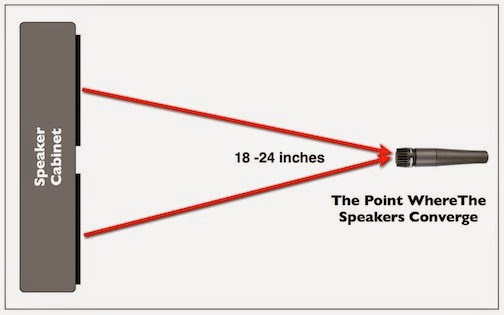
Distant guitar cabinet miking image
Figure 2: Distant miking
E) Move the mic about at least a foot away from the the speaker or speakers to capture some of the room sound. The ideal distance on a cabinet with two speakers is where the output of both speakers combine (see Figure 2). Does it sound bigger? Can you hear the sound of the room in the recording? Can you hear some frequencies cancel out between the two speakers?
F) Move the mic to the side to capture more of the sound of one of the speaker’s voice coils if more high end is required.

Classic Setup Three - Close and Distance Miking
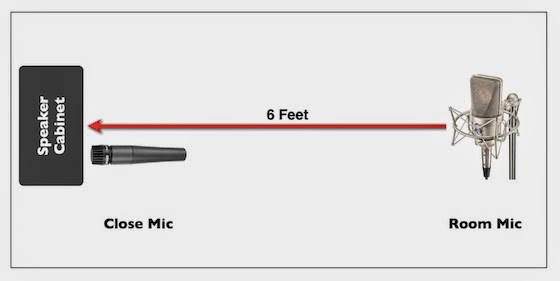
Close and distant guitar cabinet miking image
Figure 3: Close and distance miking
G) Move the mic back to the best sounding position close to the speaker and add an additional mic at the spot where the sound of the speakers converge 18 to 24 inches away. Is the sound still full? Did it get brighter? Did it get bassy? Did it get bigger sounding? Is it closer to what you heard in the room? Is there more of the room sound?
H) Increase the distance to 6 feet if possible (Figure 3). Is the sound still full? Did it brighter? Did it get bassy? Is there more of the room sound?
I) Place both mics at the point where they give the sound closest to what you heard in the room, or what best fits the track when the other instruments are playing."

By following this guideline, you should end up with a guitar sound that fits your track well without having to resort to any EQ or effects.

To read additional excerpts from the Audio Recording Basic Training book, go to the excerpts section of bobbyowsinski.com.
----------------------------------

Monday, June 9, 2014

Goodbye 3.5mm Jack

headphones with lightning connector
Don't you just hate those 3.5mm mini-phone jacks and plugs? The jacks are really fragile, and now that most headphones come that way, you always have to have a 1/4" adapter handy when connecting to professional gear.

I'm happy to report that the 3.55mm jack may be headed for obsolescence, as Apple has quietly announced that it will soon be providing headphones with a Lightning connector on its upcoming gear. That means that the A/D and D/A convertors can be moved to the headphones so they will be capable of receiving 48kHz stereo audio and send 48k from the microphone. It will also allow more remote control features from the headphones as well.

Apple will supply two headphone configurations: a simple one where the convertors live on the playback device, and a premium version with the convertors onboard. Since the premium headphones can draw power from the playback device, they can also incorporate noise canceling features as well.

There's some speculation that the first units will come from Beats, now that Apple owns them. That said, I wonder what one does when you need a headphone extension cable? And will it be a hassle when we won't be able to use our current phones with our iDevice?
----------------------------------

Sunday, June 8, 2014

New Music Gear Monday: Eventide DDL-500 Delay Module

Eventide DDL-500 module image
We all love 500 series racks and modules. They're portable, and the mix and match factor can't be beat. Most modules have fallen into the mic pre, EQ or compressor categories, however, until now. Eventide has introduced its DDL-500 module, which finally puts a delay into a 500 rack space.

Eventide has a long history with digital delay, being one of the first companies to manufacture a rack mount unit (the model 1745) way back in 1970. The DDL-500 takes the best from that heritage and the best from modern technology to offer a module that's as analog as possible, with digital circuitry kept to a minimum.

The unit features 10 seconds of delay at 192kHz sample rate, which can be increased to 160 seconds at a lowered 16kHz rate. It also features soft saturation clipping, low pass filter, feedback control, insert loop, a relay bypass and up to a +20 boost.

Let's face it, delay plugins are great, but sometimes you just need that hardware sound to make a difference in your mix, and that's where the DDL-500 comes in. The Eventide DDL-500 retails for $899. See the specs and additional features on the Eventide site.
----------------------------------

LinkWithin

Related Posts Plugin for WordPress, Blogger...