 |
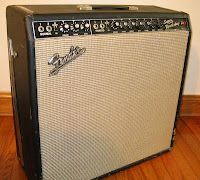
| Original Blackface Super Reverb |
I recently had a long conversation with a friend and fellow guitar player about amps that were game changers in terms of either starting a trend, their longevity or their desert island desirability. This is a fantasy list, of course, but after some thought, here are the ones I've come up with. I'm sure you probably have your own favorites, and I'd love to hear them. Here we go, in no particular order:
59 Fender Bassman: Still the most coveted guitar amplifier more than 50 years later. Thanks to its four 10" speakers, the Bassman was originally made for the then new
Precision bass, but instead found a home with discerning guitarists everywhere who loved the built-in smooth sounding and totally unintentional overdrive.
Marshall Super Lead 1987: Along with the Marshall 4x12 cabinet, the 1987 made up the famed "stack" that became the signature sound of hard rock and metal players everywhere thanks to its brilliant natural distortion and distinctive sound. The circuit was actually a copy of the Bassman, but the sound changed due to the different and more accessible parts (like tubes and transformers) used to make it affordable in the UK.
Fender Super Reverb: An updated version of the 59 Bassman specifically made for guitarists, the Super kept the 4x10 concept yet added reverb and vibrato. The early black-face versions were noted for not only their natural overdrive but also their projection, even with only 40 watts of power.
Sunn 2000S: The first of the super-power amps, the 2000S was specifically built for large outdoor concerts. Fitted with KT-88 tubes and JBL D140F bass speakers for extra headroom and low end, it was the centerpiece of
Noel Redding's rig in
The Experience.
Ampeg SVT: Perhaps no amplifier screams bass more than the SVT with its 8x10 cabinet and hefty 300 watt output. Still going strong 40 years later, some version of the SVT can be found at nearly every concert you go to. Also probably the heaviest amp you will ever lift (you better have help).
Fender Deluxe Reverb: The Deluxe is different from all other amps because it used a different bias method (called cathode bias) on the power tubes that's hardly used even to this day (the exception being the AC-30). That's the reason why guitar players love its creamy overdriven sound. And with a single 12" speaker, it's easy to carry around too. (UPDATE: Sorry, as was pointed out to me in the comments below, the earlier Deluxe's were cathode biased but the Deluxe Reverb was not).
Vox AC-30: The sound of the
British Invasion, the AC-30 is known for its sweet chimey sustain. Listen to any
Queen song and you'll hear the king of the AC-30 in
Brian May. Its smooth sounding overdrive comes from cathode biasing of the power tubes, one of the few amps to use this scheme. It is
not a class A amp, as many believe.
Mesa Boogie Mark IV: The original Boogie Mark IV was significant because it was the first amp built with an additional gain stage and a master volume control specifically so it could distort at lower volumes. This lead the way to the now-common 4 stage amps made by virtually every amp manufacturer these days.
Ampeg B-15: Listen to any record from Motown, Nashville, and New York from the 70s and 80s and what you'll hear is the bass played through a B-15. At 30 watts with a single 15" speaker in a unique flip-top cabinet, the B-15 was and still is the perfect studio amp for bass.
Line 6 Axxess: The first modeling amplifier, the Axxess set the stage for the wide variety of modeling amps, modules and plugins to come. They all owe their existence to this amp.
That's my 10. What are yours?
If you want a really good detailed explanation about what makes an amp sound the way it does, check out
The Ultimate Guitar Tone Handbook. Here's an excerpt about the
tonal factors of an electric guitar.
----------------------------------


