Get This Free Cheat Sheet Guaranteed To Help Your Next Mix

Showing posts with label lexicon. Show all posts

Monday, March 30, 2015

New Music Gear Monday: Exponential Audio Excalibur Modulation Plugin

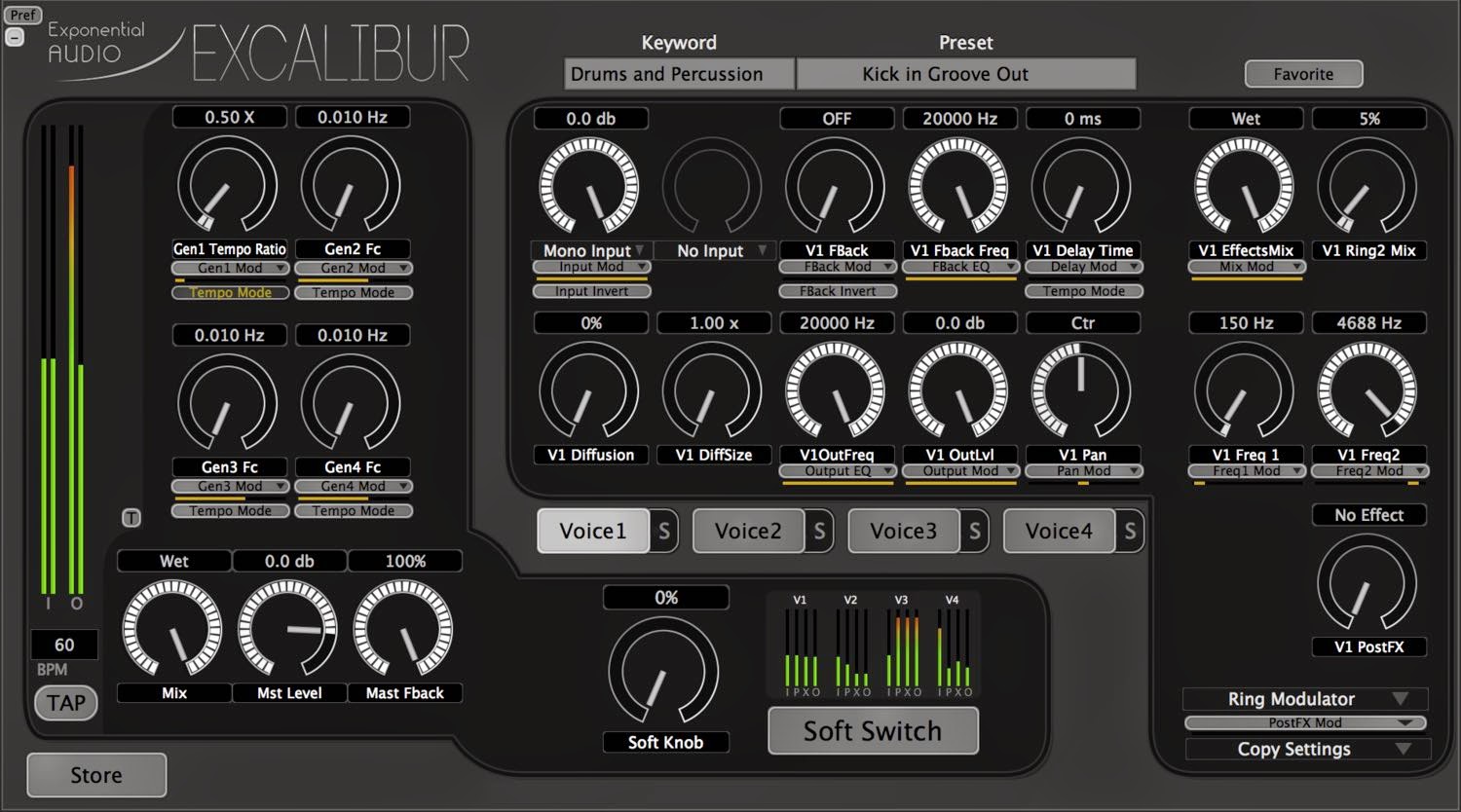
Exponential Audio Excalibur plugin image
If you're not already familiar with Exponential Audio plugins then you should be. The brainchild of former Lexicon chief engineer Michael Carnes, the first two products, the R2 and PhoenixVerb, give you that great Lex reverb sound at a very reasonable price.

Now Michael has come up with something completely different with his new Excalibur modulation plugin. It's a multi-effects unit with a modular synth-like architecture that allows you to  quickly and easily configure both traditional and non-traditional effects.

If you're not up to building your own effects chain, Excalibur comes with 500 presets of classic chorus, flanger, phase shifter, phasor, ring modulator, resonators, glide, distortion and reverb effects.

The plugin is built around a 4 voice engine (with 2 inputs per voice) that allows for millions of different combinations of the above effects.

The Exponential Audio Excalibur operates on Mac or Windows platforms and on most DAWs. It also works in just about any plugin format and is comfortable with sample rates up to 384kHz. Despite it's architecture, the plugin is super efficient in terms of processor power (as are all Exponential Audio plugins) and low latency. An iLok 2 is required.

The Exponential Audio Excalibur multi-effects plugin normally sells for $199 but there's an introductory price of just $119 that's good until April 10th. A free trial is also available.

Don't forget to check out my Music 3.0 blog for tips and tricks on navigating social media and the new music business.

Tuesday, March 17, 2015

My 5 Favorite Effects Plugins

Since everyone seems to enjoy reading about the gear I like to use, here's yet another post on the subject. This time it's on my 5 favorite effects plugins. If you missed it, you can can read about my favorite compressors, equalizers, microphones, preamps and most used plugins.

1. Soundtoys MicroShift - The MicroShift emulates the sound of the famous Eventide Harmonizer, and anyone who's used one of the various hardware versions knows that there's nothing else that sounds like it. The same goes for the Micropitch (except for the Eventide's own Ultra-Channel). If you want to widen out a guitar track, make a keyboard more interesting, or smooth out a pitchy vocal, this is the plug to do it.

2. Pro Tools Dual Delay - There are lots of other great stereo delays on the market and they all well, but I find myself always coming back to this basic Pro Tools native plug. It's simple and easy to use, doesn't eat processor power, and has plenty of features for the majority of situations you'll face.


3. Lexicon PCM Reverb Bundle - Once again, there are a lot of great sounding reverbs on the market, but there's something about the Lexicon bundle (which includes a hall, plate, chamber, and room) that just seems to meld a track together so well. Just like the famed Lex hardware units that were the standard in studios for decades, Lexicon reverb plugins are hard to beat. (Honorable mention to the Pro Tools native D-Verb, which always seems to work when you need some extra ambience without having to sacrifice computer processing).


4. Universal Audio EMT 250 - I'm a big Universal Audio proponent and one of the best things they've done is a great emulation of the world's first digital reverb - the EMT 250. The 250's limitations were actually its strong points, with a limited bandwidth that means it always sits well in a track. Hard to beat for drum ambience.

5. Universal Audio MXR Flanger/Doubler - For modulation, it's hard to find a more versatile plugin. It does deep flanging and excellent doubling (although the Boss CE-1 admittedly has a sweeter chorus), which works really great when it comes to subtly widening a keyboard or just plain making it more interesting. I find new uses for it all the time.

There you have it. You'll see at least a couple of these on every mix that I do.

If you want to learn some really great mixing tricks using some of the above plugins, check out my 101 Mixing Tricks coaching program.
----------------------------------

Wednesday, June 25, 2014

My Top 10 Most Used Plugins

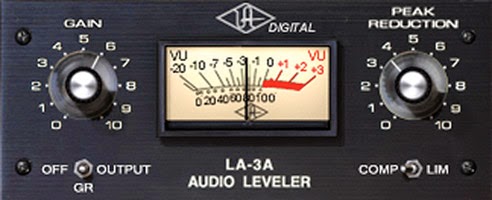
Universal Audio Teletronix LA-3A plugin image
It seems like a lot of you enjoy reading what kind of gear I like to use, as evidenced by the views for my top 10 mics, mic preamps, EQs and compressors. I'm going to continue the series with my "Top 10 Most Used Plugins."

Keep in mind that I use a lot of other plugs by other manufacturers, but these are the ones that I find are used somewhere on almost every mix that I do. Also, I'm a Pro Tools user, so some plugs are PT-centric.

1. Pro Tools 7 Band EQ: I love this plugin because it sounds pretty good, doesn't eat up any system resources, and has hi and low pass filters. Sometimes I'll just use it for the filters only (like on effects), but I always find a lot of these sprinkled across a mix in many other places.

2. Universal Audio 1176LN: My go-to compressor in most cases. UA has a lot of different variations in their Classic Limiter bundle, but this is the one that works best for me. I find it can just about work on anything if you adjust the attack and release times, but I'll almost always use it on bass for sure, toms, and probably vocals (although the UA LA-2A works great there as well).

3. PSP Vintage Warmer: Everything I use this on just sounds better, especially the mix buss. I rarely use much of it, but it makes a big difference on the glue of a final mix.

4. Lexicon PCM Native Hall: I love all the Lexicon reverbs, but I find I use the PCM Hall almost all the time, mostly for things that need depth like strings and pads. The Lexicon PCM Plate is a close second, but the Pro Tools D-Verb can be surprisingly good in many places as well.

5. Universal Audio Teletronix LA-3A: Back in the hardware days I always used these on electric or acoustic guitars, since I've never found anything better on those instruments. It's no different with the plugin. It's also good on keys.

6. Soundtoys MicroShift: I looked around for a long time for a plugin with that old Harmonizer sound. The MicroShift is the first plug that I found that really does it (although you can also now get the same sound from the Eventide Ultrachannel). It's dead easy to use and provides that extra presence or smoothing like nothing else.

7. Universal Audio Precision Limiter: There are other great limiters (like the Waves L series and the Slate Digital FG-X), but this is my favorite for the stereo buss to just take care of those nasty peaks that result in overs. I don't use much of it (a dB or 2), and it's very transparent already, so you don't hear it while it does the job.

8. TT Dynamic Range Meter: This is an excellent plugin that tells you when you're squashing the mix too much. It provides precision output metering, plus that great dynamic range meter, and its FREE. Let's keep the hypercompression out of music. Use this meter.

9. Pro Tools Long Delay: There are other great delay plugs (Soundtoys Echoboy and the PSP 42 and 85 come to mind), but this is the one I reach for all the time. It's not as versatile as many plugins, but it's fast to set up, and once again, takes up virtually no system resources (which can be important on a large mix). I alter it with a previously mentioned PT 7 Band EQ ahead of it to get the sound I need and keep it out of the way of the vocal.

10. Sample Magic Magic AB: This is one of my new favorites. It provides an instant AB against any audio file. You can load up to 9 sources to AB against, and easily match the level between them all for a tight comparison. Plus you can even loop a section if you want. It's great for making sure your mix is really in the ballpark.

Like I said before, there are a lot of other great plugins that I use by a variety of companies, and there are many that I haven't tried yet, but these are the ones that I use on every single mix that I do.

What are your favorites?
----------------------------------

Thursday, May 6, 2010

Finally, A Reverb Plug-In I Can Love

I'm not ashamed to say that I've always had trouble with reverb. It just seemed so hard to make it sound good. I could make it mesh perfectly with a vocal or instrument when soloed only to find that it stuck out from the track like a sore thumb with all the instruments in the mix. I would find that the correct wet and dry balance was always elusive, with the verb either disappearing or washing everything out (I've since learned a lot of tricks to make things work better, which I've shared in previous posts).

Of course, there were those times when the verb sound came easy if I worked in a studio that had an EMT 250, a wonderfully tuned EMT 140 plate, or even a great chamber (like at Capitol or the old A&M), but if you weren't working in the A-list places, you could probably forget about having access to any of these. When the Lexicon 224 and the later 480 came along, I was afraid to tell anyone that I had one personal setting that I thought sounded good and worked for me, and I would never deviate from it because I found the unit too complex to set up. Only years later did I find out that I wasn't alone, and most engineers felt the same way.

When the DAW came along, reverbs got a little easier to make sound good, especially with convolution-based reverbs like Altiverb, but I still had to fiddle more than I wanted to make everything sit in the mix just right. That's why I'm so blown away with the new Lexicon PCM Native Reverb plug-in. No matter what you do and how you do it, it always sounds great.

The PCM Native Reverb is actually a bundle of different reverb plug-ins - vintage plate, plate, hall, concert hall, random hall, room and chamber. It works on the Mac 10.4.2 or later, Windows XP, Vista or 7, and any version of Pro Tools after 7.3. It also works as a VST, Audio Units or RTAS plug-in, so it's compatible with just about any DAW on any platform.

It takes up about 500 meg of disc space and isn't very processor intensive at all like you'd expect. I haven't tried more than 3 plug-ins at a one time yet, but the processor load hardly budged under those conditions.

I won't get into a long review here except to say that I can't make it sound bad, regardless of the type of verb plug-in or it's setting. I especially love the chamber, which just sounds so thick and gorgeous, yet lays in the track perfectly. I compared the Lexicon to 4 of my other plug-in reverbs, all of which I think sound pretty good and I was pretty happy with, but they just don't sound as good. I'll continue to use them, but the Lexicon is now my go-to verb.

Michael Carnes and Casey Young should really be commended for their work on the PCM Native Reverb, especially the user interface. Unlike Lexicon hardware of the past, the PCM Native plug-ins are logical and easy to use, and have a built-in help screen that tells you what each control does if you need it. The fact is, it's harder to make it not sound good than the other way around.

So kudos, Lexicon. I don't think I'll be having any of my former reverb problems ever again.

----------------------------------
Follow me on Twitter for daily news and updates on production and the music business.

Don't forget to check out my Music 3.0 blog for tips and tricks on navigating the music business.

Wednesday, May 5, 2010

6 Questions For JamHub VP Sales And Guitarist Dave McCarthy

Dave McCarthy is one of the most well-liked people in the pro audio business, having met just about everyone during stints in executive positions at lexicon, Line 6, Peavy and now with JamHub. Dave is the perfect guy to sell a new product like JamHub (the silent rehearsal studio - see my JamHub article for a description, or the JamHub website) because he's more of an evangelist than a sales exec. It's difficult not to get caught up in his excitement, and his product explanations are so clear on its benefits that you've got to have one now!

What most people don't know is that Dave is a hell of a guitar player, having toured with a variety of bands including everyone's 60's favorite Mitch Ryder. Here are Dave's answers to this week's "6 Questions."

1) How did you break into the business?
I played and toured with bands in the Midwest and Canada. In the early 80’s I landed in LA and had to go to work selling gear in music stores. At the end of my retail career, I began jumping store to store and taking my rather large clientele with me. Joe Goodman decided to end the chaos (to Los Angeles retailers) and make it his mission to get me a rep gig ( and get me out of retail) so he had me work on pro accounts while he shopped my resume. He helped me get my first rep gig with a manufacturer, which was with Lexicon.

2) What makes you unique?
I think I’m unique because I still believe that we’re in the joy business. It’s not about the products, it’s about the joy they create. It causes me to approach my job with wonder and excitement.

3) Who was your biggest influence?
When I was working in music stores, I met Dan Armstrong and we became close friends. I wasn’t really smart enough to hang with him, so he spent most of the time teaching me what he knew. So much of this business is undocumented and the only way some of that knowledge continues is from one person to another. Knowledge is the greatest gift.

4) What's the best thing about your job?
Every once in a while I get to see someone have a perfect moment. When something I show someone opens the doors to expression for them and you see the lights go on, that is the best part of what I do.

5) When and where were you the happiest?
In the late 80’s traveling the world evangelizing for Lexicon and meeting the kind of folks that cared about fantastic audio.

6) What's the best piece of advice you ever received?
You have 2 ears and 1 mouth. Listen twice as much as you talk. If you listen twice as much as you talk you’ll know what to say.

----------------------------------
Follow me on Twitter for daily news and updates on production and the music business.

Don't forget to check out my Music 3.0 blog for tips and tricks on navigating the music business.

LinkWithin

Related Posts Plugin for WordPress, Blogger...