Get This Free Cheat Sheet Guaranteed To Help Your Next Mix

Friday, September 26, 2014

Nashville Engineer Ed Seay On The Latest Inner Circle Podcast

Ed Seay is one of Nashville's finest engineers and he's my guest on the latest Inner Circle podcast. Ed has a way of looking at and explaining recording that's crystal clear and he always has multiple nuggets of wisdom to offer, so this is one that I think you'll really enjoy.

In the intro section I'll also discuss the future of the album and take a look at how different tuning standards can affect our mood and even our musical enjoyment.

Remember that you can find the podcast either on iTunes or at BobbyOInnerCircle.com, and now also on Stitcher
----------------------------------

Thursday, September 25, 2014

Led Zeppelin "Ramble On" Isolated Lead Guitar Track

Here's a very interesting isolated track from "Ramble On" by Led Zeppelin. It's the isolated lead guitar track, and while there isn't that much music of it (most of the track consists of only headphone leakage), it is pretty telling of how Zep recorded.

What you'll hear is Jimmy Page's guitar parts in the turnaround before choruses, the solo harmony parts, and an interesting part at the end that's not on the record. Here's what to listen for:

1. The first part enters at 1:05 and it's the pre-chorus clean guitar part. Nothing particularly remarkable here; it sounds just like the record.

2. The first solo begins at 1:55 and it consists of long sustaining distorted notes that are a harmony to the main guitar part. Listen to the end, where Page plays a very busy fill that doesn't make the final mix.

3. The second solo comes at 2:31 and once again it's a harmony part. It's not performed with great precision but it certainly works within the context of the part.

4. At 4:00 the reverb is turned way up and Page plays some harmonics and sustained notes, then some fills at the end. This is something that you won't hear on the record as the song is faded by the time these parts enter.

5. The interesting thing in this track is that it appears that Page knew exactly what he was going to play in every section beforehand. Where today we would take each section at a time and work on it, in this case it was more like, "Go into record for the entire song and let me take a pass." As a result, this might have been the only take of these parts.


----------------------------------

Wednesday, September 24, 2014

Desqueak A Guitar Using iZotope RX4

iZotope RX4 is one of the great tools for postproduction, now a standard for every engineer doing ADR, foley or sound design just about everywhere. It's also very effective in a musical capacity as well, as you'll soon see.

This video by Russ at Pro Tools Expert (which is a great site you should really know about if you use Pro Tools) shows how you can use RX4 to clean up the squeaks from an acoustic guitar track. This is something that drives mixers crazy, but RX4 does a great job of attenuating them so they virtually disappear from the mix. RX4 also works great on electric guitar as well, and there's a video on how to do that as well.

----------------------------------

Tuesday, September 23, 2014

A Look At Life On A Tour Bus

On a Warped Tour bus
For most bands playing club gigs, the goal is to get popular enough to get out of the van and into a tour bus. Many musicians and techs also have a vision of going on the road with a popular act, but unless you've experienced life on a tour bus before, you'll find it's not at all like those days going from gig to gig in a station wagon.

Here's an excerpt from The Touring Musician's Handbook about life on the tour bus and the proper etiquette to use when you get there.
---------------------
"The tour bus is looked upon as the mansion on the hill. It holds a unique place in the minds of concert goers and musicians everywhere, but when it comes right down to it, it’s just a way to get a bunch of people from point A to point B as comfortably as possible. The definition of comfortable, however, is in the eye of the beholder. Let’s take a look at life on the bus.

The Bus Itself
Most tour buses are laid out the same. There’s a small front lounge, a larger rear lounge, bunks for either 8 or 12 people, a galley, and a bathroom with a shower. Most buses have a satellite television in both lounges as well as a DVD player and sound system, wireless Internet, and maybe even an X-Box or other gaming device. Many now have iPod docs as well.

The rear lounge can usually be reconfigured as a twin or queen size bed as necessary. There are multiple air conditioning zones (up to four on some buses), so there’s usually at least one area that you can find that has a temperature you’re comfortable in. The bus also has a generator so you’ll have plenty of AC power for plugging in laptops and anything else requiring external electrical juice. Most bunk areas are small, but many have a flip-down television, a DVD/CD player, and their own power outlets.

If the artist and the band share the same bus, it’s not uncommon for the artist to commandeer the rear lounge, even though it’s supposed to be for everyone (you better knock before trying to enter). Someone might even sleep back there if they’re claustrophobic in a bunk.

Life On The Bus
Because you share such tight quarters with seven to eleven other people, it’s very easy for tempers to fray. That’s why everybody has to be on their best behavior, no matter how difficult that may be. Because you can offend someone without even knowing, you have to be extra considerate of everyone on the vehicle and respect their physical space and personal belongings. Keeping yourself and your area clean and dumping the trash at every stop goes a long way to keep from setting off anyone’s phobias or quirks.
“Traveling by bus with eight other people is not something everyone can deal with.You have to have a certain type of personality to handle the intimacy and lack of privacy. The bus is close quarters, you can't walk down the aisle without bumping into someone, you can't sit alone anywhere without there being noise and a conversation, maybe someone watching a movie or listening to music. It's difficult to read because there are too many distractions and there is literally nowhere to go except to your bunk, which is about the size your coffin will be when you die. You have to be extremely cool and conscientious of others and hope they will be the same to you because it can be completely psychologically draining.”
 Sue Foley
As far as the bus goes, you never want to leave any of your stuff out in the aisle. When I started touring, they told you once to put your shoes in your bunk and if you didn’t listen, the next morning they were gone. You always want to clean up after yourself and you don’t want to go to sleep leaving your beer bottles or food out.
Walter Earl
You also have to take into consideration the opposite sex if you have a mixed male and female band. Women have different needs and a different energy from guys, which changes the dynamic of the behavior on the bus dramatically. Surprisingly, it tends to get mellower as the testosterone levels seem to decrease.
I know this is going to sound really old school but I always bring a book because sometimes when you’re on the bus with a lot people crammed in, the chances of having some kind of unpleasant discourse between band members or management or crew is pretty high. The longer you’re out, the less sleep you have, and the more you see the differences in personalities. It’s inevitable that there’s going to be a blow-up. I always want to have an escape or a self-defense to get out of those social situations which can go bad and lead you to losing your gig. Burying yourself in a book is a good way to stay out of those situations.
Ed Wynne
Is it a smoking bus, and does that bother you? How much are recreational drugs or alcohol a part of your touring life? Can you sleep on the bus? These are the things you must ask yourself before you take the gig.
TIP: Buy a cheap pair of slippers just for the bus. They’re easier to slip on and off in the tight quarters of your bunk."


----------------------------------

Monday, September 22, 2014

Apple's New Audio System For Thin Devices

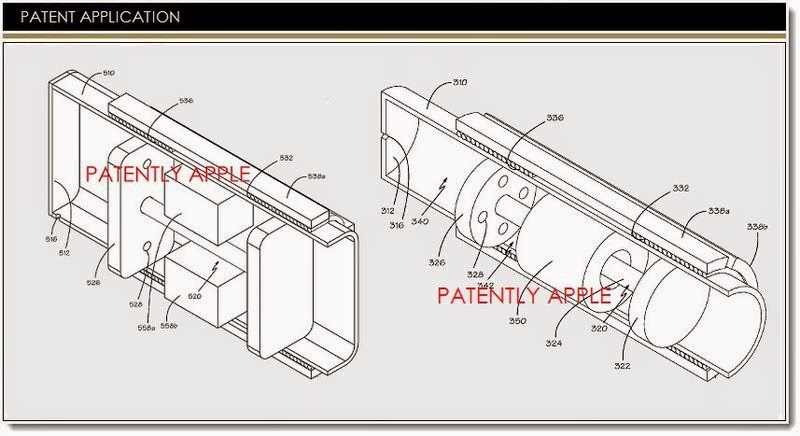
Apple Speaker Patent image
Every since Apple hired my friend and surround sound mentor Tomlinson Holman a few years ago, I knew that the company would be working towards higher audio quality in a profound way. And generally speaking, the sound of Apple products does continue to improve, even if it's hardly ever noted. I just purchased a new iMac and Macbook Pro, and could immediately tell the difference between my 3 year old versions.

iPhone 6 plus speaker imageThis recent Apple patent application was dug up that's titled "Long Throw Acoustic Transducer," and it relates to a playback element in the thin device iOS environment. The idea behind it is that it has two permanent magnets that are joined by a linkage with a high magnetic permeability to form a a piston that is inserted into a housing. There are two pole coils surround the housing with each coil adjacent to one of the magnets, and they oscillate within the housing when an electrical signal is applied. One of the magnets can have a vent passage, but that's not entirely necessary. The whole idea is to provide a greater volume of air from a compact device than was previously possible.

We don't know for sure because it's not marked, but it doesn't look like the transducer in the new iPhone 6 plus is using this technology yet. Here's a picture of it thanks to the breakdown of the phone on ifixit. Either way, the boffins at Apple haven't forgotten audio, and we Mac/iPhone/iPad fanboys should be thankful.
----------------------------------

Sunday, September 21, 2014

New Music Gear Monday: UAD AMS RMX16 Plugin

There is so much new gear coming out for the upcoming AES show that it's an exciting time. One of the things I'm most excited about is the new AMS RMX16 plugin for the Universal Audio UAD platform. The original hardware box had a very distinctive sound that, along with the SSL 4k buss compressor, is really the sound of the 80s in many ways.

The algorithms in the RMX16 plug are exactly the same as the hardware unit, and includes those wonderful Ambience and Non-linear programs that we all used so much way back then. There are also a number of features that are unique to the plugin that weren't on the original hardware unit like dry/wet mix, wet solo, and much easier editing.

The plugin costs $349, and of course, you need a UAD-2 DSP card or Apollo interface. Check out the video below that features Mark Crabtree, the original designer of the RMX16.


----------------------------------

Saturday, September 20, 2014

Engineer Ed Stasium On The Latest Inner Circle Podcast

Bobby Owsinski's Inner Circle Podcast
My latest Inner Circle podcast features the great engineer Ed Stasium who talks about the excellent guitar sound that he gets (my personal favorite) on the records that he's done for The Ramones, Living Color, and Mick Jagger among many others. We'll also touch upon some interesting other bits of his engineer career, like his first record ("Midnight Train To Georgia").

In the intro section, I also talk about the pros and cons of giving your music away, as well as the 8 different things that enter into creating a production budget.

Remember that you can find the podcast either on iTunes or at BobbyOInnerCircle.com, and now also on Stitcher
----------------------------------

Thursday, September 18, 2014

The Who "Who Are You" Isolated Drums

I just love listening to tracks from a hit song. It doesn't matter from which era, since each hit captures some kind of magic, and it's fun trying to sort out exactly what that magic is. Today we'll look at the drum track from a hit from The Who from 1978 called "Who Are You."

This was the last recording of drummer Keith Moon, as he died 20 days after the album was released. Moon was a one-of-a-kind drummer, especially when compared with the drummers of today, and you'll hear that his playing is almost garage-band like, although it was perfect for The Who at the time.

What's interesting was that the drums here were overdubbed, which is why all you hear is headphone leakage, and the leakage contains obvious overdubs. Here's what to listen for.

1. Listen to how dynamic the high-hat work is. Moony plays more than the beat, as the playing really breathes.

2. The sound of the drums is really the sound of the kit. This song used engineer Glyn Johns famous minimalist mic technique (as compared to today) so that the drums sound more like one instrument rather than what we hear today. Check out this video that will show you what he used.

3. The playing's not perfect, especially the kick. You can hear slight lags in timing in the kick, tom fills and the hat, although I'm sure that never bothered anyone listening to the record. Today we'd fix all that, most likely to the detriment of the song.

4. You can hear Moon singing and/or grunting at times throughout the song. Again, we'd probably fix that today.

5. At 3:30 you can hear a tympani overdub that isn't that obvious when listening to the entire mix.


----------------------------------

Don't forget to check out my Music 3.0 blog for tips and tricks on navigating social media and the new music business.

Wednesday, September 17, 2014

How Much Does Music Contribute To A Film?

It's really easy to take film music for granted. When it's done really well, we don't notice it at all; it just enhances the film in ways that we really perceive, but don't necessarily pay attention to.

Here's a great example of how important the music of a film can be. It's a short clip from the original Star Wars (Episode 4), but minus the John Williams score after the first 15 seconds.

Considering that this was the feel good payoff of the film, notice how awkward it is without the music (kind of like real life sometimes).

So hail to all film composers and all the things you do!


----------------------------------

Tuesday, September 16, 2014

Getting The Most From Amp Tone Controls

Tone controls image
I'm always kind of baffled when I hear a band live and there's no separation between instruments, especially between guitar players. Then I think back to when I was a young player and remember, "They just don't know how to set their tone controls yet."

For too many players, setting those amp tone controls is such a random act with little thought behind it. Here's an excerpt from my Ultimate Guitar Tone Handbook (written with the excellent guitar player, composer and author Rich Tozzoli) that gives some context as to how to get those most out of these controls.

"So often players are confused by the tone controls on their amps. What’s the best way to set them? Is there a method for doing so? In order to get the most out of them, it’s best to understand the reasons why they’re there in the first place.

The biggest reason for having tone controls is so that all the frequencies of your instrument speak evenly so no particular range is louder or softer than any other. Shortly after the first amps were developed with only a single “Tone” control, manufacturer’s noticed that players might be using guitars with different types of pickups with their amps, so more sophisticated tonal adjustments were really necessary. A guitar with a humbucking pickup might sound too boomy through an amp, but if you roll off the low-end with the bass control, the frequencies even out. Likewise, a Strat might be too light on the low-end or have too much top-end, but a simple adjustment would make all frequencies come out at roughly the same level.

Another place where tone controls come in handy is if you have a frequency that really jumps out, as compared to all the rest, either because of the way the amp is overdriven or because of a pedal. Often a slight adjustment of the Treble, Middle or Presence control can alleviate the problem, although these controls will also adjust all the frequencies around the offending one as well.

Where tone controls are especially effective is how the guitar fits within the context of the mix of the song. You want to be sure that every instrument is distinctly heard and the only way to do that is to be sure that each one sits in it's own particular frequency range, and the tone controls will help shape this. It's especially important with two guitar parts that use similar instruments and amps (like two Strats through two Fender Super Reverbs). If this occurs, it’s important to be able to shape your sound so that each guitar occupies a different part of the frequency spectrum. To make our example work in the mix, one guitar would occupy more of a higher frequency register while the other would be in a lower register, which would mean that one guitar has more high end while the second guitar is fatter sounding, or both guitars might have different mid-range peaks. 

Not only do guitars have to sonically stay out of the way of each other, but they have to sit in a different frequency space than the bass and drums (and vocals, keys, percussion, and horns if you have them) too. As a result, you either adjust the tone controls on your amp or try another guitar so it fits better in the sonic space with everything else. While the engineer can do this with equalization either during recording or mixing, it’s always better if you get as close to the sound as possible out in the studio first because it will save time and sound better too.


The best way to get an ear for how guitars are sonically layered is to listen carefully to a number of hit songs in almost any genre and really dissect how everything fits together. Of course, the producer, engineer or artist (if you’re playing on someone else’s recording) will also have specific ideas as to the sound they’re looking for in the track, and will guide you in that direction."

To read additional excerpts from the Ultimate Guitar Tone Handbook and my other books, go to the excerpts section of bobbyowsinski.com.
----------------------------------

Monday, September 15, 2014

Using Sound To Talk To Atoms

Atom and particles image
I love when I hear about audio or music being used for things other than what we're familiar with, and this is a really good one. One of the latest uses for audio is in quantum physics where scientists from Chalmers University of Technology in Sweden are using sound to communicate with with atoms.

Quantum physics deals with particles at a nanoscopic or sub-atomic scale and a great number of everyday products like the transistor, the laser and the MRI machine operate on a quantum scale. You might say that modern audio, which is so dependent upon the microchip, is a direct result of what happens way down there in the quantum universe.

In this case, the scientists first decided to try to listen to the sound emitted by an atom, which is the weakest sound which can be detected (imagine the amplifier needed for that!). After that they decided to try to manipulate the atom with sound, which proved to be a success.

It turns out that using sound works a lot better than light, which is what is usually used for this purpose, because it travels 100,000 times slower, which provides more control over the atoms and their particles. Because the atom is so large compared to the wavelength of the sound used, it can be customized to only react to certain frequencies.

Lest you think you might try this at home, you should know that the experiments where carried out at near absolute zero temperature and the scientists used a frequency of 4.8GHz, which equates to a D28 note. That's 20 octaves higher than the highest note on a grand piano!
----------------------------------

Sunday, September 14, 2014

New Music Gear Monday: iCon Digital iControls Pro

While many have gotten used to mixing in the box with a mouse or trackball, some of us just have to have some faders under our fingers to feel comfortable. Unfortunately many of the mainstream DAW controllers can be way more money than a home studio can bear. That's why the iCon Digital iControls Pro may be the perfect solution in those situations.

The iControl Pro offers 8 motorized touch sensitive channel faders plus a master, as well as transport control, 9 encoder knobs and a jog wheel all in an ergonomic aluminum form factor. It also has solo and mute buttons for each channel, the ability to switch to different banks and layers, and DAW horizontal and vertical zoom controls. The unit has 2 USB inputs to allow for daisy chaining devices  using Mackie control for Ableton, Cubase, Samplitude and Logic Pro, and Mackie HUI control for Pro Tools. iMAP software also allows all of the controls to be mapped for MIDI too.

Best of all, iControl Pro only retails for $429 and streets for even less. Find out more about it on the iCon Digital site, as well as the company's other fine controllers. Check out the nice overview below from Sounds and Gear.


----------------------------------

LinkWithin

Related Posts Plugin for WordPress, Blogger...