1. Eminem - 8,818 unique words
2. Jay Z - 6,899
3. Tupac - 6,569
4. Kenye West - 5,069
5. Bob Dylan - 4,883
It should be noted that many artist/writers like Bruce Springsteen don't make the list because they haven't granted permission for Musixmatch to use their lyrics.
There have been other studies that have looked at parameters like lyric density and intervals between new words, but this is the first to check overall vocabulary size.
The study looked at 93 top artists across 25 different genres that ranged from pop to new age.
In the grand scheme of things, this matters little to the listener and is far from a factor in determining a hit, but you can look at it as a gauge of the intelligence of the writer. On the other hand, Julio Iglecious, Celine Dion, Mariah Carey and Andrea Bocelli also rank high, and no one has ever accused their songs of catering to intellectuals.
Personally, I'd just prefer to listen and not analyze. Do you think songwriter vocabulary matters?
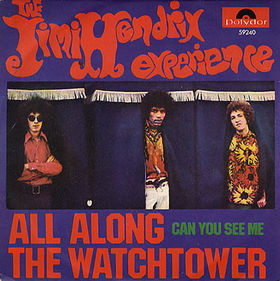
Maybe the definitive Jimi Hendrix song is one he didn’t write himself. “All Along The Watchtower” was written by Bob Dylan and released in 1967 on his John Wesley Hardingalbum, which was given to Jimi by the publicist for Dylan’s manager Albert Grossman. The song was released as part of The Jimi Hendrix Experience's third and final album called Electric Ladyland.
Recording began at Olympic Studios in London on a 4 track tape recorder with Experience members Mitch Mitchell on drums and Noel Redding on bass, along with Traffic guitarist Dave Mason on acoustic 12 string. On take 7, Redding, dissatisfied with how long it was taking, left for the pub and Mason took over on bass. On takes 11 and 12 Stones guitarist Brain Jones arrived at the studio drunk and insisted on playing piano. After playing poorly, he was asked to leave and Mason returned to 12 string.
Take 27 became the keeper, after which Hendrix himself added the bass. All subsequent overdubs and mixing took place at the Record Plant in New York City, first on a 12 track tape deck, then eventually on a 16 track. Rolling Stone Magazine has named “All Along The Watchtower” #47 of their 500 Greatest Songs of All Time, while Britain’s Total Guitar has it as the #1 greatest cover song of all time.
The Song
“All Along The Watchtower” is interesting in that the song is made up of a single set of chord changes that repeat over and over. There are no other sections other than three verses, and solos that occur over the same verse chord changes. On that alone you would think that this would be a boring song, but that’s not the case, thanks to a constantly changing palette of sounds. The form looks like this:
The lyrics are more poetry set to music than anything, which of course, is the strength of Bob Dylan. The hook “All Along The Watchtower” is stated only once at the beginning of the last verse, yet it’s such a strong image that it supersedes the other lyrics by far.
The Arrangement
The arrangement of “All Along The Watchtower” doesn’t change all that much in terms of instruments building as much as different sounding guitars entering and exiting.
The song begins with the bass, drums, and the acoustic 12 string playing the intro, which is punctuated with a vibraslap on beat 4 of every bar. Then a little twist that makes it totally interesting, and uncountable if you’re playing along, where there’s a half-beat guitar pickup going into the instrumental intro with the famous lead guitar solo line where the rest of the band enters with more intensity.
On the first verse you can feel the band pull back dynamically as the music gets less intense to make room for the vocal. A new dark sounding strumming electric guitar enters on the left channel that acts like a glue for the track, and the tambourine adds the high frequencies as it pushes it along. Also, at the end of bar 16 (half-way through the verse), the bass and rhythm guitar play the last chord as a IV chord, while the 12 string guitar plays it as a flat VII. Throughout the verse a lead guitar fills in between each vocal phrase.
During the first solo, the intensity once again builds with the drums and tambourine switching again to double time, then slightly lowering the intensity for the second verse but still staying with the double time feel. Once again, the lead guitar fills in the holes between the vocal phrases.
In the solo section, the first one is similar to the previous lead sections in intensity and clean tone of lead guitar, but the second changes to the verse feel. In that solo, the bass also changes from a loose, ad-libbed part to one that’s structured on octaves, while the slide lead guitar pans from side to side. The next solo keeps the same feel but the lead guitar changes to a wah, which again pans left to right. The last part of solo increases in intensity while the guitar changes back to a slightly overdriven Strat sound.
The last verse is identical in structure to the previous two. The outro solo section differs in that the 12 string guitar is replaced with a 6 string acoustic strumming a different, more aggressive pattern than was previously used, while the guitar and vocal ad-libs pan back and forth from left to right over the ending fade.
The arrangement elements look like this:
The Foundation: bass and drums
The Rhythm: 12 string acoustic guitar, 6 string acoustic at the end, tambourine
The Pad: strummed low register electric guitar low in the mix
The Lead: lead vocal, lead guitars
The Fills: lead guitar
The Sound
“All Along The Watchtower” provides an interesting glimpse into the old recording world of 4 track as well as the then new world of multitrack all within the same song. You can hear the old world primarily on the drums and percussion, which were mixed in mono onto a single track. In order to make them sound stereo, they’re panned hard to the left and slightly delayed to hard right, which sounds somewhat odd as there’s a big hole in the middle as a result. This actually works to the song’s advantage as the center is filled up nicely with a number of guitars and the vocal. The tambourine, which subtly plays a big part in the song, gets the same stereo treatment as the drums. The bass is panned slightly to the left while the 12 string is panned slightly to the right.
Where the new multitrack world enters is all of the different guitars layered on the song. Virtually every solo has a different guitar sound, and there’s a very low and dark but important strummed electric guitar on the left that works as the glue to the song. On the outro the 12 string turns into 6 string acoustic.
There are a lot of effects layers in the song made up of several delays and delayed reverb. Except for the delay used to double them, the drums and tambouring are dry, but all of the other guitars have a slight delayed reverb that blends the track together well. The vocals and many of the guitars receive what sounds to be about a 350 millisecond tape delay with about three or four repeats. Since it’s tape, the frequency response is limited to begin with (most tapes used for tape delay wear out during the session from oxide shed, so the high frequencies suffer) so the delays decay seamlessly into the track.
Be sure to listen for the long reverb tail on the 12 string guitar in the intro before the vibraslap enters, and how the solos in the middle of song pan left to right and back again, but the echo still remains on the right.
The Production
“All Along The Watchtower” began as a co-production between Jimi and his manager Chas Chandler (who produced his previous two albums), but Chandler quit early in the process over Jimi’s irregular studio habits and the fact that it was taking so long to accomplish anything. Without hearing the previous takes of the song, it’s difficult to say if a better one was played before the keeper at 27, but you have to like Jimi’s instincts on keeping that one, as well as the many guitar overdubs that it took to complete the song, which was the total opposite from the quick recording of his previous records. The song has stood the test of time, and considering it’s simple form, a big reason for that can be attributed to it’s production. Send me your requests for song analysis.
Most stories involving a guitar revolve around one that was stolen and sometimes returned (like Peter Frampton's famous Les Paul). This one's different because of the claim that a famous guitar was not stolen or lost.
It all revolves around the Strat that Bob Dylan used at the Newport Folk Festival in 1965, which was significant because it was the first show that he did electric, which almost caused a riot with the purist acoustic fans there.
The PBS television show History Detectives claims to have Dylan's Strat from that show, found by a New Jersey women in her woman's attic. The women's father was a pilot for Dylan's private plane at the time and claimed that the guitar was accidentally left behind. He tried to get in touch with Dylan several times afterwards but was never able, then passed away in 1977. Not only did the case (marked "Property of Ashes & Sand Inc," Dylan's tour company at the time) have the sunburst Strat, but also contained several pages of lyrics. The show brought in several rock and guitar historians who feel that they've authenticated the guitar and lyrics beyond a shadow of a doubt.
End of story, right? Not really. Dylan's attorney issued a statement stating that the original guitar played at the festival was still in his possession, and that he didn't use a private plane for show, driving down from his home in Woodstock, NY instead.
So who's right here? Having just co-written a book that relied on people's memories of events from long ago (Ken Scott's Abbey Road To Ziggy Stardust), I can say that the memory can be a fuzzy thing. Dylan could easily be thinking of a different show. I guess we'll have to watch the show to see the evidence presented.
One thing's for sure, the guitar is valued at $1 million +, but the women isn't selling.


 In a study looking at the largest vocabularies in the music industry, it seems that rappers take the cake. The Musixmatch lyric site found that 4 out of the top 5 largest songwriter vocabularies come from rap. Here's what they found.