Here's a real treat. It's an isolated guitar part from the Jimi Hendrix Experience's "Third Stone From The Sun" from the first Are You Experienced album. Here's what to listen for:
1. The guitar begins in stereo with the drier side to the left and the effect to the right. At 2:31 it pans out across the stereo spectrum back and forth, and does so for the remainder of the song.
2. Listen to the subtle delayed reverb, which you can hear better during the panning after 2:31, and a lot after 6:00 when the level is increased.
3. I love the fact that Jimi changes pickups frequently to change the sound in different sections of the song.

Get This Free Cheat Sheet Guaranteed To Help Your Next Mix

Showing posts with label Jimi Hendrix. Show all posts
Showing posts with label Jimi Hendrix. Show all posts
Friday, February 13, 2015


Monday, December 8, 2014
The 15 Most Expensive Guitars
 |
| #5 on the list of most expensive guitars |
That's what makes this list of the 15 most expensive guitars compiled by VH1 especially fascinating. They revolve around scarcity and name recognition more than art or even sound. Here they are:
#15. Leo Fender's original Telecaster prototype - $375,000
#14. George Harrison's custom one-of-a-kind rosewood Telecaster - $435,000
#13. Eric Clapton's 23 carat gold leaf 50th Anniversary Stratocaster - $455,550
#12. Jimi Hendrix' 1966 red Fender Mustang - $480,000
#11. Jimi Hendrix' torched 1965 Strat - $495,000
#10. Eric Clapton's "Brownie" Strat - $497,500
#9. George Harrison's red 1964 Gibson SG - $571,000
#8. Stevie Ray Vaughn's favorite "Lenny" Strat - $623,500
#7. Eric Clapton's 1939 Martin acoustic - $791,000
#6. Eric Clapton's 1964 red Gibson 335 - $847,500
#5. Jerry Garcia custom built "Tiger" guitar - $850,000
#4. Eric Clapton's 1964 "Blackie" Start - $959,500
#3. Keith Richard's 1959 Les Paul Standard - $1,000,000
#2. Jimi Hendrix' white "Woodstock" Strat - $2,000,000
#1. Plain old Strat with lot's of star signatures - $2,700,000
Notice how Fenders dominate the list, as does Hendrix and Clapton-owned instruments? Now you know what to buy your favorite guitar player for Christmas.
----------------------------------
Tuesday, December 2, 2014
An Interview With The Great Eddie Kramer

Unquestionably, one of the most renowned and well-respected producer/engineers in all of rock history, Eddie Kramer’s credits list is indeed staggering. From rock icons such as Jimi Hendrix, The Beatles, The Rolling Stones, Led Zeppelin, Kiss, Traffic and The Kinks, to pop stars Sammy Davis Jr. and Petula Clark, as well as the seminal rock movie Woodstock, Eddie is clearly responsible for recording some of the most enjoyable and influential music ever made. Here's an excerpt from the interview section of the The Recording Engineer's Handbook where he talks about his setups, technique and even a little Jimi Hendrix.
"When you started you were pretty limited by the number of tracks and channels available.
Definitely. You have to use your imagination and think really hard about how to plan it out. For instance, on Hendrix’s stuff, which is the classic example, it was done on four track. On Are You Experienced we used mono drums and mono guitars and so forth. We would fill a four track up then dump it down to another four track, leaving two tracks open, then you may have to do that again. On Axis: Bold As Love, I was recording stereo drums which made a big difference.
Was your approach different when you went to stereo?
Yes. When it was mono I just used a single overhead, a snare mic and bass drum mic. There might be one or two tom mics but that would be it. When I went to stereo I probably used a pair of 251’s or 67’s, I can’t remember which. I was just trying to get that left to right image when the toms would go left to right. I always record from the drummers perspective and not from the listeners perspective.
Has your approach to tracking changed when you do it today?
Yes, it has been modified in the sense that you don’t have to use an enormous room to record the drums anymore. In fact, bands today don’t want that huge reverberant drum sound that we used to love, so you can record drums in a smaller deader space and still get a big fat sound. Obviously I’m using more mics, multiple mics on the bass drum, multiple mics (top and bottom) on the snare, which I didn’t do before. I use a lot of mics on the guitar and then pick the ones that I like.
Is your setup the same all the time?
Pretty much. I will experiment with different microphones as they come in. The [Shure] KSM-27 is a great guitar amp mic. I love the new KSM141, which is a cross between a 451 and a KM84, on hat, percussion, acoustic guitar and underneath the snare. The SM91 and SM 52 are my bass drum mics of choice, and I use KSM44 on overheads, but I still use vintage mics like 47’s, and the new Neumann TLM 103’s, 147’s and 149’s. To me a microphone is like a color that a painter selects from his palette. You pick the colors that you want to use, so the mics are my palette. In the end it doesn’t matter to me too much. Whatever is available, I’ll just look at it and think, “I wonder what this will sound like on the guitar, or bass or whatever instrument.” I know what my standard stuff is and if I need to do something really fast I’ll always go back it, but I’ll often experiment with whatever happens to be in the studio.
Do you tailor the mic preamp to the microphone? Do you have certain combinations that you like?
No, just blanket it with vintage Neve modules, either 1033’s or 1081’s. I like the 1081’s because of the four band EQ so I can carve things out particularly when I’m recording bass drum. Lately I’ve been using the new Vintech X81, which is a copy of the 1081.
So you’re EQing during recording?
I always do. I have done so my whole life. If I hear a sound that I like then it immediately goes to tape. If it’s a guitar, then I’ll print the reverb as well on a separate track so the sound is there and locked in. I usually have an idea of what it’s going to sound like in the final analysis so the EQ and compression is done right then and there. I think if you bugger around with it afterwards you have too many choices. This isn’t rocket science, it’s music. Just record the thing the way you hear it! After all, it is the song that we’re trying to get and the guy’s emotion. We’re becoming so anal and self-analytical and protracted with our views on recording, I think it’s destructive and anti-creative. It’s bad enough that we have to be locked into a bloody room with sweaty musician (laughs).
Recording music should be a fun filled day. To me, making a record should be about having a ball because it makes the day go quickly and yet you’re still getting what you want on tape. There’s a friend of mine that has a bar in his studio and after the session is finished everybody has a beer and relaxes. What a wonderful thing! I think artists today have a tendency not to do this. You cut to a bloody click track, go to Beat Detective, do a lot of overdubs in Pro Tools, and then spend a lot of time searching for the right plugins to make it sound cool.
But the track has to move and breathe. Listen to all the great songs and albums that have been recorded the last 30 years. The ones that really stand out are the ones that breathe and move. With human beings, their tempo varies. I do admire what can be done in Pro Tools, but if there’s something that wrong, you should have done another take and maybe chop things together.
What’s the hardest thing for you to record?
The toughest thing to record is a full orchestra. Getting the right room and properly placing the microphones is really tough, but it’s also so rewarding. The other thing that’s tough is the artist that can’t get the right feel so you have to go through a lot, changing microphones and instruments and placement, to make it work. That can be boring.
I like to think that going into the studio is a challenge. What usually happens is that the artist, unbeknownst to himself, has done a brilliant job on the first take and it all goes down-hill very rapidly after that. The reverse can also be true in that the first take is weak because the person is just getting used to it and they build up gradually to point where it “is” great.
Didn’t you tell me once that “All Along The Watchtower” was take #27?
That’s a great example of an artist of Jimi’s stature starting from square one with a very difficult arrangement. He’s yelling at Mitch [Mitchell, drummer for the Experience], “C’mon. Here’s how you do the rhythm part,” then Mitch eventually gets it. Then he yells at Dave Mason because he can’t get the secondary rhythm guitar part. Eventually he gets it and Jimi keeps going at it and going at it. At one point Brian Jones walks into the studio drunk out of his mind and starts to play piano. Jimi politely lets him play, I think on take 20 or 21, and then excuses him by saying “No, I don’t think so, Brian.” Then by take 25 it’s a 4 star, take 26 is good but take 27 is the master, you can just tell. Everything is perfectly placed and has the intensity that Jimi wanted, so the song evolved because it had to. There was no time for rehearsal, this was something that had to be learned in the studio. It’s not the way you want to do it, but because he’s a musician of that stature, you don’t mind if it takes 30 takes."
To read additional excerpts from The Recording Engineer's Handbook and my other books, go to the excerpts section of bobbyowsinski.com.
----------------------------------
Thursday, February 6, 2014
Jimi Hendrix "Bold As Love" Behind The Scenes
Here's another outtake from the great Jimi Hendrix American Masters documentary shown on PBS last year. This one shows my buddy engineer Eddie Kramer, Jimi's manager and producer Chas Chandler, drummer Mitch Mitchell and bassist Noel Redding describing the making the "Bold As Love," the title song for the band's Axis: Bold As Love album.
You'll hear some great isolated tracks as well as very cool recoding story about the song from Eddie. Sorry, but you have to sit through a commercial before the clip begins.
You'll hear some great isolated tracks as well as very cool recoding story about the song from Eddie. Sorry, but you have to sit through a commercial before the clip begins.
----------------------------------
You should follow me on Twitter and Facebook for daily news and updates on production and the music business.
Don't forget to check out my Music 3.0 blog for tips and tricks on navigating social media and the new music business.
Thursday, January 9, 2014
Jimi Hendrix "Voodo Child" Behind The Scenes
Here's more for the PBS American Masters program on Jimi Hendrix. It's the behind the scenes making of "Voodoo Chile/Voodoo Child (Slight Return)" from his Electric Ladyland album, and it features my buddy engineer Eddie Kramer, drummer Mitch Mitchell, a bit of Noel Redding, and Jimi's manager/producer Chas Chandler.
You also get to hear some isolated tracks of both Jimi and Steve Winwood playing, which is very cool.
I don't think this part was actually in the PBS doc, as there were a lot of outtakes that are spectacular but didn't make the cut because of time restrictions. That make this video even cooler, since it's pretty rare.
You also get to hear some isolated tracks of both Jimi and Steve Winwood playing, which is very cool.
I don't think this part was actually in the PBS doc, as there were a lot of outtakes that are spectacular but didn't make the cut because of time restrictions. That make this video even cooler, since it's pretty rare.
----------------------------------
You should follow me on Twitter and Facebook for daily news and updates on production and the music business.
Don't forget to check out my Music 3.0 blog for tips and tricks on navigating social media and the new music business.
Thursday, November 21, 2013
Jimi Hendrix "The Wind Cries Mary" Behind The Scenes
If any of you caught the recent American Masters show about Jimi Hendrix on PBS you know that there was some great seldom-seen interviews that made that documentary one of the best. It seems like there was a lot of footage that didn't make the program, and here's some of it, describing the making of "The Wind Cries Mary" from Jimi and The Experience's first album Are You Experienced.
In the video you'll hear Jimi's late manager and producer Chas Chandler (once the bass player with the original Animals) describing how the song was cut in 20 minutes including 5 guitar overdubs (obviously everything was first take). Then you'll hear my buddy the great Eddy Kramer (you can read part of his interview from The Recording Engineer's Handbook here) isolate some of the guitar tracks from the song.
Sorry, but you'll have to sit through a 15 second commercial first, but it's worth it.
In the video you'll hear Jimi's late manager and producer Chas Chandler (once the bass player with the original Animals) describing how the song was cut in 20 minutes including 5 guitar overdubs (obviously everything was first take). Then you'll hear my buddy the great Eddy Kramer (you can read part of his interview from The Recording Engineer's Handbook here) isolate some of the guitar tracks from the song.
Sorry, but you'll have to sit through a 15 second commercial first, but it's worth it.
----------------------------------
You should follow me on Twitter and Facebook for daily news and updates on production and the music business.
Don't forget to check out my Music 3.0 blog for tips and tricks on navigating social media and the new music business.
Thursday, August 1, 2013
Jimi Hendrix "Fire" Isolated Guitar Track
When it comes to modern rock guitar players no one is more revered than Jimi Hendrix. Here's an inside look at his playing on one of the most popular songs from his first Are You Experienced album - "Fire." In this isolated track, you'll hear Jimi's guitars like you've never heard them before.
Here are some things to listen for.
1. Jimi was a great rhythm player and you can hear him push along the groove of the track really well here with the lower mellow guitar part.
2. There are a lot more guitars on this track than what seems apparent on the record. In fact, there's usually at least 2 and sometimes as many as 4. When there's 2 playing, Jimi keeps them separated by having one playing in a higher register while the other is in a lower register.
3. Listen to the double on the guitar solo at 1:23, but also check out the rhythm guitar underneath.
4. The reverb on the guitar sounds very much like a spring reverb.
5. Play it all the way to the end to hear the ending that's not on the record.
Here are some things to listen for.
1. Jimi was a great rhythm player and you can hear him push along the groove of the track really well here with the lower mellow guitar part.
2. There are a lot more guitars on this track than what seems apparent on the record. In fact, there's usually at least 2 and sometimes as many as 4. When there's 2 playing, Jimi keeps them separated by having one playing in a higher register while the other is in a lower register.
3. Listen to the double on the guitar solo at 1:23, but also check out the rhythm guitar underneath.
4. The reverb on the guitar sounds very much like a spring reverb.
5. Play it all the way to the end to hear the ending that's not on the record.
----------------------------------
You should follow me on Twitter for daily news and updates on production and the music business.
Don't forget to check out my Music 3.0 blog for tips and tricks on navigating social media and the new music business.
Thursday, June 13, 2013
Jimi Hendrix "All Along The Watchtower" Isolated Guitar Track
Here's a real treat. It's the isolated guitar track from Jimi Hendrix's seminal cover of Bob Dylan's "All Along The Watchtower" from his Electric Ladyland album. The song was magnificently recorded and mixed by Eddie Kramer, with the basics recorded at Olympic Studios in London and the overdubs and mixing at The Record Plant in New York City. The original recording was done on a 12 track (yes, that was a format for about a half a second), then later transferred to 16 track. There were so many overdubs that many had to mixed together on the same track, as you'll hear. Here are some things to listen for:
1. The delayed reverb on the guitars. This is an Eddie Kramer signature.
2. The fills in the first two vocal verses, many of which you can't hear on the record.
3. The track is in stereo, with the lead slightly on the left and the reverb on the right. The stereo is very apparent during the 2nd and 3rd solo and again on the outro as it pans hard right to left.
4. The 12 string that plays on the intro later reappears during the last vocal verse.
5. You get to hear the entire ending, instead of the one that fades on the record.
1. The delayed reverb on the guitars. This is an Eddie Kramer signature.
2. The fills in the first two vocal verses, many of which you can't hear on the record.
3. The track is in stereo, with the lead slightly on the left and the reverb on the right. The stereo is very apparent during the 2nd and 3rd solo and again on the outro as it pans hard right to left.
4. The 12 string that plays on the intro later reappears during the last vocal verse.
5. You get to hear the entire ending, instead of the one that fades on the record.
----------------------------------
You should follow me on Twitter for daily news and updates on production and the music business.
Don't forget to check out my Music 3.0 blog for tips and tricks on navigating social media and the new music business.
Wednesday, August 8, 2012
Jimi Hendrix "All Along The Watchtower" Song Analysis
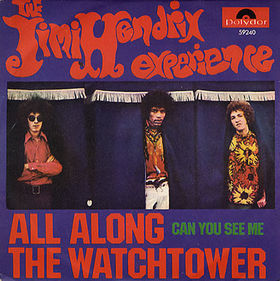
Recording began at Olympic Studios in London on a 4 track tape recorder with Experience members Mitch Mitchell on drums and Noel Redding on bass, along with Traffic guitarist Dave Mason on acoustic 12 string. On take 7, Redding, dissatisfied with how long it was taking, left for the pub and Mason took over on bass. On takes 11 and 12 Stones guitarist Brain Jones arrived at the studio drunk and insisted on playing piano. After playing poorly, he was asked to leave and Mason returned to 12 string.
Take 27 became the keeper, after which Hendrix himself added the bass. All subsequent overdubs and mixing took place at the Record Plant in New York City, first on a 12 track tape deck, then eventually on a 16 track. Rolling Stone Magazine has named “All Along The Watchtower” #47 of their 500 Greatest Songs of All Time, while Britain’s Total Guitar has it as the #1 greatest cover song of all time.
The Song
“All Along The Watchtower” is interesting in that the song is made up of a single set of chord changes that repeat over and over. There are no other sections other than three verses, and solos that occur over the same verse chord changes. On that alone you would think that this would be a boring song, but that’s not the case, thanks to a constantly changing palette of sounds. The form looks like this:
intro 1, intro 2, verse, solo, verse, solo, solo, solo, verse, outro
The lyrics are more poetry set to music than anything, which of course, is the strength of Bob Dylan. The hook “All Along The Watchtower” is stated only once at the beginning of the last verse, yet it’s such a strong image that it supersedes the other lyrics by far.
The Arrangement
The arrangement of “All Along The Watchtower” doesn’t change all that much in terms of instruments building as much as different sounding guitars entering and exiting.
The song begins with the bass, drums, and the acoustic 12 string playing the intro, which is punctuated with a vibraslap on beat 4 of every bar. Then a little twist that makes it totally interesting, and uncountable if you’re playing along, where there’s a half-beat guitar pickup going into the instrumental intro with the famous lead guitar solo line where the rest of the band enters with more intensity.
On the first verse you can feel the band pull back dynamically as the music gets less intense to make room for the vocal. A new dark sounding strumming electric guitar enters on the left channel that acts like a glue for the track, and the tambourine adds the high frequencies as it pushes it along. Also, at the end of bar 16 (half-way through the verse), the bass and rhythm guitar play the last chord as a IV chord, while the 12 string guitar plays it as a flat VII. Throughout the verse a lead guitar fills in between each vocal phrase.
During the first solo, the intensity once again builds with the drums and tambourine switching again to double time, then slightly lowering the intensity for the second verse but still staying with the double time feel. Once again, the lead guitar fills in the holes between the vocal phrases.
In the solo section, the first one is similar to the previous lead sections in intensity and clean tone of lead guitar, but the second changes to the verse feel. In that solo, the bass also changes from a loose, ad-libbed part to one that’s structured on octaves, while the slide lead guitar pans from side to side. The next solo keeps the same feel but the lead guitar changes to a wah, which again pans left to right. The last part of solo increases in intensity while the guitar changes back to a slightly overdriven Strat sound.
The last verse is identical in structure to the previous two. The outro solo section differs in that the 12 string guitar is replaced with a 6 string acoustic strumming a different, more aggressive pattern than was previously used, while the guitar and vocal ad-libs pan back and forth from left to right over the ending fade.
The arrangement elements look like this:
- The Foundation: bass and drums
- The Rhythm: 12 string acoustic guitar, 6 string acoustic at the end, tambourine
- The Pad: strummed low register electric guitar low in the mix
- The Lead: lead vocal, lead guitars
- The Fills: lead guitar
The Sound
“All Along The Watchtower” provides an interesting glimpse into the old recording world of 4 track as well as the then new world of multitrack all within the same song. You can hear the old world primarily on the drums and percussion, which were mixed in mono onto a single track. In order to make them sound stereo, they’re panned hard to the left and slightly delayed to hard right, which sounds somewhat odd as there’s a big hole in the middle as a result. This actually works to the song’s advantage as the center is filled up nicely with a number of guitars and the vocal. The tambourine, which subtly plays a big part in the song, gets the same stereo treatment as the drums. The bass is panned slightly to the left while the 12 string is panned slightly to the right.
Where the new multitrack world enters is all of the different guitars layered on the song. Virtually every solo has a different guitar sound, and there’s a very low and dark but important strummed electric guitar on the left that works as the glue to the song. On the outro the 12 string turns into 6 string acoustic.
There are a lot of effects layers in the song made up of several delays and delayed reverb. Except for the delay used to double them, the drums and tambouring are dry, but all of the other guitars have a slight delayed reverb that blends the track together well. The vocals and many of the guitars receive what sounds to be about a 350 millisecond tape delay with about three or four repeats. Since it’s tape, the frequency response is limited to begin with (most tapes used for tape delay wear out during the session from oxide shed, so the high frequencies suffer) so the delays decay seamlessly into the track.
Be sure to listen for the long reverb tail on the 12 string guitar in the intro before the vibraslap enters, and how the solos in the middle of song pan left to right and back again, but the echo still remains on the right.
The Production
“All Along The Watchtower” began as a co-production between Jimi and his manager Chas Chandler (who produced his previous two albums), but Chandler quit early in the process over Jimi’s irregular studio habits and the fact that it was taking so long to accomplish anything. Without hearing the previous takes of the song, it’s difficult to say if a better one was played before the keeper at 27, but you have to like Jimi’s instincts on keeping that one, as well as the many guitar overdubs that it took to complete the song, which was the total opposite from the quick recording of his previous records. The song has stood the test of time, and considering it’s simple form, a big reason for that can be attributed to it’s production.
Send me your requests for song analysis.
Send me your requests for song analysis.
----------------------------------
You should follow me on Twitter for daily news and updates on production and the music business.
Don't forget to check out my Music 3.0 blog for tips and tricks on navigating social media and the new music business.
Monday, March 15, 2010
12 Things You Never Knew About Jimi Hendrix

The gold standard for guitarists everywhere, Jimi was a virtuoso, but I think more because of his taste rather than his dexterity with his instrument. Regardless, he's still revered even 4 decades after passing.
This is from the "12 Things You Never Knew About Jimi Hendrix" article on Clashmusic.com, but I refined it a bit because I think the author lost the point in places, at least from a musician's point of view.
1.
Jimi Hendrix was born John Allen Hendrix, named by his mother while Jimi's father was away fighting World War II. When Al Hendrix returned from Europe, he renamed him James Marshall. It was The Animals’ bassist Chas Chandler, who became his manager, that suggested he swap James for Jimi.
2.
Jimi dropped out of high school and enlisted in the Army in May 1959, becoming a member of ‘The Screaming Eagles’ 101st Airborne Division based in Fort Campbell, Kentucky, as a trainee paratrooper. Less than a year later he received a medical discharge after breaking an ankle on his twenty-sixth parachute jump.
3.
Jimi's first electric guitar was a Supro Ozark 1560S, purchased by his dad Al.
4.
Before breaking out as an artist himself, Jimi played with several name R&B acts, including Ike And Tina Turner, Sam Cooke, The Isley Brothers, and Little Richard.
5.
Jimi agreed to follow Chas Chandler to England only if he promised to introduce him to Eric Clapton. Within forty-eight hours of his arrival, he would take to the stage for an unprecedented onstage jam with Clapton and Cream.
6.
Jimi's left-handed playing skills were much to the chagrin of his father, who believed it was a sign of the devil.
7.
Although Jimi was most identified with the Fender Stratocaster, he also played the Gibson SG, Flying V, Les Paul, and even the Fender Jazzmaster and Duo-Sonic on rare occasions.
8.
He called his music “electric church” because he believed music was his religion.
9.
The Experience Music Project in Seattle that honors Jimi was designed by famed architect Frank Gehry.
10.
Jimi and Miles Davis had agreed to do a project together, with Davis receiving an advance of $50,000. Jimi died before it happened.
11.
11.
In search of a full night’s sleep, Jimi asked his then girlfriend Monika Dannemann for some of her powerful German sedatives called Vesparax. Unaware of the half-tablet dosage, Jimi took nine. His reckless mixing of drugs and alcohol had become so commonplace the previous year that his girlfriends regularly woke up to hear him gasping and had to clear his windpipe. Sort of reminds you of Michael Jackson in a way (except for the girlfriends).
12.
His iconic performance of ‘The Star Spangled Banner’ at Woodstock in 1969 was not a symbol of national pride as everyone was led to believe, but rather a symbol of Jimi's disgust with America’s continued occupation of Vietnam. Seconds before going onstage, Jimi debated whether or not to perform the anthem, as his manager Mike Jeffrey feared it could spark a riot.
Thursday, January 21, 2010
The Making Of Dolly Dagger By Jimi Hendrix
If you read this blog much you probably know by now that I'm a sucker for "making of" videos and stories. It doesn't matter who the artist is, you can always learn something from their creative experience because each one is so unique.
Here's the making of Jimi Hendrix's Dolly Dagger from the Rainbow Bridge album. The song was never a big hit, but a "making of" really doesn't have to be. I have a little bit of a connection to Rainbow Bridge in that I was the producer and surround mixer for the DVD release, and my good friend Eddy Schreyer's (a great mastering engineer and owner of Oasis Mastering) father was the cinematographer on the film.
The video features a very young Eddie Kramer (engineer for most of Jimi's records) working on an API console and an Ampeg MM-1100 tape recorder (gear that I cut my teeth on as well), which probably dates this to about the early 70's. Eddie has also been a friend for a long time and is featured in a couple of my books. You can read an excerpt of an interview with him from The Recording Engineer's Handbook.
The video is interesting in that Eddie talks about how complicated the song is, and it really is for the time. Today, most engineer's would revel in it's simplicity, but it's still pretty interesting to see and hear how it was put together.
Here's the making of Jimi Hendrix's Dolly Dagger from the Rainbow Bridge album. The song was never a big hit, but a "making of" really doesn't have to be. I have a little bit of a connection to Rainbow Bridge in that I was the producer and surround mixer for the DVD release, and my good friend Eddy Schreyer's (a great mastering engineer and owner of Oasis Mastering) father was the cinematographer on the film.
The video features a very young Eddie Kramer (engineer for most of Jimi's records) working on an API console and an Ampeg MM-1100 tape recorder (gear that I cut my teeth on as well), which probably dates this to about the early 70's. Eddie has also been a friend for a long time and is featured in a couple of my books. You can read an excerpt of an interview with him from The Recording Engineer's Handbook.
The video is interesting in that Eddie talks about how complicated the song is, and it really is for the time. Today, most engineer's would revel in it's simplicity, but it's still pretty interesting to see and hear how it was put together.
Subscribe to:
Posts (Atom)
LinkWithin
