Get This Free Cheat Sheet Guaranteed To Help Your Next Mix

Showing posts with label touring musicians handbook. Show all posts

Wednesday, March 23, 2016

6 Auditioning Tips That Will Get You The Gig

6 Auditioning TipsIt's the dream of many musicians to get a gig with the touring band of a major artist. Here's an excerpt from my Touring Musician's Handbook that covers the 6 things to keep in mind if you want to get that gig.

"Depending on how you look at it, an audition can be really fun or so stressful that it makes you want to loose your lunch. The more prepared you are, the less likely you are to do the latter, so here are a number of things to help you through the process.

1. Know The Material
You can be a great player with chops that came from Mount Olympus, but the only thing that the artist or MD (musical director) cares about is if you can play the artist’s material well show after show. If you go into an audition thinking that you’re going to wing it, you’re wasting everyone's time, in which case you should be prepared for a very short audition.
First off, I want the person auditioning to play the music exactly like the record. I don’t want to hear them improvise, and I don’t want to hear their take on it. I want to hear them play it exactly with the right feel, just like they were playing Mozart or Beethoven. I want them to respect the music regardless of if it’s Pink’s music, or Cher’s or Janet Jackson’s, I want them to play it exactly as you hear it on the record. Then if I ask them to change it, they’re changing it from a place where I know that they know what it is so they can take their own spin on it after the fact.
Paul Mirkovich
Go-to guys like guitarist Peter Thorn (Melissa Etheridge, Chris Cornell, Jewel, Don Henley) will learn as much of the artist’s catalog possible before the audition, going as far as to dial in the tone of the parts as well. It’s a lot of work, but if you’re up against another guy that did that and you didn’t, who do you think will get the gig?
The other thing is that you have to be not only better than everyone else, but you have to be different. It’s basically a sales pitch. In five or ten minutes, you have to prove to them that if they hire you, they’ll get more for their money than hiring anybody else.
Ed Wynne
2. Don’t Be Late
This will just about eliminate you right from the start. Being late indicates that you have a reliability problem, which is the last thing anyone wants on the road. There are a lot of great players out there, and most of them are punctual and reliable. Who do you think they’re going to pick?

3. How You Look Counts
Not only does clothing and grooming make a good first impression, but it’s important to see how you visually fit on stage with the rest of the band. It’s possible to fit the bill perfectly as a player but still not get the gig because of the way you look.

As an example, an accomplished touring player that I know recently got a gig with a major artist that lasted one day. He went back to the hotel and received a call saying, “We’re good. Don’t come back to rehearsal tomorrow.” They just didn’t like the way he looked against the other players in the band.

You might get rejected because you have a shaved head and so does the artist or another player player in the band and they don’t want two people on stage with that look. Or you might have blond hair and so does the artist. Or you have facial hair and no one else in the band does. Nothing personal, sometimes you just don’t fit in.
I always felt that if someone is auditioning players that he’s not already aware of, it’s a clue that he’s looking for something else besides the way you play or the gear that you have. It’s a good tip that they may be looking more at how you look or at your age. I’ve seen that a lot.
Mike Holmes
4. Your On-stage Demeanor Also Counts
If possible, get a DVD or watch a video of the artist and her band playing live and take notice of the on-stage demeanor of the players. A lot of people get gigs because their physicality is right, which means how they look when they’re playing the music. Maybe the artist wants energy on stage and really likes it when a player is so into it that he’s moving all around. On the other hand, some artists just want you to stand there and play, leaving any showmanship up to them. You’ve got to know your place, so you have to tailor your demeanor to the artist.

5. Bring The Right Gear
You’ve got to tailor the gear to the gig. If you were auditioning for the job as the Strat player for Lynrd Skynrd, it wouldn’t be a great idea to bring a Les Paul or what some perceive as a metal guitar like a Jackson. If you were auditioning for the touring band of 50 Cent, you wouldn’t bring a drum kit with the snare tuned up high for reggae or ska. Can the artist or MD imagine how you’d play with the right gear? Sure they can. But once again, if everything were equal between two players, the one who will get the gig is the one that has the right sound at the audition. That way, no guessing, imagining or wondering come into play. Remember, what the artist wants most is security and one less thing to worry about. Whoever can provide that gets the gig.

6. Be Nice To Everyone
It’s important that you’re nice to everyone, including the crew, while you’re at the audition. If these people are going to spend months on a bus with you, they’d prefer that you didn’t have an attitude of superiority and were very easy to get along with. Remember, if it’s a toss-up between you and someone else, the one who will get the gig will be the one that everyone believes they can live with."



Wednesday, January 6, 2016

The 6 Categories Of Tours

The 6 Categories Of Tours imageIf you've never been on a real tour, it's easy to think that they're all like U2 or Alecia Keys, but there are actually a number of different types, categorized by their duration. This excerpt from The Touring Musician's Handbook outlines the differences in each.

"Tours can be divided into six general categories of duration; local shows, one-offs, fly dates, mini-tours, full tours and corporate gigs. Let’s look each one.

The Local Show
Local shows are easy. You get to sleep in your own bed, you probably have a good bit of the day (at least the morning) to attend to personal matters, and you get to play in a familiar venue in front of friends and family. You can’t really call a local show part of a tour (unless you happen to be passing through town during a real tour), but these types of shows are frequently used as a warm-up before the tour starts. It’s a good time to fine tune the set list, hone the production, and tighten the band. It’s a sweet gig, but there’s never enough of them and they’re all too short. Fun, though.

The One-Off
The one-off is a single show where you return home after it’s completion. It can be relatively local or it can be half-way around the world, but regardless of how long it takes you to get there, you’re still only playing a single show.

The typical one-off generally means that there’s at least some travel time involved (you might arbitrarily say a couple of hours) which basically means that your entire day is consumed leading up to the gig. If you can’t do much else in your day but travel, sound check and play the show, you’ve experienced a one-off.

The Fly Date
The Fly-Date is the most desirable type of one-off that you can get, and means that you’re flying on a plane out of town for the show, then directly returning either the same day or next (it might take a little longer it your gig happens to be in an exotic place). You may do a series of fly-dates, but you’re always returning back to your home base after the gig.

Acts like Aerosmith and Madonna might only do fly-dates for an entire tour, but they have private jets that can take them exactly where they need to go and bring them back to their airport hub directly afterwards without having to worry about the rigors of commercial aviation. That’s not the case for the players in a touring band, who may have to fly commercially, although it may be in business or first class.

The Mini-Tour
Anything that’s two dates to a week on the road is considered a mini-tour. This means that you’re away from home for that entire duration and don’t see your bed at home until you return. If a band from Boston books a show in New York and then returns directly home after the gig, that’s a one-off. If it books shows in Providence and New Haven on the way and doesn’t return home to Boston after either one, that’s a mini-tour.

Mini-tours are inefficient and difficult to make money on since there are are few economies of scale with labor and rentals. The bus, bus driver, techs and tour managers usually cost more since everyone would rather take a longer gig for the job security, and a short gig might get in the way of that happening. Aside from the money aspects, it is a desirable gig, since you’re not away from home for very long.

The Full Tour
Once you get past a week out on the road where you don’t return home, you’re on a full tour. Tours can range from a week to a couple of years, in the case of a major act with a hit album. If the album continues to sell, the tour will keep going in order to take advantage of the sales momentum, even returning to play the same city a second and third time.

Many touring musicians refuse to sleep at home even when a tour travels through their home town, preferring to stay in the mood and rhythm of the tour. Even though it might feel good to sleep in your own bed, it can be mentally disruptive, not to mention financially harmful since the business manager might decide that you don’t need the per diem for the day since you’ve telegraphed that you didn’t use your hotel room. It’s OK to go home to do your laundry and check in on things though.

The Corporate Gig
The corporate gig is a somewhat modern event where an artist or band plays what amounts to a private party for a corporate entity. Once upon a time this type of gig was frowned upon and deemed a “sell-out,” but as the touring business has become more mature and financially aware, the corporate gig is now the industry’s cash cow. It’s now become commonplace for a Fortune 500 company to hire superstar acts and pay them sums that exceed their normal nightly take when on tour, but much smaller acts (including many that don’t have national visibility) benefit immensely as well.

Corporate gigs are normally one-offs and fly-dates, since most are so lucrative that they’re worth playing even if the artist or band is not currently on tour."

To read additional excerpts on The Touring Musician's Handbook and my other books, check out the excerpts section of my website.

Thursday, November 26, 2015

Some Road Veteran Tips For Eating Well On Tour

Live Fast, Eat Well image
Anyone who's ever been on road even for a few dates knows how screwed up your diet can get. The inconsistent schedule can turn your eating habits upside down, which eventually will take a toll on your energy.

In this excerpt from The Touring Musician's Handbook, a number of road veterans provide some tips on the best way to eat in order to stay healthy.
------------------
"After a few weeks on the road, you start to get weary. After a couple of months, you’re constantly tired in a low level sort of way. Sure, you may be getting enough sleep, but it’s a restless, uncomfortable sleep that silently wears on every fiber of your being.

When that happens, it’s easy to give up on any health routines that you might have and just want to survive. That’s when you have to be more vigilant than ever before you slip into some nasty health-related habits that can stay with you for the rest of your life.

What To Stay Away From
One of the first things to get out of whack is your diet. Junk foods are never good for you, but they can be especially hazardous on the road.

Fast food not only can add some unwanted pounds but the added dairy products like cheese and mayonnaise can play havoc with your voice (more on that in a bit). Mayo alone can easily add 200 calories to a dish and anything with a cream sauce even more. You’re better off to ask them to hold it or put it on the side. 
The most important thing is to eat healthy, and it’s so easy not to in our situation. There are snacks and sodas around all day and you have a number of choices for meals because most (of the bigger) tours are very well catered. So you need to watch your diet and keep your weight down. A lot of guys put on weight when they go out on tour because they eat a lot at meals and eat a lot after the show.  - Terry Lawless: keyboard tech with U2
Watch your diet. That’s a big deal. I’ve seen so many guys that would go out on their first tour and come back a year later and they’d gained forty pounds. You get to the venue at about four o’clock and backstage there’s going to be catering, it’s going to be good, and you’re going to pig out. As you know, musicians are not known for their self-control.  - Mike Holmes: keyboard player for Lee Greenwood, Leroy Parnell, and Delbert McClinton
You have to stay away from eating pizza every single night, unless your twenty-five and still have the metabolism of a hummingbird (laughs). The older you get, the better shape you can keep your body and mind, the better you’re going to perform and play.
One of the things that’s great about being on the road is that you travel to great cities and you can eat a lot of great food and you can go out and party with your friends every now and then and have a really great time. But you can’t do that every night because you’re going to end up fat and lazy and not in very good shape. Eventually it will take it’s toll no matter who you are.  - Paul Mirkovich: musical director for Cher, Pink, Janet Jackson and Anastasia
Some Good Things To Eat
On the bus, apples and peanut butter on whole wheat bread is a good source of protein, carbohydrates, vitamins and roughage, and will help you save your pre diem. It’s easy to get dehydrated so drink lots and lots of water, and substitute fruit juice instead of soda whenever you can. 

Healthy alternatives like protein bars, dried fruit, trail mix and nuts are easy to take with you to snack on, and the more fresh fruit you can eat, the better.
I also take Power Bars or some kind of nutritional bar on the road with me because you can’t depend upon other people for your sustenance on the road. I’ve been stuck before when we’ve missed our flight and nobody had any money for food, so I learned never to go out on the road broke. Don’t let anyone stick you on an eight hour bus ride on a sit-up bus with no food and no water where they’re telling you, “We can’t stop because we don’t have the time. We’re going to miss sound check as it is.” While that may be true, you have to take care of yourself, so when you get on the bus, take a bottle of water and a couple of Power Bars. If they stop for lunch, great. If they don’t, you’re still covered.   - Ed Wynne: sax player for Al McKay's All Stars and formerly of The Doobie Brothers
When To Eat
The best time of the day for your biggest meal is lunch, since a light dinner works best to prepare your metabolism for the show. At lunch you usually have a great variety of dishes to choose from with a lot of healthy alternatives. 

Be on the lookout for ethnic restaurants because they usually have many healthy alternatives rich in vegetables and protein alternatives like tofu. If possible, remember to substitute brown rice for white; it’s healthier for you.

Try not to eat after the gig. The only kitchens that seem to be open late are the ones that feature deep-fried food. 

When you eat a grease-laden meal before you go to bed, there’s no chance for your body to work it off. The calories can really add up after a few nights a week of post-gig fried food gorging. If you must eat after a gig, keep it light and healthy.

Finally, take a shower whenever the opportunity presents itself, since it doesn’t come often enough."


Wednesday, June 10, 2015

What To Pack For A Tour

Packing for a tour image
When most musicians plan for a tour, the first thing they think about is the musical gear they’re going to bring. While that’s important, you have to put some thought into your personal items as well. Here's an excerpt from my Touring Musician's Handbook that looks at some of the other things to consider when packing for a tour.

What To Pack
Space is always limited so you may only be able to bring one large bag or suitcase, which determines the items that you can bring with you. Large expandable duffle bags are inexpensive and can fit a lot more than even a large suitcase or travel case (see Figure 9.1). One of the larger ones (either 32 or 36 inches) can fit a surprising amount of clothing and has multiple compartments for various items from shoes to wet articles.

Generally, the clothing you bring with you will be separated into two categories; the general category of gym, travel and sleep, and stage clothing.

General Clothing
Pack enough clothing to last a week, ten days at most. You’ll be able to do laundry at various points during the tour, but you have to have enough of everything to get you to the next laundry day. Don’t forget to bring plenty of underwear, since that’s the piece of clothing that everyone goes through quickly. The same thing applies to socks.

Generally, no matter how long I’m going out of town, I don’t take more than a week’s worth of clothes because the suitcase gets to be too heavy and then you’ll be overweight, which depending upon the kind of tour you’re on, you might end up paying yourself. I’ll take sample sizes of detergent and just wash my clothes in the sink. If you lay them in a towel and just walk across the towel a few times. The towel absorbs most of the moisture so if you hang the clothes up in the bathroom overnight, they’re generally dry in the morning with the exception of jeans.
Ed Wynne

Many road veterans prefer the feel of new socks and will purchase new socks instead of washing them when they’re on the road. While this might be a good strategy for some, don’t assume that you’ll always have the time to be able to do that. Besides, you’re trying to save some dough, right?

 I have friends who throw out socks and underwear and buy them as needed instead of doing laundry, but I’m not really into doing that.
Heather Lockie

Most of the time when we pack it’s seven pairs of black jeans and seven black shirts and maybe a couple of shirts for days off. Make sure that you can get from laundry to laundry because there’s nothing worse than wearing dirty clothes. I like to have new socks whenever I can so I’m always buying new socks. 
Terry Lawless

For your day clothes, you can get by a little longer between laundry days if you stick with basic black or anything on the dark side, which hides tiny stains well. Anything that you wear for travel should be loose fitting and comfortable, since you may spend some long hours in one position. You also want to be prepared for all types of weather, so include at least one long-sleeve and one short-sleeve shirt, and a sweater or hoodie. 

Sometimes overlooked are the clothes that you like to sleep in. Whether it’s a traditional set of pajamas or a short and tee-shirt, don’t forget to pack a couple of sets. It’s hard enough to sleep in a different or unfamiliar bed sometimes, let alone feel uncomfortable because you’re not wearing what makes you comfortable. And don’t forget those gym clothes if you work out or run.

Stagewear
Some players who are naturally hip can wear the same clothes on stage that they normally wear during the day, but others pack a few changes of stagewear. You’ll be under some bright lights and may be projected onto a big screen, so here are a couple of things to think about:
  • If you want to wear something other than basic rock n’ roll black, you’re usually better off with rich, vibrant colors, which set up well against the stage lighting.
  • Don’t wear white if you’re fair skinned because the lights can wash you out, and even worse, give you a bit of a ghostly look.
  • If you perspire a lot, silk will show off the sweat. But if silk is really your thing on-stage, make sure to wear something dark that won’t show up the sweat as much. If you do happen to get sweat stains, a little vodka can take the stains out easily (this is an old opera singer’s trick), although you might have some explaining to do to the MD.
A good trick when choosing stage clothes is to always select them under some colored lights so you can get the feeling of how they’ll look when you’re bathed in theatrical lighting on stage. Also remember that it’s an old showbiz tradition (and makes good business sense) that the star picks the first color, so if you know the way she normally prefers to dress, you should stay subordinate to that to keep the peace. And don’t forget that the shoes that you wear can sometimes be more conspicuous on stage than you think, so choose them carefully.

It’s a good idea to check with the MD or tour manager before you pack stage clothing to see if there might be a color coordination of the band to consider. For instance, one show everyone might be all black (or just black shirt) and another white. Obviously, none of the above matters much if you’re playing with an artist that requires matching stage clothes (like Tom Jones or Ricky Martin) or you’re playing in an orchestra that may be touring with an artist, since you normally dress the same."


Wednesday, April 22, 2015

6 Auditioning Tips To Get That Tour Gig

6 Audition Tips For Touring Musicians image
It's the dream of many musicians to get a gig with the touring band of a major artist, but getting the audition is a lot easier than getting the gig. Here's an excerpt from Chapter 5 ("Becoming A Touring Musician") of my Touring Musician's Handbook that provides some great audition tips from some of the top touring musicians.

"Depending on how you look at it, an audition can be really fun or so stressful that it makes you want to loose your lunch. The more prepared you are, the less likely you are to do the latter, so here are a number of things to help you through the process.

1. Know The Material
You can be a great player with chops that came from Mount Olympus, but the only thing that the artist or MD (musical director) cares about is if you can play the artist’s material well show after show. If you go into an audition thinking that you’re going to wing it, you’re wasting everyone's time, in which case you should be prepared for a very short audition.
First off, I want the person auditioning to play the music exactly like the record. I don’t want to hear them improvise, and I don’t want to hear their take on it. I want to hear them play it exactly with the right feel, just like they were playing Mozart or Beethoven. I want them to respect the music regardless of if it’s Pink’s music, or Cher’s or Janet Jackson’s, I want them to play it exactly as you hear it on the record. Then if I ask them to change it, they’re changing it from a place where I know that they know what it is so they can take their own spin on it after the fact.
Paul Mirkovich
Go-to guys like guitarist Peter Thorn (Melissa Etheridge, Chris Cornell, Jewel, Don Henley) will learn as much of the artist’s catalog possible before the audition, going as far as to dial in the tone of the parts as well. It’s a lot of work, but if you’re up against another guy that did that and you didn’t, who do you think will get the gig?
The other thing is that you have to be not only better than everyone else, but you have to be different. It’s basically a sales pitch. In five or ten minutes, you have to prove to them that if they hire you, they’ll get more for their money than hiring anybody else.
Ed Wynne
2. Don’t Be Late
This will just about eliminate you right from the start. Being late indicates that you have a reliability problem, which is the last thing anyone wants on the road. There are a lot of great players out there, and most of them are punctual and reliable. Who do you think they’re going to pick?

3. How You Look Counts
Not only does clothing and grooming make a good first impression, but it’s important to see how you visually fit on stage with the rest of the band. It’s possible to fit the bill perfectly as a player but still not get the gig because of the way you look.

As an example, an accomplished touring player that I know recently got a gig with a major artist that lasted one day. He went back to the hotel and received a call saying, “We’re good. Don’t come back to rehearsal tomorrow.” They just didn’t like the way he looked against the other players in the band.

You might get rejected because you have a shaved head and so does the artist or another player player in the band and they don’t want two people on stage with that look. Or you might have blond hair and so does the artist. Or you have facial hair and no one else in the band does. Nothing personal, sometimes you just don’t fit in.
I always felt that if someone is auditioning players that he’s not already aware of, it’s a clue that he’s looking for something else besides the way you play or the gear that you have. It’s a good tip that they may be looking more at how you look or at your age. I’ve seen that a lot.
Mike Holmes
4. Your On-stage Demeanor Also Counts
If possible, get a DVD or watch a video of the artist and her band playing live and take notice of the on-stage demeanor of the players. A lot of people get gigs because their physicality is right, which means how they look when they’re playing the music. Maybe the artist wants energy on stage and really likes it when a player is so into it that he’s moving all around. On the other hand, some artists just want you to stand there and play, leaving any showmanship up to them. You’ve got to know your place, so you have to tailor your demeanor to the artist.

5. Bring The Right Gear
You’ve got to tailor the gear to the gig. If you were auditioning for the job as the Strat player for Lynrd Skynrd, it wouldn’t be a great idea to bring a Les Paul or what some perceive as a metal guitar like a Jackson. If you were auditioning for the touring band of 50 Cent, you wouldn’t bring a drum kit with the snare tuned up high for reggae or ska. Can the artist or MD imagine how you’d play with the right gear? Sure they can. But once again, if everything were equal between two players, the one who will get the gig is the one that has the right sound at the audition. That way, no guessing, imagining or wondering come into play. Remember, what the artist wants most is security and one less thing to worry about. Whoever can provide that gets the gig.

6. Be Nice To Everyone
It’s important that you’re nice to everyone, including the crew, while you’re at the audition. If these people are going to spend months on a bus with you, they’d prefer that you didn’t have an attitude of superiority and were very easy to get along with. Remember, if it’s a toss-up between you and someone else, the one who will get the gig will be the one that everyone believes they can live with."


Tuesday, January 6, 2015

The Ins And Outs Of Road Cases

I recently received a few questions about road cases so I thought this is a good time to bring back something that I posted about few years ago. It's an excerpt from The Touring Musician's Handbook that provides a good look at the differences between popular road cases.

"For many musicians, buying road cases for their gear is sort of a right of passage. As soon as you stencil your name on the cases, it suddenly means that your stock as a musician has risen and you’ve made the jump to becoming your own brand.
While some players choose not to case up their gear in order to save money in the beginning of their touring career, they soon see the shortsightedness the first time a favorite instrument is damaged from a fall off of a ramp or loading dock. Road cases are not only worth it, but almost mandatory in that your gear always has to work, and the only way to assure that happens is to keep it protected from the frequent and many knocks of the road.
The ATA Standard
Although many cases may look similar, the sturdiest (and consequently most expensive) ones are what’s known as ATA cases. This is a design based on an airplane parts packaging specification (known as ATA 300 Category 1), developed by airline packaging engineers and certified by the Airline Transport Association. ATA 300 compliant cases are designed to withstand the rigors of being shipped a minimum of 100 times, and specifies that the case will have recessed handles that will not break during transit. The standard also details the level of quality of every piece of construction material that goes into the case, including locks, hinges, and fastening systems, and also states that all rivets and screws must be non-corrosive and all edges must be rounded and have certain level of construction quality. Because of this ATA standard, the typical road case has also come to be known by the name “flight case,” since it’s made principally to survive multiple flights.
Tip: If the road case is too heavy for a single person to carry it, it needs casters.
Types Of Road Cases
Road cases come in a lot of different styles and a lot of different materials. As a result, all road cases are not created equal. Some are great for keeping the weather off your gear, while others are built to withstand the constant battle of the road. Let’s take a look at the different types.
Fiber Cases - Fiber cases are the typical drum cases that most drummers have used some time during their life (see Figure 7.2). They’re made out of fiberglass reinforced polyester and are very strong and rugged. While they work great for the club musician or weekend warrior because they keep the scuffs and incidental scratches off of the instrument, they’re deficient for road work in several ways; there’s little or no shock mounting for the instrument, the case is closed with a nylon strap that can be cut or lost, and their irregular shape make them difficult to pack efficiently. This means they usually get tossed on the top of the evenly packed square cases in the truck where they bounce around a lot as a result. Guess what that does for the instrument? They’re also prone to caving should something very heavy be placed upon them.

Aluminum - Aluminum cases have a major advantage in being extremely light weight, and usually have a fair amount of shock absorption (see Figure 7.3) inside. That being said, they’re very easy to pierce, and should generally not be used for shipping purposes as a result. It’s possible to have an ATA standard aluminum case, but you have to use so much aluminum that you lose the weight advantage that aluminum has over other types of cases.

Carpet Cases - These are simple plywood cases with an outer fuzzy carpet material (see Figure 7.4). This type of construction once again offers little in the way of impact relief and protection. They’re heavy because the internal frame may be constructed of steel, and even though the carpet finish makes them very tough, there’s not much in the way of shock mounting. Carpet cases are great for things like cables and mic stands, but not for anything expensive that must be protected.

Molded Plastic - Some cases are made out of molded plastic (see Figure 7.5) which might be good for keeping the rain off an instrument but not much help under the repeated impacts of being loaded onto a truck. Their weakness frequently is in the latches, which can break or come loose over time, and you don’t see plastic cases in very large sizes. Once again, molded plastic cases may come in an odd enough shape that it won’t easily pack in the truck. There are ATA molded cases made, which are also mil spec for military electronic gear, but they’re really expensive and generally custom made.

Sandwiched Material - The strongest and most common road cases are the ones with sandwiched material and reinforced edges and corners (see Figure 7.6), and these can be made of different materials for different types of transit. Most sandwich-type road cases are constructed in three main layers:
  • an outer layer of a plastic-based laminate called ABS
  • a middle layer of 3/16 to ½ inch cabinet-grade plywood such as birch, poplar or maple
  • an internal shock-absorbing foam layer that corresponds to the exact shape of the instrument or piece of gear.
  • The edges of the case are reinforced with aluminum extrusion, and have steel or zinc corner pieces and recessed handles and fasteners. 
Protective Foam
There are generally two types of protective foam used in road cases. Polyurethane foam is very soft and provides a gentle cushion for any delicate item. It’s usually available in ½ inch to 10 inch thickness in ½ inch increments. The problem is that it’s so soft that it can be crushed by a heavy item, in which case a polyethylene foam is used instead. Polyethylene foam is very dense and not very flexible, and the texture is almost like plastic. Frequently it’s used under a heavy item where polyurethane would simply not last due to the constant compression. Usually you want at least a half-inch of foam between your instrument and the outer layer of the case, although most people prefer one inch for added protection.

One thing that’s mostly overlooked with road cases is that the internal foam layer can have some negative chemical interactions with the finish of your instrument that can cause it to become dull and discolored over time. Nitrocellulose lacquer (like those used on vintage guitars), varnish and shellac are much more susceptible to this than the modern polyurethane and polyester type finishes. The way to prevent any interaction from occurring is to make sure that your road cases have a cloth lining over the foam (see Figure 7.7). Some companies use a velvet-like material layer mostly for cosmetics, but it will also protect your instrument from any finish damage from the foam. If buying a custom case, a cloth covering only adds a small amount to the overall cost of the case.

Remember, if you buy good quality cases, they can last for your entire career on the road, so go for the best and don’t cheap out. 

Tip: When buying road cases, try to buy either cases already in stock at your local music store or pro audio dealer, or have them made locally. The cost of shipping them can sometimes be almost as much as the case itself. Almost every city now has a company that makes road cases, so finding one that’s local should be easy.
The good thing about ATA type road cases is that they can be repaired. Just about anything can be replaced and the case will come back as good as new. In fact, there are companies that specialize in repairing road cases like Mobil Flight Case Repair, although just about any road case manufacturer can do it."


Tuesday, September 23, 2014

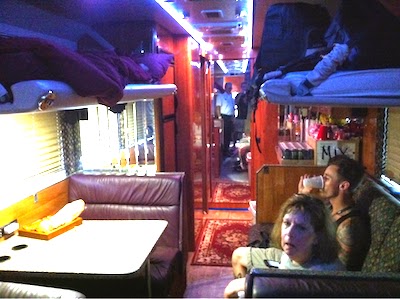
A Look At Life On A Tour Bus

On a Warped Tour bus
For most bands playing club gigs, the goal is to get popular enough to get out of the van and into a tour bus. Many musicians and techs also have a vision of going on the road with a popular act, but unless you've experienced life on a tour bus before, you'll find it's not at all like those days going from gig to gig in a station wagon.

Here's an excerpt from The Touring Musician's Handbook about life on the tour bus and the proper etiquette to use when you get there.
---------------------
"The tour bus is looked upon as the mansion on the hill. It holds a unique place in the minds of concert goers and musicians everywhere, but when it comes right down to it, it’s just a way to get a bunch of people from point A to point B as comfortably as possible. The definition of comfortable, however, is in the eye of the beholder. Let’s take a look at life on the bus.

The Bus Itself
Most tour buses are laid out the same. There’s a small front lounge, a larger rear lounge, bunks for either 8 or 12 people, a galley, and a bathroom with a shower. Most buses have a satellite television in both lounges as well as a DVD player and sound system, wireless Internet, and maybe even an X-Box or other gaming device. Many now have iPod docs as well.

The rear lounge can usually be reconfigured as a twin or queen size bed as necessary. There are multiple air conditioning zones (up to four on some buses), so there’s usually at least one area that you can find that has a temperature you’re comfortable in. The bus also has a generator so you’ll have plenty of AC power for plugging in laptops and anything else requiring external electrical juice. Most bunk areas are small, but many have a flip-down television, a DVD/CD player, and their own power outlets.

If the artist and the band share the same bus, it’s not uncommon for the artist to commandeer the rear lounge, even though it’s supposed to be for everyone (you better knock before trying to enter). Someone might even sleep back there if they’re claustrophobic in a bunk.

Life On The Bus
Because you share such tight quarters with seven to eleven other people, it’s very easy for tempers to fray. That’s why everybody has to be on their best behavior, no matter how difficult that may be. Because you can offend someone without even knowing, you have to be extra considerate of everyone on the vehicle and respect their physical space and personal belongings. Keeping yourself and your area clean and dumping the trash at every stop goes a long way to keep from setting off anyone’s phobias or quirks.
“Traveling by bus with eight other people is not something everyone can deal with.You have to have a certain type of personality to handle the intimacy and lack of privacy. The bus is close quarters, you can't walk down the aisle without bumping into someone, you can't sit alone anywhere without there being noise and a conversation, maybe someone watching a movie or listening to music. It's difficult to read because there are too many distractions and there is literally nowhere to go except to your bunk, which is about the size your coffin will be when you die. You have to be extremely cool and conscientious of others and hope they will be the same to you because it can be completely psychologically draining.”
 Sue Foley
As far as the bus goes, you never want to leave any of your stuff out in the aisle. When I started touring, they told you once to put your shoes in your bunk and if you didn’t listen, the next morning they were gone. You always want to clean up after yourself and you don’t want to go to sleep leaving your beer bottles or food out.
Walter Earl
You also have to take into consideration the opposite sex if you have a mixed male and female band. Women have different needs and a different energy from guys, which changes the dynamic of the behavior on the bus dramatically. Surprisingly, it tends to get mellower as the testosterone levels seem to decrease.
I know this is going to sound really old school but I always bring a book because sometimes when you’re on the bus with a lot people crammed in, the chances of having some kind of unpleasant discourse between band members or management or crew is pretty high. The longer you’re out, the less sleep you have, and the more you see the differences in personalities. It’s inevitable that there’s going to be a blow-up. I always want to have an escape or a self-defense to get out of those social situations which can go bad and lead you to losing your gig. Burying yourself in a book is a good way to stay out of those situations.
Ed Wynne
Is it a smoking bus, and does that bother you? How much are recreational drugs or alcohol a part of your touring life? Can you sleep on the bus? These are the things you must ask yourself before you take the gig.
TIP: Buy a cheap pair of slippers just for the bus. They’re easier to slip on and off in the tight quarters of your bunk."


----------------------------------

Tuesday, February 18, 2014

Tips For Picking Stagewear

stage lighting image
Most artists and bands pick the clothes they wear on stage rather haphazardly and never consider what they'll look like under the bright lights. Here are a few tips from The Touring Musician's Handbook on basic clothing choices that can make all the difference in how you appear to your audience.

"Some players who are naturally hip can wear the same clothes on stage that they normally wear during the day, but others pack a few changes of stagewear. You’ll be under some bright lights and may be projected onto a big screen, so here are a couple of things to think about:
  • If you want to wear something other than basic rock n’ roll black, you’re usually better off with rich, vibrant colors, which set up well against the stage lighting.
  • Don’t wear white if you’re fair skinned because the lights can wash you out, and even worse, give you a bit of a ghostly look.
  • If you perspire a lot, silk will show off the sweat. But if silk is really your thing on-stage, make sure to wear something dark that won’t show up the sweat as much. If you do happen to get sweat stains, a little vodka can take the stains out easily (this is an old opera singer’s trick), although you might have some explaining to do to the MD.
A good trick when choosing stage clothes is to always select them under some colored lights so you can get the feeling of how they’ll look when you’re bathed in theatrical lighting on stage. Also remember that it’s an old showbiz tradition (and makes good business sense) that the star picks the first color, so if you know the way she normally prefers to dress, you should stay subordinate to that to keep the peace. And don’t forget that the shoes that you wear can sometimes be more conspicuous on stage than you think, so choose them carefully.


It’s a good idea to check with the MD or tour manager before you pack stage clothing to see if there might be a color coordination of the band to consider. For instance, one show everyone might be all black (or just black shirt) and another white. Obviously, none of the above matters much if you’re playing with an artist that requires matching stage clothes (like Tom Jones or Ricky Martin) or you’re playing in an orchestra that may be touring with an artist, since you normally dress the same."

You can read additional excerpts from The Touring Engineer's Handbook and my other books on the excerpt section of bobbyowsinski.com.
----------------------------------

You should follow me on Twitter and Facebook for daily news and updates on production and the music business.

Don't forget to check out my Music 3.0 blog for tips and tricks on navigating social media and the new music business.

Tuesday, March 6, 2012

New Rules For Flying With Instruments

Flying with instrument image from Bobby Owsinski's Big Picture production blog
Musicians, engineers and anyone traveling with expensive gear can rejoice, since the restrictions on airline travel with instruments has finally been eased a bit. Earlier this month Congress finally saw the light and passed The FAA Air Transportation Modernization And Safety Improvement Act of 2012, which should lead musicians that travel to throw a party.

Here's the deal:
  • Musical instrument will now be treated exactly the same as any other luggage, for better or worse.
  • If it fits, an instrument can be stored in the overhead bin or under the seat in front of you.
  • Instruments can be checked as excess baggage at the same fee as luggage if the size and weight requirements of 150 linear inches and 165 pounds are met.
  • Musicians can purchase an extra seat for that beloved instrument that's either too large or too fragile to be set in the cargo hold.
So musicians lucky enough to do fly-dates put your hands in the air, your job has just gotten just a little easier. If you want to read more about traveling with your gear, read this excerpt from The Touring Musician's Handbook.
----------------------------------
Help support this blog. Any purchases made through our Amazon links help support this website with no cost to you.


You should follow me on Twitter for daily news and updates on production and the music business.


Don't forget to check out my Music 3.0 blog for tips and tricks on navigating social media and the new music business.

Sunday, February 19, 2012

Clapton's Guitar Tech

Here's a short interview with Jim Dickson, Eric Clapton's guitar tech of 30 years. He talks all about what it takes to be a guitar tech and the relationship with the artist that's required. Also interesting was how much the tech is required to think ahead before a particular gig or tour so he can anticipate the needs of the artist before even the artist knows them. There's a few good Clapton stories as well.

If you want to read a lot more about guitar techs and being on the road, check out some of the excerpts from The Touring Musician's Handbook on my website.


----------------------------------
Help support this blog. Any purchases made through our Amazon links help support this website with no cost to you.


You should follow me on Twitter for daily news and updates on production and the music business.


Don't forget to check out my Music 3.0 blog for tips and tricks on navigating social media and the new music business.

Wednesday, February 8, 2012

The Secret To Eating On The Road

Eat Well Boy image from Bobby Owsinski's Big Picture production blog
Anyone who's ever been on road even for a few dates knows how screwed up your diet can get. The inconsistent schedule can turn your eating habits upside down, which eventually will take a toll on your energy. In this excerpt from The Touring Musician's Handbook, a number of road veterans provide some tips on the best way to eat in order to stay healthy.
------------------
"After a few weeks on the road, you start to get weary. After a couple of months, you’re constantly tired in a low level sort of way. Sure, you may be getting enough sleep, but it’s a restless, uncomfortable sleep that silently wears on every fiber of your being. When that happens, it’s easy to give up on any health routines that you might have and just want to survive. That’s when you have to be more vigilant than ever before you slip into some nasty health-related habits that can stay with you for the rest of your life.

What To Stay Away From
One of the first things to get out of whack is your diet. Junk foods are never good for you, but they can be especially hazardous on the road. Fast food not only can add some unwanted pounds but the added dairy products like cheese and mayonnaise can play havoc with your voice (more on that in a bit). Mayo alone can easily add 200 calories to a dish and anything with a cream sauce even more. You’re better off to ask them to hold it or put it on the side. 
The most important thing is to eat healthy, and it’s so easy not to in our situation. There are snacks and sodas around all day and you have a number of choices for meals because most (of the bigger) tours are very well catered. So you need to watch your diet and keep your weight down. A lot of guys put on weight when they go out on tour because they eat a lot at meals and eat a lot after the show.   Terry Lawless: keyboard tech with U2
Watch your diet. That’s a big deal. I’ve seen so many guys that would go out on their first tour and come back a year later and they’d gained forty pounds. You get to the venue at about four o’clock and backstage there’s going to be catering, it’s going to be good, and you’re going to pig out. As you know, musicians are not known for their self-control.   Mike Holmes: keyboard player for Lee Greenwood, Leroy Parnell, and Delbert McClinton
You have to stay away from eating pizza every single night, unless your twenty-five and still have the metabolism of a hummingbird (laughs). The older you get, the better shape you can keep your body and mind, the better you’re going to perform and play.
One of the things that’s great about being on the road is that you travel to great cities and you can eat a lot of great food and you can go out and party with your friends every now and then and have a really great time. But you can’t do that every night because you’re going to end up fat and lazy and not in very good shape. Eventually it will take it’s toll no matter who you are.   Paul Mirkovich: musical director for Cher, Pink, Janet Jackson and Anastasia
Some Good Things To Eat
On the bus, apples and peanut butter on whole wheat bread is a good source of protein, carbohydrates, vitamins and roughage, and will help you save your pre diem. It’s easy to get dehydrated so drink lots and lots of water, and substitute fruit juice instead of soda whenever you can. Healthy alternatives like protein bars, dried fruit, trail mix and nuts are easy to take with you to snack on, and the more fresh fruit you can eat, the better.
I also take Power Bars or some kind of nutritional bar on the road with me because you can’t depend upon other people for your sustenance on the road. I’ve been stuck before when we’ve missed our flight and nobody had any money for food, so I learned never to go out on the road broke. Don’t let anyone stick you on an eight hour bus ride on a sit-up bus with no food and no water where they’re telling you, “We can’t stop because we don’t have the time. We’re going to miss sound check as it is.” While that may be true, you have to take care of yourself, so when you get on the bus, take a bottle of water and a couple of Power Bars. If they stop for lunch, great. If they don’t, you’re still covered.   Ed Wynne: sax player for Al McKay's All Stars and formerly of The Doobie Brothers
When To Eat
The best time of the day for your biggest meal is lunch, since a light dinner works best to prepare your metabolism for the show. At lunch you usually have a great variety of dishes to choose from with a lot of healthy alternatives. Be on the lookout for ethnic restaurants because they usually have many healthy alternatives rich in vegetables and protein alternatives like tofu. If possible, remember to substitute brown rice for white; it’s healthier for you.
Try not to eat after the gig. The only kitchens that seem to be open late are the ones that feature deep-fried food. When you eat a grease-laden meal before you go to bed, there’s no chance for your body to work it off. The calories can really add up after a few nights a week of post-gig fried food gorging. If you must eat after a gig, keep it light and healthy.

Finally, take a shower whenever the opportunity presents itself, since it doesn’t come often enough."


----------------------------------
Help support this blog. Any purchases made through our Amazon links help support this website with no cost to you.


You should follow me on Twitter for daily news and updates on production and the music business.


Don't forget to check out my Music 3.0 blog for tips and tricks on navigating social media and the new music business.


Sunday, January 8, 2012

6 Tips For Auditioning For The Tour

It's the dream of many musicians to get a gig with the touring band with a major artist. I wrote a book called The Touring Musician's Handbook that covers the ins and outs of what it takes to get that gig, so I thought it might be a good time for an excerpt. Here's a bit from Chapter 5 - "Becoming A Touring Musician."
----------------------------------

"Depending on how you look at it, an audition can be really fun or so stressful that it makes you want to loose your lunch. The more prepared you are, the less likely you are to do the latter, so here are a number of things to help you through the process.

1. Know The Material
You can be a great player with chops that came from Mount Olympus, but the only thing that the artist or MD (musical director) cares about is if you can play the artist’s material well show after show. If you go into an audition thinking that you’re going to wing it, you’re wasting everyone's time, in which case you should be prepared for a very short audition.
First off, I want the person auditioning to play the music exactly like the record. I don’t want to hear them improvise, and I don’t want to hear their take on it. I want to hear them play it exactly with the right feel, just like they were playing Mozart or Beethoven. I want them to respect the music regardless of if it’s Pink’s music, or Cher’s or Janet Jackson’s, I want them to play it exactly as you hear it on the record. Then if I ask them to change it, they’re changing it from a place where I know that they know what it is so they can take their own spin on it after the fact.
Paul Mirkovich
Go-to guys like guitarist Peter Thorn (Melissa Etheridge, Chris Cornell, Jewel, Don Henley) will learn as much of the artist’s catalog possible before the audition, going as far as to dial in the tone of the parts as well. It’s a lot of work, but if you’re up against another guy that did that and you didn’t, who do you think will get the gig?
The other thing is that you have to be not only better than everyone else, but you have to be different. It’s basically a sales pitch. In five or ten minutes, you have to prove to them that if they hire you, they’ll get more for their money than hiring anybody else.
Ed Wynne
2. Don’t Be Late
This will just about eliminate you right from the start. Being late indicates that you have a reliability problem, which is the last thing anyone wants on the road. There are a lot of great players out there, and most of them are punctual and reliable. Who do you think they’re going to pick?

3. How You Look Counts
Not only does clothing and grooming make a good first impression, but it’s important to see how you visually fit on stage with the rest of the band. It’s possible to fit the bill perfectly as a player but still not get the gig because of the way you look.

As an example, an accomplished touring player that I know recently got a gig with a major artist that lasted one day. He went back to the hotel and received a call saying, “We’re good. Don’t come back to rehearsal tomorrow.” They just didn’t like the way he looked against the other players in the band.

You might get rejected because you have a shaved head and so does the artist or another player player in the band and they don’t want two people on stage with that look. Or you might have blond hair and so does the artist. Or you have facial hair and no one else in the band does. Nothing personal, sometimes you just don’t fit in.
I always felt that if someone is auditioning players that he’s not already aware of, it’s a clue that he’s looking for something else besides the way you play or the gear that you have. It’s a good tip that they may be looking more at how you look or at your age. I’ve seen that a lot.
Mike Holmes
4. Your On-stage Demeanor Also Counts
If possible, get a DVD or watch a video of the artist and her band playing live and take notice of the on-stage demeanor of the players. A lot of people get gigs because their physicality is right, which means how they look when they’re playing the music. Maybe the artist wants energy on stage and really likes it when a player is so into it that he’s moving all around. On the other hand, some artists just want you to stand there and play, leaving any showmanship up to them. You’ve got to know your place, so you have to tailor your demeanor to the artist.

5. Bring The Right Gear
You’ve got to tailor the gear to the gig. If you were auditioning for the job as the Strat player for Lynrd Skynrd, it wouldn’t be a great idea to bring a Les Paul or what some perceive as a metal guitar like a Jackson. If you were auditioning for the touring band of 50 Cent, you wouldn’t bring a drum kit with the snare tuned up high for reggae or ska. Can the artist or MD imagine how you’d play with the right gear? Sure they can. But once again, if everything were equal between two players, the one who will get the gig is the one that has the right sound at the audition. That way, no guessing, imagining or wondering come into play. Remember, what the artist wants most is security and one less thing to worry about. Whoever can provide that gets the gig.

6. Be Nice To Everyone
It’s important that you’re nice to everyone, including the crew, while you’re at the audition. If these people are going to spend months on a bus with you, they’d prefer that you didn’t have an attitude of superiority and were very easy to get along with. Remember, if it’s a toss-up between you and someone else, the one who will get the gig will be the one that everyone believes they can live with."
To read additional excerpts from this and my other books, go to bobbyowsinski.com.
----------------------------------
Help support this blog. Any purchases made through our Amazon links help support this website with no cost to you.

You should follow me on Twitter for daily news and updates on production and the music business.

Don't forget to check out my Music 3.0 blog for tips and tricks on navigating social media and the new music business.

Monday, October 10, 2011

There's More Than One Kind Of Tour

If you've never been on a real tour, it's easy to think that they're all like U2 or Alecia Keys, but there are actually a number of different types, categorized by their duration. This excerpt from The Touring Musician's Handbook outlines the differences in each.
---------------------------

"Tours can be divided into six general categories of duration; local shows, one-offs, fly dates, mini-tours, full tours and corporate gigs. Let’s look each one.

The Local Show
Local shows are easy. You get to sleep in your own bed, you probably have a good bit of the day (at least the morning) to attend to personal matters, and you get to play in a familiar venue in front of friends and family. You can’t really call a local show part of a tour (unless you happen to be passing through town during a real tour), but these types of shows are frequently used as a warm-up before the tour starts. It’s a good time to fine tune the set list, hone the production, and tighten the band. It’s a sweet gig, but there’s never enough of them and they’re all too short. Fun, though.

The One-Off
The one-off is a single show where you return home after it’s completion. It can be relatively local or it can be half-way around the world, but regardless of how long it takes you to get there, you’re still only playing a single show.

The typical one-off generally means that there’s at least some travel time involved (you might arbitrarily say a couple of hours) which basically means that your entire day is consumed leading up to the gig. If you can’t do much else in your day but travel, sound check and play the show, you’ve experienced a one-off.

The Fly Date
The Fly-Date is the most desirable type of one-off that you can get, and means that you’re flying on a plane out of town for the show, then directly returning either the same day or next (it might take a little longer it your gig happens to be in an exotic place). You may do a series of fly-dates, but you’re always returning back to your home base after the gig.

Acts like Aerosmith and Madonna might only do fly-dates for an entire tour, but they have private jets that can take them exactly where they need to go and bring them back to their airport hub directly afterwards without having to worry about the rigors of commercial aviation. That’s not the case for the players in a touring band, who may have to fly commercially, although it may be in business or first class.

The Mini-Tour
Anything that’s two dates to a week on the road is considered a mini-tour. This means that you’re away from home for that entire duration and don’t see your bed at home until you return. If a band from Boston books a show in New York and then returns directly home after the gig, that’s a one-off. If it books shows in Providence and New Haven on the way and doesn’t return home to Boston after either one, that’s a mini-tour.

Mini-tours are inefficient and difficult to make money on since there are are few economies of scale with labor and rentals. The bus, bus driver, techs and tour managers usually cost more since everyone would rather take a longer gig for the job security, and a short gig might get in the way of that happening. Aside from the money aspects, it is a desirable gig, since you’re not away from home for very long.

The Full Tour
Once you get past a week out on the road where you don’t return home, you’re on a full tour. Tours can range from a week to a couple of years, in the case of a major act with a hit album. If the album continues to sell, the tour will keep going in order to take advantage of the sales momentum, even returning to play the same city a second and third time.

Many touring musicians refuse to sleep at home even when a tour travels through their home town, preferring to stay in the mood and rhythm of the tour. Even though it might feel good to sleep in your own bed, it can be mentally disruptive, not to mention financially harmful since the business manager might decide that you don’t need the per diem for the day since you’ve telegraphed that you didn’t use your hotel room. It’s OK to go home to do your laundry and check in on things though.

The Corporate Gig
The corporate gig is a somewhat modern event where an artist or band plays what amounts to a private party for a corporate entity. Once upon a time this type of gig was frowned upon and deemed a “sell-out,” but as the touring business has become more mature and financially aware, the corporate gig is now the industry’s cash cow. It’s now become commonplace for a Fortune 500 company to hire superstar acts and pay them sums that exceed their normal nightly take when on tour, but much smaller acts (including many that don’t have national visibility) benefit immensely as well.

Corporate gigs are normally one-offs and fly-dates, since most are so lucrative that they’re worth playing even if the artist or band is not currently on tour."

To read additional excerpts on this and my other books, check out the excerpts section of my website.
----------------------------------
Help support this blog. Any purchases made through our Amazon links help support this website with no cost to you.

You should follow me on Twitter for daily news and updates on production and the music business.

Don't forget to check out my Music 3.0 blog for tips and tricks on navigating social media and the new music business.

Sunday, September 25, 2011

Tips For Getting A Gig

I've given tips on how to get gigs both as a studio musician and on the road as a sideman in excerpts from The Studio Musician's Handbook and The Touring Musician's Handbook. Now UK session player Bob Knight provides a bit of reinforcement during a recent interview on the excellent musiccoaching.com blog.
----------------------------

"The most important thing for me, talent aside, is finding musicians that understand the music. It sounds flippant. But I’m not a fan of the gospel chops approach of playing higher, faster, louder, better. I think a lot of people don’t really grow out of that. I’ve seen so many people blow auditions by getting their chops out, because they feel that they need to prove they can play rather than just play the song. The majority of things I book are song based. So, chops aren’t that important. You need to have a  degree of facility or technique beyond the music you’re playing, but that’s kind of a given. We all studied lots of things we don’t necessarily need so they would open up our musical vocabulary.

Personally, I’m really looking for people with ears, people with a good attitude and people who go the extra mile when the paycheck doesn’t necessarily dictate that they have to. I want them to want to go that extra mile because they care about turning in a good performance. Obviously, budgets these days are a real fight. I’m also looking for people who are socially aware and know how to behave in front of an artist and with other musicians. And because I’m a drummer, I’m always looking for the feel.

From a non-musical perspective, I need people to be punctual, always. You can never be the last in the lobby. You should always strive to be the first for a bus call, a lobby call or a sound check. To turn up last, a minute before the call time and say, “I’m here on time” really isn’t good enough for me. Specific timings are set out by tour managers as the latest you can arrive, not the time you should arrive; because there’s something that can go wrong – public transport or your own private transport, etc. If people are late for me, I usually give them a three strikes option. And on the third strike, they get fired. I’ve seen it through on a couple occasions, and it’s not particularly pretty. I don’t think people think you’re actually going to do it. But in a professional environment, music can be a bit deceptive:  it feels quite social; everyone is getting on; you’re not in an office. I think sometimes people forget they’re at work, and they think they can take a lot of liberties.

Of course, maintenance of equipment and general personal hygiene, etc., as ridiculous as it sounds, are all really important. You don’t want guys coming on tour with a toothbrush and one shirt when you’re away for six weeks. But you’d be amazed."

Read the entire interview here. 
----------------------------------
Help support this blog. Any purchases made through our Amazon links help support this website with no cost to you.

You should follow me on Twitter for daily news and updates on production and the music business.

Don't forget to check out my Music 3.0 blog for tips and tricks on navigating social media and the new music business.

LinkWithin

Related Posts Plugin for WordPress, Blogger...