Get This Free Cheat Sheet Guaranteed To Help Your Next Mix

Showing posts with label Guitar Center. Show all posts

Monday, February 1, 2016

Artist Management Consultant Mike Gormley On My Latest Inner Circle Podcast

Mike Gormley imageMy guest on this week's Inner Circle Podcast is artist management consultant Mike Gormley.

Mike was head of PR for Mercury and A&M Records before he headed into management, where he worked with acts like The Bangles, Oingo Boingo, Wall of Voodoo and Danny Elfman, and now heads up LA Personal Development.

We'll discuss the differences between PR and management from the classic days of the 80s and 90s to today, and you'll hear some good war stories as well.

In the intro I'll discuss how Spotify will now stream video but not for the reasons you might think, the latest music streaming platform called Cur Music, and the latest in the labor dispute between Guitar Center and its employees.

Remember that you can find the podcast at BobbyOInnerCircle.com, or either on iTunes, Stitcher and now on Mixcloud and Google Play.

Tuesday, January 19, 2016

Guitar Center: "Sign This Or You're Fired!"

Guitar Center o,ageGuitar Center is at it again, bullying employees into signing an agreement that would strip them of the right to sue the company in class action lawsuits over wage violations, workplace discrimination and unjust firings, among other disputes, according to the Huffington Post.

Employees at the Las Vegas store were told that they had to sign the agreement by the end of Friday or their jobs would be terminated.

Arbitration is a tactic used my many big companies today to keep down the legal costs that a court case may involve during a dispute. Instead the case is referred to a third party arbitrator for settlement.

While on the surface that might seem fair, many times the arbitrator maintains a cozy relationship with the company, resulting in favorable rulings, as outlined by an article in the New York Times. The big difference here is that GC is requiring employees to sign the agreement after they've been hired, while usually the agreement is signed when they're first hired.

Keep in mind that GC is still involved in a labor dispute with the Retail, Wholesale and Department Store Union regarding 3 GC stores electing to unionize, but the company failing to reach a contract agreement with any of them. A decision hasn't been issued by the arbitrator in that case yet.

While its unclear whether Guitar Center's current actions violate a law since the court has ruled multiple ways in the past, the union is considering additional legal actions.

Things just get worse for GC employees, which means that it won't get any better for customers either.

Monday, August 3, 2015

Film And Television Composer Rich Walters On My Latest Inner Circle Podcast

Television and film composer Rich Walters image
On this episode of my Inner Circle podcast, I'm pleased to have television and film composer Rich Walters as my guest.

Rich has been nominated for 2 Emmys and and 2 Canadian Screen awards, and his most recent credits include the Sci-Fi Network show Olympus, and the feature film Chappie (with Hans Zimmer).

He'll tell us what it's like to be a composer on major projects yet live outside of Los Angeles, as well as what a music editor does, a job that many not in the post business find completely mysterious.

In the intro I'll take a look at how music sales are up all over the world, the new Soundcloud subscription service, Rode's purchase of Aphex and Guitar Center being sued by the National Labor Relations Board.

Remember that you can find the podcast at BobbyOInnerCircle.com, or either on iTunes or Stitcher.

Tuesday, May 12, 2015

More Evidence Of Big Changes Coming To Guitar Center

Guitar Center Store image
Guitar Center has been in and out of the news lately mostly thanks to Eric Garland’s excellent analysis of the company’s woeful financial state. The huge musical instrument retailer has been treading water for some time, but now it looks like it might be readying itself to finally sink.

To recap, Guitar Center was acquired in 2007 by Bain Capital, who took on a huge debt load of $1.6 billion in the process. More recently Bain’s partner Ares Management turned it’s debt into equity when Bain had trouble making payments and took over the management of GC. Suddenly there was less inventory, fewer SKUs and fewer vendors, but there was also the matter of 5 stores unionizing. Ares was allegedly very slow in negotiating a union contract with these stores and was then hit by an unfair practice charges by the Retail Workers Union to the National Labor Relations Board.

Garland has stated all along that this was a financial hole that GC could probably never crawl out of, and that at some point the company would have to declare bankruptcy and regroup. The latest evidence that this might might be in the offing comes from a new employee agreement (as seen below) that resulted in decreasing sales commissions from 10% on profit and 2% on gross down to 0.25%.

Not only that, the company has decreased the number of work hours for both salesman and managers to the point where the inside joke is that the company is at “liquidation staffing” levels. To grind the corporate heel in the salesman’s face just a little more, the company has raised the cost for employees to purchase new gear (one of the major reasons for musicians wanting to work there) by 10 to 15%. Read more on Forbes.

Tuesday, April 21, 2015

An Album Made From Guitar Center Doodlers

Guitar Center image
Anyone that's ever gone into a Guitar Center on a Saturday afternoon knows that it's a cacophony of sound. You'll hear just about every famous lick being played by mostly beginners all at the same time. It's difficult not to get a headache after about 10 minutes (I don't know how the employees stand it).

New York experimental artist Noah Wall saw the beauty of it though, and decided to record some of these musical doodlers and compile it into an album. I guess the big question here is "Why?" but you have to admit there's something oddly familiar about the recordings.

Have a listen to a track from Live At The Guitar Center below.


Friday, February 20, 2015

Eric Garland Talks Guitar Center Finances On My Latest Inner Circle Podcast

About a year ago bass player and analyst Eric Garland started a firestorm after he posted on his blog that Guitar Center's finances were a mess.

A few weeks ago he fanned the flames again after he declared that the end of the giant retailer might be closer than you think.

I'm pleased to have Eric on the podcast to discuss just how he came to those conclusions and to give us a quick lesson in financial engineering.

During the podcast intro I'll also discuss the 4 recommendations from the US Copyright Board regarding finally bringing copyright into the 21st century, as well as the new MQA audio file format.

Remember that you can find the podcast either at BobbyOInnerCircle.com, or on iTunes or Stitcher. 


Don't forget to check out my Music 3.0 blog for tips and tricks on navigating social media and the new music business.

Wednesday, February 4, 2015

A Round Of Layoffs At Guitar Center

Guitar Center image
Guitar Center has been embattled for a number of years now, and it seems like every few months some new negative news pops up that makes you not only wonder about the immediate health of the company, but of its future as well.

The latest is the announcement that 43 corporate executives and 28 field managers have been laid off, according to a leaked email from GC's new CEO Darrell Web. Among those let go include long-time GC Pro vice-president Rick Plushner.

This last bit might make a difference for all of you who regularly buy from the pro side of the company, since Pro Sound News is reporting being told that pro sales will report to the Senior Vice President of Services rather than the stores going forward. In other words, if you think buying GC is tough now, just wait until corporate gets in the middle.

I've never had particularly good luck buying from GC although I've tried, most recently about a month ago when I stopped in the Sherman Oaks store to buy a new field recorder. I wanted to make the sale quickly as I was on the run, but kept getting passed from salesman to salesman, none of whom seemed particularly interested in helping me. It was the middle of the afternoon with an almost empty store, so the employees attention wasn't exactly taken up by other customers. I bought it online instead.

Still, this move affects management, which may or not be bloated to begin with, and doesn't affect staff at the store level, at least not yet. What this means is that the remaining corporate staff now have more responsibility and work to do in the same amount of time and for the same amount of money, which is never great for efficiency.

That said, Guitar Center has a number of larger issues on its plate at the moment, like extricating itself from massive debt, an investigation by the Security and Exchange Commission, and being accused of unfair labor practices. Cutting a few executives might make the company's bottom line look a little better, but that's small fish in a big sea of problems.

Friday, October 3, 2014

Tunecore Publishing President Jamie Purpora On The Latest Inner Circle Podcast

Bobby Owsinski's Inner Circle Podcast
Jamie Purpora, Tunecore's president of publishing, is my guest on my latest Inner Circle podcast. We discuss the merits of  Tunecore publishing versus other publishers, foreign rights, and more. Jamie's a fountain of wisdom and experience when it comes to publishing, so there's a lot of great information to soak up.

In the intro, I'll discuss why more people are going into tech than music these days, as well as Guitar Center's labor dispute with employees.

Remember that you can find the podcast either on iTunes or at BobbyOInnerCircle.com, and now also on Stitcher
----------------------------------

Sunday, August 10, 2014

Guitar Center Charged With Unfair Labor Practices

Guitar Center front and dark image
We all like the convenience of Guitar Center, especially when it comes to product selection, but one of the things that most customers dislike is the service. Most floor salesman don't stay very long (especially if they're any good), and that high turnover rate leads to a generally inexperienced and sometimes inattentive and undertrained staff that can sometimes be frustratingly unhelpful.

The reason why employees don't stay very long is that they're not treated very well by the company, having to work long hours for low pay and few benefits for the "privilege" of having a day job connected to the music that they love. Even store managers have a real grind that takes over their lives.

Many thought that situation might turn around last year when three GC stores in New York, Chicago and Las Vegas won elections to become part of the Retail, Wholesale and Department Store Union (RWDSU), with two other New York stores voting against installing the union.

Now the RWDSU has filed unfair labor practice charges with the National Labor Relations Board alleging that Guitar Center has stalled in bargaining talks and attempted to punish workers who voted for union representation. The reason? Although the union was voted into the three GC stores, it has yet to reach a  collective bargaining contract with the company and seemingly has no interest in doing so.

The powerful AFL-CIO labor federation has even gotten involved and accused the company of dragging its feet as a tactic to warn other employees to back off from any attempts at unionizing.

Here's the bottom line - A strong Guitar Center is good for the entire music business, especially at the moment. Happier and better trained employees would lead to more satisfied customers and stronger sales, which once again, is good for everyone.

The company is now being run by Ares Management, who recently took over from Bain Capital, two investment firms that have demonstrated their interest more in bottom line profits at any cost rather than happy employees and customers (here's more about that in a previous post).

What we're seeing is some long-standing union busting management tactics because Ares/Bain needs to squeeze every dollar out of the company. Simply stated, both companies are very upside down in terms of their return on investment in GC, so the last thing they want to see is an increase in labor costs and benefits due to unionization. Meanwhile GC, the manufacturers, employes and customers suffer, with no glimmer of hope on the horizon.

Unfortunately, this is another lose-lose situation where no one benefits. A strong Guitar Center is currently very important to our industry, but this course of action does little in taking it there.

You can read more details here.
----------------------------------

Tuesday, April 1, 2014

Guitar Center: The Sad Story Continues

Guitar Center image
When I wrote about the financial condition of Guitar Center a while back, the post received a huge response, maybe the biggest I've ever had. Much of it came from customers who disliked the company's business style, some of it came from supporters, and a few from GC employees at various levels. Now analyst Eric Garland has written a long post on his blog on the current financial wrangling of the company that's truly an eye opener. Who thought selling guitars and amps could be this complicated?

To briefly and simply recap, GC was bought by private equity firm Bain Capital 6 years ago and has a huge billion dollar debt as a result. Ares Management, who holds much of the Bain's debt, announced at the beginning of March that it was converting its debt to equity and assuming management of GC. Since then there have been a number of announcements regarding the complex behind the scenes financial engineering to sell a number of notes to other private equity companies to raise the necessary cash to keep everything afloat and pull some money out before the whole thing implodes.

Eric discusses this in his article, and compares what's happening to the lead-up to the mortgage crisis in that the same kind of financial engineering is taking place. The deals are all complex to keep analysts and regulators from easily figuring things out, but he managed to get to the bottom of the everything thanks to the help of some extremely literate finance experts, who all seem incredulous at the situation.

Here's the bottom line. Guitar Center is owned by a bunch of Wall Street .1%ers who don't give a crap about you, the industry or music in general. It's strictly all about money, and they'll do anything to squeeze as much out of the industry before they leave it in the dust.

I really feel sorry for the manufacturers that are caught in the middle. They have to hang in there because they've geared up for the sales volume that GC brings, but I bet they're holding their collective breath that they won't get caught holding the bag when the fire sale happens.

Read Eric Garland's post, then decide where you want to make your music purchases. And no, this is not an April Fool's joke.
----------------------------------

You should follow me on Twitter and Facebook for daily news and updates on production and the music business.

Don't forget to check out my Music 3.0 blog for tips and tricks on navigating social media and the new music business.

Monday, March 3, 2014

The Beginning Of The End As Guitar Center To Be Acquired

Guitar Center image
As if one blockbuster business deal in our industry isn't enough (see my blog about Avid yesterday), today the news came from the Wall Street Journal that Guitar Center was in talks about being acquired by one of its creditors (see this post for the backstory).

It appears that Ares Management, who owns the majority of Bain Capitol's (the owner of GC) debt, is in discussions to convert the debt into equity by taking over the majority of the company.

Talk about sending shudders through the industry, this is going to change the landscape of music retail, for better or worse.

Ares wants their money, so watch as they squeeze GC by making it leaner and meaner than ever, all at the expense of the customer. If you think doing business with them now is hard, just wait until this comes down. Fewer sales people that turn over even more frequently, less stock on hand, only the latest products and no deep inventory - that's what you can expect. It'll be the way it is now, only worse, if you can imagine.

And expect to see some of your favorite small manufactures either struggle or go out of business, as GC cuts its inventory and SKU's even more. For all those companies depending upon GC for a good chunk of their business, times are about to get a lot tougher.

And we may be seeing the beginning of the end of GC, at least as we know it. Ares could just decide it wants as much money as it can get right now and liquidate it.

The good thing out of all of this could be the rise of the indie music store again. I relish the days of individual services from people who really cared.

Once again, this is a small industry filled with creative people. It's too small for a company to go public, roll up smaller companies, or grow to big box levels without the customer suffering.

I want to thank Eric Garland for his heads up on the story. He's been on top of this from the start.
----------------------------------

You should follow me on Twitter and Facebook for daily news and updates on production and the music business.

Don't forget to check out my Music 3.0 blog for tips and tricks on navigating social media and the new music business.

Sunday, January 26, 2014

Bobby O's NAMM 2014 Report - Part 1

Another NAMM show has come and went, so let me start off by saying that NAMM 2014 was very cool in a lot of ways. There were off-the-hook large crowds, which was good because the exhibition had a lot of energy and vitality, but also bad because traffic and parking were the worst I've ever experienced. One of the days it took me a half-hour just to get off the 5 Freeway onto Harbor Blvd, then another hour to park.

I spent a lot less time in the audio hall (Hall A) this year than in the past, mostly because there was a lot to see almost everywhere. That said, here are some general show observations.

I Was Busy
Bobby Owsinski and Alfred Celebrate New Books image
Bobby O and Alfred Celebrate New Books
This was probably the busiest NAMM I've had in a long time. Back to back to back meetings all day every day was pretty grueling. I did a number of "photo ops" during the show that were fun though. Here's one with the gang from Alfred Publishing. We're all holding new books of mine that made their debut at the show including Presonus StudioLive: The Official Guide, and the Deconstructed Hits series.

While at NAMM I got a call to go to CNN in Hollywood to comment on a story I wrote for Forbes about Justin Bieber breaking his brand. I think they aired at least some of it during the day (I didn't see it myself) as I saw a big spike in blog readership. Thanks, CNN!

I also did a great panel called "Getting Great Guitar Sounds" with Scott Kahn from Musicplayers.com, guitarist extraordinaire Doug Doppler, Prince engineer and old buddy Dave Hampton, and author Bill Gibson, who was the moderator. Thanks for including me, Bill!
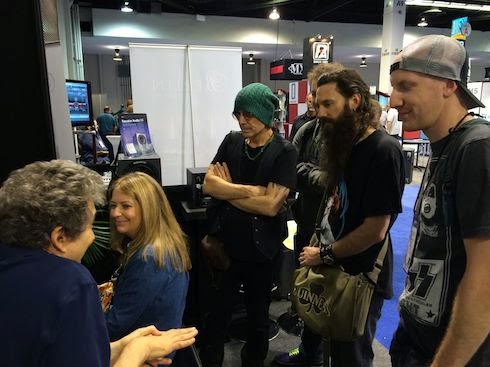
NAMM Walkabout image
Ted Kefalo from Equator, Marie-Ann, Paul, Nick, Greg and Rueben
The Walkabout
First of all, thanks to Paul, Marie-Ann, Rueben, Nick, Greg and Hovak for joining me on my tour of the audio products in Hall A on Friday. We saw a lot of company's booths and I think we all had a good time. Thanks to Brad Lunde at Transaudio Group (ATC, Drawmer, Bock), Eveanna Manley at Manley Labs, Rick Naqvi at Presonus, JD at Universal Audio, Ted Kefalo at Equator, Robby Sharf at Neumann, Dave Morrison at IsoAcoustics, Antoni Ozynski (no relation) at PSP, John Jennings at Royer, Dusty Wakeman at Mojave, and Larry Droppa at API for taking the time to tell us about your latest products.

The Mood
The general mood of the show was extremely upbeat. For the most part, manufacturers seemed to be experiencing brisk sales (although they can't officially sell at the show), and everyone I spoke with, from musicians to journalists, were experiencing busy times once more. If you haven't noticed, the economy is back, and this show proved it.

Not all manufacturers appeared to be doing well though. Peavey moved from its traditional spot in the center of Hall B to the darkest part of the second floor in a place that no one ever ventures. The result was a much less impressive booth and from what I could tell, very little traffic.

Mackie was the same. Now that it's owned by Loud Technologies, you won't even see the Mackie name mentioned, only the little running man logo. Once again, this was a company that was once in the center of things on the floor of Hall B or C, and is now relegated to a very small room on the second floor. As a matter of fact, the entrance was labeled Ampeg (which Loud also owns), so unless you were going to check out a bass amp, you wouldn't know that Mackie/Loud was even there. I sense a rebranding here with the Mackie name disappearing forever in the near future.

The Trends
This may very well be the year that software took a backseat to hardware. There were fewer software apps and a lot more boxes around, especially in the downstairs Hall E were all the small boutique manufacturers start their journey to retail. There were far fewer iOS apps than in previous years, and the ones that were were more or less expected to be attached to the hardware device they paired with. In general, that meant there's now a tighter integration of hardware and software as a single product, rather than two separate ones.

Another trend was that there were far fewer booth babes this year, which kind of defies a NAMM tradition. This was probably a good thing as I read a study were good looking women in a booth actually decreases traffic by about two-thirds.

Finally, regardless of the music that seems to hit the top 40 these days, rockers still reign supreme at NAMM. You'll see longer hair, more tattoos, more body piercing and more spandex than anywhere else at one time. I guess some things never go out of style.

The Odd
Vagina Guitars Van image
An Interesting Name Choice
I think this pictures says that all the good names for companies must be already taken. As far as I could tell, this company didn't exhibit at NAMM, but they did have a prominent parking space every day right near the convention center. It was great marketing because everybody that walked by commented, and I even saw people getting their picture taken in front of it.


Boycott GC image
It's OKTo Protest If You Have Strong Arms
And the show was not without it's share of protests. This one was generated by the fact that an inventor showed an exec at Guitar Center an idea for a pedal for a cajon, who then allegedly turned it over to Gibraltar Hardware to make. Can't say who's right here, but they had a healthy protest. Also, check out the second sign on the back right for some nice irony.

Tomorrow: The Gear Awards

----------------------------------

You should follow me on Twitter and Facebook for daily news and updates on production and the music business.

Don't forget to check out my Music 3.0 blog for tips and tricks on navigating social media and the new music business.

Wednesday, December 11, 2013

Is Guitar Center Broke?

Guitar Center Wall image
Is Guitar Center, the music store we all love to hate, going broke? It looks that way, according to a number of news stories in The Nation, Reuters, Huffington Post, and a wonderful post by Eric Garland. As many of you already know, GC was purchased by Bain Capital (formerly owned by Mitt Romney) six years ago, and it's been downhill ever since.

GC has a number of problems, not all of its making. One is that it carries a huge amount of debt as a result of the Bain deal, currently owing over $1.18 billion (yes, that's with a b). That's a lot of interest it's paying on the debt service (just think of what you pay on your credit card every month), plus it seems to have a $953 million(!!) balloon payment coming up in 2017 that's really going to stretch the company's finances to its limits.

Then there's the fact that the employees in some cities have tried to unionize, which has not only sent chills through company management, but has caused (along with other factors) the company's bonds to fall to junk status. GC tried to counter by giving its employees an extra $1.25 an hour, but that hardly seems enough to appease its poor abused workers.

Then there's the fact that GC's earnings have been essentially flat despite the upturn in the economy. Much of that has to do with the fact that GC's biggest competitor is the Internet, with musicians purchasing from Amazon, Sweetwater or even GC's own Musician's Friend. Anyone who's tried to buy something at GC knows that the process can be long and painful regardless of the size of the order, compared to the quick and easy online experience.

The big box store concept that we used to love so much has fallen on our collective disfavor lately, so we no longer look at GC as that mecca where we can see and try things not found in our local mom and pop store. Like in all parts of tech, when all things are equal, convenience always wins. With the relative commodity nature of music and audio gear these days (even with cheaper guitars and stringed instruments), we no longer have to try before we buy in many cases. We're winners when that happens, but Guitar Center may end up being the big loser.
----------------------------------

You should follow me on Twitter and Facebook for daily news and updates on production and the music business.

Don't forget to check out my Music 3.0 blog for tips and tricks on navigating social media and the new music business.

Sunday, December 30, 2012

10 Of The Biggest Stories For 2013

2013 image from Bobby Owsinski's Big Picture blog
I don't normally cross-post between my Music 3.0 music industry blog and Big Picture production blog, but the topics below apply to both. As 2012 draws to a close, now is the time to take a look at what might be ahead in 2013. Here are 10 story lines to look out for in the year ahead, in no particular order of importance. In some cases we can clearly see what might happen, while in others it's still an open question.

1. A new trend in music. In case you haven't noticed, we in living in the middle of two musical trends with EDM going mainstream and the folk-roots movement led by Mumford and Sons breaking big. Is 2013 going to be more of the same as both trends peak, or will there be something completely new that captures our attention?

2. Streaming music takes over. 2012 was a year for pushing the streaming music ball up the hill and so many people were converted. When Apple announces their plans for streaming in 2013, the ball will begin rolling down the other side of the mountain and downloads will join the ranks of the CD - still in use, but no longer the music distribution mainstay.

3. Guitar Center's decline. The king of the music equipment retailers is in trouble, with falling sales and reportedly a huge balloon payment due. Don't be surprised if you see some changes in the marketplace, with a smaller more nimble GC facing some real competition. All in all, good for the business.

4. The Big 3 provide a boost to DIY. With the Universal Music takeover of EMI now complete, we've moved to a 3 major label world. Although you still need a major to become an international superstar, will this be the year that mold is broken and we see a true DIY breakout?

5. Hi-res music comes to the forefront. Bandwidth and storage are now cheap, and in a world where we're streaming hi-res video with monetary impunity, why should we still be listening to the lowly MP3? With Apple now moving to hi-res with their Mastered for iTunes program, Neil Young's Pono (if it gets off the ground), and sites like HD Tracks, is it possible that the mass market can finally move beyond CD quality?

6. Avid's decline. Talk about a sinking ship, Avid's stock has fallen like a rock (although it's been up a little in recent days), many of their best people have jumped ship, and Pro Tools looks vulnerable for the first time in years. It will still take a lot to get the entrenched pro market to change, but the upcoming NAMM show may hold a few surprises.

7. The tablet takes control. There's no doubt that the tablet computer has taken the world by storm even to the extent that PC sales are way down. While 2012 saw a few new serious audio creation programs come to the platform, will 2013 be the year where we cross the threshold into doing serious projects on it?

8. Diminished trade show importance. With the Internet, we no longer have to go to a trade show to see what's new. With so many of the industry trade shows faltering to the point where some of the biggest manufacturers don't attend, look to see the trend continue toward irrelevance.

9. The increased importance of the Cloud. So much of our every day world now takes place in the cloud that it's almost become transparent to us. Will music creation and storage switch completely to the cloud in order to increase security and eliminate leaks? Will more online collaboration make studios even less relevant than they currently are?

10. Can the album be saved? We now live in a singles world again, and although the album hasn't totally fallen by the wayside, it's becoming less and less important all the time. Every year a new electronic form of the album enters the marketplace, but none have yet to catch on. Will 2013 be the year that a new format wins our hearts and our pocketbooks?

There are many more than these 10 issues, but I thought that these were particularly interesting to watch for, at least in the beginning of the year. As always, it will be fun to look back at this time next year to see how each story developed.

Have a very happy New Year, and may you find it profitable and fulfilling. And once again, thanks for reading!

----------------------------------

You should follow me on Twitter for daily news and updates on production and the music business.

Don't forget to check out my Music 3.0 blog for tips and tricks on navigating social media and the new music business.

Wednesday, October 17, 2012

The Money Behind Fender

Fender logo image from Bobby Owsinski's Big Picture blog
It's funny how the music economy works. In the 50's through the 70's Wall Street could care less about the music business, but when the CD came out in 1981 and the labels began to resell their catalogs at a big profit, every major label but one (BMG) was gobbled up by a conglomerate. The recorded music business hasn't been the same since.

The same thing sort of happened in the musical instrument business. When every kid bought a guitar through the 60's thanks to the popularity of the British Invasion, suddenly there was a great deal of money in that end of the business. Fender, who was the revenue leader at the time, attracted a buy-out from CBS in 1965, which eventually ended in disaster. In trying to streamline the business, Fender's quality took a dive and it took a long time for guitar players to regain confidence in the company.

What's not known is that Fender was almost out of business by 1980 and had a $10 million loss on only $40 mil of revenue, but then-president Bill Schulz organized a plan for CBS to inject some cash for a new five year product development plan. Three years later, CBS lost interest, and Schulz was able to organize a leveraged buyout for only $12.5 million, but the company was seriously bootstrapped, since it didn't even own a factory at this point. It was still a great brand though, and within 3 years, Fender was in black again.

In 2001 a private investment company, Weston Presidio, bought 50% of Fender, with the idea of eventually taking it public, which is the goal of any venture investor. That almost happened earlier this year, but it was cancelled on the eve of the initial public offering. The company was trying to raise almost $400 million, but there was so little interest from the investment community that the IPO would've looked even worse than the Facebook offering. When investors looked at the MI market, they saw it shrinking, with no room for growth and Fender's market segment saturated.

Fender isn't the only major MI company with a big venture investor though. Did you know that Mitt Romney's Bain Capitol owned Guitar Center until earlier this year? The interesting thing is that this had been a very bad investment for Bain, as they'd been losing money like crazy with GC since the buy-out. You know who owns it now? Weston Presidio! That means the same company owns both Fender and GC.

Here's the thing - the record industry was ruined by Wall Street investors, and it could happen again in the MI part of the business. The one good thing about the fact that the business is shrinking and that means it's less attractive to the Wall Street bunch now. This is a business where love of music and art comes first. It's a place where big money interests doesn't mix.

----------------------------------

You should follow me on Twitter for daily news and updates on production and the music business.

Don't forget to check out my Music 3.0 blog for tips and tricks on navigating social media and the new music business.

Monday, August 27, 2012

Judge Dismisses Suit Against GC and NAMM

Guitar Center sign from Bobby Owsinski's Big Picture production blog
Just to show how slow the wheels of justice actually move, a class action suit against NAMM, Guitar Center, Fender, Korg, Martin, Peavey and a dozen more MI vendors started in 2009 has finally been dismissed for lack of evidence.

The suit involved 38 separate plaintiffs from 15 states, and alleged that NAMM, GC and the various manufacturers conspired to raise the minimum advertised price (MAP) policies, thereby bilking musicians out of hundreds of millions of dollars in the process. What the suit basically said is that GC and the various manufacturers unlawfully restrained trade and artificially reduced competition, thereby violating the Sherman Antitrust Act.

After numerous court exchanges, the judge couldn't find any evidence to support the allegation, and threw the case out. The MI industry finally breathed a sigh of relief since the damages could have been north of $200 million, which would have really hurt in this economy.

Okay, so here's the reality as I see it. Guitar Center is definitely guilty of wanting to monopolize the MI retail business, and they've successfully done that, but not by conspiracy. They've achieved their monopoly by bullying the manufacturers. If anyone thinks that the manufacturers want to go along with GC's pricing policies, they're sorely mistaken. GC forces a manufacture to sell to them almost at a price they determine, not the manufacturer, so the only one making out in the deal is GC, not the rest of the industry.

And NAMM? The last thing they want to see is less competition, since the more market share GC gets, the less relevant they become. Bottom line, this was a misguided suit from the beginning.

That said, GC is the big winner, as always. You know you owns them? Bain Capital. Ring a bell, by any chance?
----------------------------------

You should follow me on Twitter for daily news and updates on production and the music business.

Don't forget to check out my Music 3.0 blog for tips and tricks on navigating social media and the new music business.

Thursday, September 24, 2009

Lawsuit Claims Guitar Center And NAMM Fixed Prices

According to a post on Hypebot, a nationwide class-action lawsuit has been filed against Guitar Center and the National Association of Music Merchants (NAMM) claiming the two conspired to fix retail pricing on guitars, allowing the music retail giant and other major retailers to reap higher profits and squash competition at the expense of consumers.

The suit filed earlier this week by the firm of Hagens Berman Sobol Shapiro claims that retailers met at NAMM in 2001 and voiced concerns that gross margins would erode from the then-current 27 to 32%. According to the suit, the NAMM meetings played an instrumental role in creating agreements between Guitar Center, other leading retailers and product manufacturers to impose 'resale price maintenance' agreements designed to raise and maintain retail prices and according to the complaint, the cabal's actions were successful with 2008 margins holding steady at 30%".

Although Guitar Center is truly the 800 pound gorilla of the musical instrument business and would probably love to fix prices where ever possible, I find it hard to believe that this actually happened. It's true that they fixed prices in their stores and longer have the wild "sell at any cost" policy of old, but there's no love lost between GC and it's competitors and suppliers, so any type of collusion seems remote. Still, all the facts haven't come out yet, so it will be interesting to discover more info as it becomes available.

LinkWithin

Related Posts Plugin for WordPress, Blogger...