Get This Free Cheat Sheet Guaranteed To Help Your Next Mix

Showing posts with label Tascam. Show all posts

Sunday, April 20, 2014

New Music Gear Monday: Gibson Memory Cable

Have you ever heard a lick in your head but didn't have any way to record it before it was forgotten? Gibson thinks it's come up with a solution to that dilemma with a new instrument cable it calls a "Memory Cable" that actually contains a flash audio recorder inside.

The Memory Cable records up to 13 hours of 44.1kHz/16 bit audio on a 4GB micro-SD card, either continuously or only when your playing. It uses an AA battery and a LR44 battery to work, which could be a problem, since we all know how much musicians hate to change batteries. If you run out of storage space, the Memory Cable deletes the oldest recorded material, so you're always covered when it comes to recording your latest thoughts. The engineering was done by Tascam, who have always been a leader in digital recorders and which is now owned by Gibson.

The Gibson Memory Cable is 16 feet long and costs $99. It's targeted to be available on May 15th.

I can't decide if this is a brilliant invention or an idea that's missed the boat. Anyone care to share their opinion?


----------------------------------

Monday, January 27, 2014

Bobby O's NAMM 2014 Gear Awards

This year I thought I'd change things up a bit and give out some awards out for products I liked at the Winter NAMM show. These are products that really stood out to me either as something I would personally want to use or something that's innovative. In this inaugural year of the Bobby O NAMM Awards, we have 8 winners.

Equator D8 image
Coolest Monitor Speaker Award
Equator Audio D8 - I'm already an everyday user of the Equator D5s, which are built around 5 inch dual concentric drivers. I love their sound but always wished for more bottom end. The D8's appear to have solved that problem, and sounded tremendous on the floor (the booth was at the back of the hall somewhat away from the noise so you could actually hear them a bit). They also had a potentially very useful feature for some in that the DSP could switch to the curve of an Auratone or NS-10 if desired (not that I every would, personally). Their curve was also tweaked by golden ears engineer Francis Buckley and mastering engineer Chris Bellman, so they have some of their mojo, which really made them stand out.

I actually thought I was going to give this award to the Presonus Scepter 8's, which I heard at the Presonus factory studio back in June. I loved them at the time, but they weren't set up for a serious demo at NAMM so there was no way to even remotely compare them with the D8's. Still, I'd like to hear both products side by side to see which I'd like better.

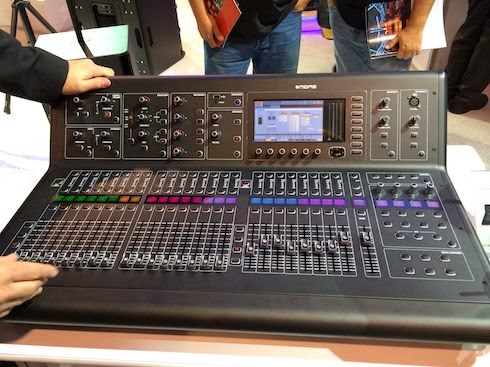
Midas M32 at NAMM 2014 image
Scariest Audio Product Award
Midas M32 Console - Midas consoles are legendary for their great audio in the live sound world, and were purchased by Behringer a few years ago. Now after undergoing a makeover in manufacturing techniques, the new M32 has arrived.

What's scary is the tremendous bang for the buck here. I mean it! I did a double take when I looked at the $4,999 price tag for a real Midas (same analog electronics, I was assured) for 40 inputs, 32 Midas mic preamps, and 25 mix buses, plus a built in stereo recorder. It's a fully digital console complete with 192kHz convertors, and it looked to be really easy to use. I had it figured out to the point where I think I could use it after only a couple of minutes, or about what it would take on an analog desk. All I can say is "Wow."

Universal Audio Apollo Twin image
Best Home Studio Product
Universal Audio Apollo Twin - The UA Apollo has been a runaway preference as a multichannel computer I/O interface since its debut, but the problem was that it was too much for many home studio owners who only need two channels. UA heard the call of that market segment and came out with the Apollo Twin, a scaled down two channel Apollo, in response.

The Apollo Twin can handle sampling rates of up to 192kHz, has two UA quality mic amps built in, and has all the same functionality as its larger Apollo brothers. Best of all, it sells for $699 for the solo core and $899 for the dual core thant can handle more of the built-in plugins in a mix. The only downside for those with legacy computers is that it's only available via a Thunderbolt connection, which should be no problem if you own a newer computer.

The Beamz at NAMM 2014 image
Coolest Controller Award 
The Beamz - This is a pretty cool controller that kind of works like a theramin but triggers loops instead. It can be connected via USB or MIDI to control either a DAW or sequencer, but it also comes with a library of instrument sounds that work together so that anyone can make music in just minutes by waving their hands. There are three packages that start from $199, including one for DJs and one dedicated to education and health care.

Tascam DR 60D at NAMM 2014 image
Coolest Camera Audio Accessory
Tascam DR 60D - If you want to add some professional audio recording to your DLSR camera, the DR 60D is just the thing. It's a 4 track recorder with a built-in mixer that's designed to closely integrate with the digital cameras of today. There's also multiple record modes, including a dual "safety" mode with lower levels so you never had to worry about those sudden overloads that sometimes happen. One of the best features is a dedicated camera output so that you also print a high-quality reference track as well. Best of all, it's a very affordable $349

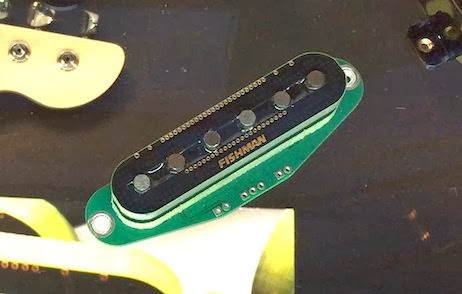
Fishman Fluence Pickup at NAMM 2014 image
Coolest Guitar Idea
Fishman Fluence Pickups - Since the beginning of the electric guitar, guitar pickups have been made pretty much the same way, with coils of wire wound around a bobbin with magnets in the middle. The Fishman Fluence changes that by having smaller winds mounted on separate layered circuit boards, which means that multiple sounds can be easily chosen externally without having to change pickups. The Fluence pickups are made in single coil or humbucker forms so that they look like the real thing and fit easily fit into the slots of a Strat or Les Paul (or guitar with humbuckers).

Line 6 Amplifi at NAMM 2014 image
Coolest Recreational Guitar Product
Line 6 Amplifi - Here's a great idea if you just want to have some fun playing guitar at home. It's a full modeling guitar amp with a couple of big twists. First of all, it's fully Bluetooth so you can send the songs from your iPad or phone to it for playback. Here's where it gets cool. There are actually two playback systems in the amp; one stereo for the song playback, and another for the guitar. But even better is the fact that the amp will determine which song is playing, go to the cloud to look at a database of sounds, and dial in the right guitar sound for you to play along with that particular song! The 75 watt Amplifi is only $399 while the 150 watt version is $499.

Manley Core Channel Strip image
Coolest Outboard Piece
Manley Core Reference Channel Strip - Manley always been known for great sounding outboard gear and the new Core channel strip is no exception. It starts with a Class A mic input into a 3 band equalizer with a sweepable midrange, into an ELOP compressor (the same one as the VoxBox), completed by a fast-attack FET limiter. Add to this a brand new switching power supply (one that actually works well for audio) and you have a very cool package perfect for any studio. At $2250, the price is right for so much power in two rack spaces.

These are the products that knocked me out. Tomorrow, some that made me scratch my head.
----------------------------------

You should follow me on Twitter and Facebook for daily news and updates on production and the music business.

Don't forget to check out my Music 3.0 blog for tips and tricks on navigating social media and the new music business.

Tuesday, January 18, 2011

NAMM 2011 Report Part 3

Here we go with Part 3 of my Winter NAMM 2011 report. Once again, the order is totally random depending upon how the pictures came up.


OK, we've tried every other material for a guitar body, how about glass? That's just what this guitar is made out of. I'd be really afraid to drop it. Looked good though.


This was the year of the iPad and iPhone accessory as they were everywhere. While iRig seemed to get all the publicity, there were probably a couple of dozen similar devices like this one from Sonoma WireWorks, although you can plug a mic simultaneously with a guitar in to it.


For you guitar players who can't get enough of fingering practice, here's a mini-neck that you can take everywhere you go.


And speaking of mini, for you bass players that just have to have that SVT sound, here's an Ampeg Micro-SVT amp and cabinet. It's small but packs a wallop with 200 watts into two 10 inch speakers.


This isn't a product, but I thought it was pretty cool. It's all 4 players of a band, each on their own individual display. It was so much more compelling than watching them all together on the same screen for some reason.


Paul Reed Smith came out with their own amp line, which sounded great in the demo. They also had one pulled apart on a bench in the their demo room. Take notice that it's point to point wiring, just the way the old Fenders and the like were made.


Tascam came out with their version of their groundbreaking Portastudio (complete with cassette tape) for the iPad. I wonder if it sounds as bad as the original?


The pickguards on these guitars change design and color about every 5 seconds. Unfortunately, the video that I took didn't come out too well. I wonder how distracting that would be for the player or the audience?


This is actually a musical device. The Reactable is a new way to make electronic music by placing different sound and control blocks on the table. It gives you instant visual feedback, but I have no idea how long it would take to really be able to make music with it.


The last part of my report will be tomorrow, and it will contain at least one significant product that I previously overlooked.


----------------------------------
You should follow me on Twitter for daily news and updates on production and the music business.

Don't forget to check out my Music 3.0 blog for tips and tricks on navigating the music business.

Sunday, February 7, 2010

The Digital Portastudio - A New Twist On An Old Friend

This post may look like a review, but it's not since I've never used the following item. It was brought about by a post on Wired regarding some products from the recent NAMM show. Nothing caught my eye except for one product that I missed at the show - Tascam's 8 track digital Portastudio.

There are few times when an obsolete product gets a successful revival and facelift to where it becomes a modern and useful version of its previous form, but Tascam has continually reinvented one of the most useful devices for a musician to ever hit the musical instrument market - the Portastudio.

Tascam invented the portable recording studio category and literally started a revolution in 1979 when it delivered it's Model 144 Portastudio, an awful sounding 4 track recorder that used cassette tape as storage. Musician's didn't care about the audio quality though, because it was the first time that they could inexpensively record multiple tracks to get an idea down or even make a demo. Despite it's limitations, artists like Bruce Springsteen, John Frusicante, Primas and Marilyn Manson managed to use the device to record material that eventually made it onto their records over the years, so maybe it wasn't as bad as everyone remembers. It was a great learning tool though.

When computers became cheap and powerful and recording software a must-have for every musician, the lowly Portastudio fell by the wayside as an entire generation became computer savvy and their desktops and laptops became their recorder. Even though Tascam continually updated the product, eventually even taking it into the digital age, it was still hardware and the musician of the day wanted to record with software.

But soon everyone discovered the limitations of the software recorder. It was sometimes unreliable, given to the quirks of the computer foundation it resided on. It certainly wasn't portable (or not as portable as we were all lead to believe), and if you ever tried to capture an idea quickly on a computer DAW, you know that the idea is usually long gone by the time the computer starts recording, thanks to any number of maddening roadblocks.

That's why I think that this new DP-08 Portastudio is so amazing. You get 8 tracks, it records on flash memory, it has a built-in stereo mic, it has a built-in reverb, and runs on AA batteries. With a price of only $300 retail, this is a device that should be a no-brainer for every musician to own just to get those musical brainstorms recorded quickly.

The DP-08 has some limitations in that it only records 2 tracks at a time and is only 16 bit, but if ever there was a must-have for an artist as a digital scratchpad, this is it. If only I had one of these 25 years ago.

Tuesday, January 19, 2010

Winter NAMM 2010 Overview - Part 3 - Audio And Recording

In the final part of the 2010 Winter NAMM overview, we take a look at the audio and recording side of things. While there were no blockbuster products again this year, there were quite a few useful boxes. Let's look at some.


First of all, SM Pro Audio lived up to their monicker of "clever audio solutions" with a variety of great boxes that were truly clever audio solutions. One of them that I really liked was the DiDock (pictured left), which featured an iPod or iPhone dock complete with balanced and unbalanced outputs with level controls and a headphone amplifier. This is the perfect box for any kind of live applications that include an "i" device. SM also had a number of other boxes that I liked including the Jackeroo all-in-one tester/generator and gender bender, and a number of volume controllers, summing amps and outboard VU meters. Every item had a really substantial feel to it and the "bang-for-the-buck factor" was very high.


And speaking of clever solutions, Lehle had a number of cool guitar-oriented pedals that solve the problem of switching between amps, guitars, pedals, or just about anything else you can think of.


Speaking of fixit boxes, Tascam came out with a number of boxes that had you thinking, "Why did this take so long to come to market" Balancing up an unbalanced line (and vice-versa) has always been a royal pain, but here were a couple of 8 channel rack-mountable boxes, about 15 years too late. Better late than never, I guess.


Tascam also featured a number of "trainer" boxes for guitar, bass and even vocals, that allow you to play or sing against existing tracks or loops, record it, slow it down, add effects, and do all the things that help you to increase your skill level fast. Once again, where was this when I really needed it?


Portable solid-state recorders were everywhere again but one of the coolest was the Xacti XPS01M (totally Japanese model number) by Sanyo.  The unit was incredibly small and light, maybe too much so since it might be easy to lose because it feels like a feather. Even so, it had a pretty nice display, enough functions to do what needs to be done, and a 150 buck price tag.


This has nothing to do with recording (at least in the traditional sense), but it seems like the  next big thing in guitar pedals is to make them look well-used. I guess this company figured that if players would pay big bucks for a beat-up "relic" guitar, they'd do the same for a "relic" pedal. It's true that the only thing that counts is how it sounds, but sometimes you just want something to look brand new so you feel like you got your money's worth for a second.


A cool device that I really liked was a plug-in battery meter that really tells you the battery strength while it's under load, which is the only way to know for sure how much life the battery has left. All you have to do with the Batt-o-meter is plug it in, although it tests batteries outside of the device as well. Good idea.


Stepping back into the recording world, Movek's myMix is a new twist on the personal headphone mixer, adding a built-in digital recorder along with virtual mixer. Up to 8 units can be connected together for 8 different mixes via ethernet and an ethernet switch. Nice form factor, but I had a little trouble navigating. From experience, the last thing a player wants is something complicated when mixing his headphones. Perhaps I didn't spend enough time with it.

For quite a few years now, the vast majority of new microphone models have been made in China. Some of the biggest microphone brands have even resorted to having some of their mics made there, or at the very least, some of the parts. Chinese manufacturers have now apparently decided that it's OK to put out their own versions of these mics, so at the show it was common to see knock-offs of Shures, Neumanns, Sennheisers and just about any other major brand you can think of. I find it hard to imagine that the IP attorneys of these companies are sitting idly by, despite the difficulties of international justice. Wanting to do my part, I started to play a game with these Chinese imitators, going on the booth and checking out the mic details closely, taking some pictures, and then covering up my badge and scurrying away when approached, giving them the illusion of some American industrial espionage. They did it to us for a long time and now deserve the return favor.


Here's another blatant example of a Mackie console rip-off from China. Once again, I hope there's a team of IP attorneys working on this. After all, these things are plenty cheap already compared to what they used to cost. At least with an American company you have some home-grown QC going on.

Enough of the rant - one last product that caught my eye. It's called Mic Check and it's used to clean and disinfect microphones. A really good idea that probably can done for a lot less money with just a typical drug store-bought handi-wipe, but give them points for the packaging.

That's it until the next trade show (NAB in April). Next post - back to our regularly scheduled program!

LinkWithin

Related Posts Plugin for WordPress, Blogger...