The iPad is becoming more and more powerful to the point where many are using it as a legitimate music creation device. Moog Music has further added to this capability with its new Animoog iPad app.
Animoog is powered by Moog's new Anisotropic Synth Engine (ASE), making it fully polyphonic and capable of dynamically moving through an X/Y timbre space.
It features a Timbre page, which provides a wide range of classic Moog synth and pedals sounds that are generated by ASE and not via sample playback.
It also features polyphonic modulation, polyphonic pitch shifting, a classic ping pong delay module, a "Thick Module" that provides bit crushing to unison voice detuning and drive, and the classic Moog 4 point filter.
That's not all. Animoog also has a Record Module that allows you to record your performance and overdub new layers on top, then transfer the recordings via the pasteboard. There's also a flexible modulation matrix, and MIDI In so Animoog can be controlled from a MIDI controller.
Moog Music's Animoog is available from the App Store for $24.99. Check out the video below for an example of Animoog at work.
Help Support This Blog
Showing posts with label iPad. Show all posts
Monday, August 31, 2015
New Music Gear Monday: Moog Music Animoog App
Labels:
Animoog,
iPad,
Moog Music,
synthesizer app,
video
Sunday, March 10, 2013
New Music Gear Monday: Focusrite iTrack Solo
As I reported to you in my recent NAMM update, one of the things that surprised me this year was how little was introduced for the iPad. Maybe it was that we all expected last year's trend to iOS to pick up steam, but it never did as predicted.
That being said, the iPad wasn't forgotten by everyone. In fact, Focusrite came out with a series of iOS interfaces that now make recording on the iPad very convenient. One of those is the iTrack Solo, which is brilliant in that it contains everything you need to turn the iPad into a real recording device.
The iTrack Solo has two inputs, one mic input and one instrument, as well as a monitor control and headphone output and zero-latency recording ability. It even comes with the proper interface cable, which always seems to be an add-on accessory with these types of devices.
Check out the movie below, which provides an overview of the device during the tracking of a song, and the iTrack Solo page on Focusrite's site.
That being said, the iPad wasn't forgotten by everyone. In fact, Focusrite came out with a series of iOS interfaces that now make recording on the iPad very convenient. One of those is the iTrack Solo, which is brilliant in that it contains everything you need to turn the iPad into a real recording device.
The iTrack Solo has two inputs, one mic input and one instrument, as well as a monitor control and headphone output and zero-latency recording ability. It even comes with the proper interface cable, which always seems to be an add-on accessory with these types of devices.
Check out the movie below, which provides an overview of the device during the tracking of a song, and the iTrack Solo page on Focusrite's site.
----------------------------------
You should follow me on Twitter for daily news and updates on production and the music business.
Don't forget to check out my Music 3.0 blog for tips and tricks on navigating social media and the new music business.
Labels:
Focusrite iTrack Solo,
iOS,
iPad,
iPad interface,
movie,
New Music Gear Monday
Sunday, January 27, 2013
NAMM 2013 Overview - Part 1
Winter NAMM in Anaheim is certainly a winter-wonderland of gear, music, friends and celebs that should be experienced at least once in a lifetime. If you've been to it more times that I'd like to admit, it's not quite the experience that it once was. That said, it's still the best way to spot trends (which is what I try to do), gauge the health of the industry, network, and catch up with old friends.
First a few NAMM bitches. The TSA-like security was at an all-time high, with rules that even many of the door attendants didn't seem to understand. Then, the cell phone communication was as troublesome as ever. And still no free wi-fi? Come on, Anaheim, it's 2013 already.
Then there was the new promenade that was created in front of the convention center between the hotels. It was great for the concerts at night (Tower of Power on Thursday night, Legends of Rock on Friday) as it seems to accomodate about 5,000 people, but it made the foot and car traffic much more difficult. And parking was harder than ever, although that was no doubt due to the 100,000+ crowds.
Okay, let's get on with some of the trends that I saw.
One of the things that was bigger than ever was controller category, with new offerings by Akai, Ableton, Livid and many more. Here's the Livid Base, which caught my eye as very cool, although the picture doesn't do it justice.
Speaking of Akai, they had some cool new products with the new streamlined MPC Studio.
Akai also got the "best idea in packaging" award for coming up with MPC Fly which is built like a laptop with the top half being an iPad dock.
It seemed like ever mic company at the show had a new USB offering. Here's the new Blue Nessie, which has a built-in EQ, limiter, desesser and even zero-latency monitoring. Very cool.
One of the things that I expected to be hot that wasn't was iPad software and accessories. Last year that was the big trend for the show, this year not so much, although Behringer had a number of products like this iS202 Docking Station. Behringer had so many new products that they've truly become a major force in the industry. Like Yamaha from about 30 years ago, they've developed into a powerhouse by making their products better and better, yet they've managed to keep the prices extremely low.
By the way, Yamaha was truly disappointing at the show, with only a minimal showing of very dated products. I don't know what that means exactly, but it's not looking good on that front.
While the iPod had some decreased traction, the iPhone had some renewed energy, with a ton of new products and accessories like mics and mic preamps similar to these offerings from Tascam.
So those are the big picture trends that I saw from the show. I was only there for 2 days and didn't see all of it, but I did get around enough and speak to enough people to get the general feel. Tomorrow we'll take a look at audio products, then we'll visit with music products, and some oddities.
First a few NAMM bitches. The TSA-like security was at an all-time high, with rules that even many of the door attendants didn't seem to understand. Then, the cell phone communication was as troublesome as ever. And still no free wi-fi? Come on, Anaheim, it's 2013 already.
Then there was the new promenade that was created in front of the convention center between the hotels. It was great for the concerts at night (Tower of Power on Thursday night, Legends of Rock on Friday) as it seems to accomodate about 5,000 people, but it made the foot and car traffic much more difficult. And parking was harder than ever, although that was no doubt due to the 100,000+ crowds.
Okay, let's get on with some of the trends that I saw.
![]() |
| The Livid Base |
![]() |
| Akai MPC Studio |
Speaking of Akai, they had some cool new products with the new streamlined MPC Studio.
![]() |
| Akai MPC Fly |
Akai also got the "best idea in packaging" award for coming up with MPC Fly which is built like a laptop with the top half being an iPad dock.
![]() |
| Blue Nessie |
It seemed like ever mic company at the show had a new USB offering. Here's the new Blue Nessie, which has a built-in EQ, limiter, desesser and even zero-latency monitoring. Very cool.
![]() |
| Behringer iS202 iPad Dock |
One of the things that I expected to be hot that wasn't was iPad software and accessories. Last year that was the big trend for the show, this year not so much, although Behringer had a number of products like this iS202 Docking Station. Behringer had so many new products that they've truly become a major force in the industry. Like Yamaha from about 30 years ago, they've developed into a powerhouse by making their products better and better, yet they've managed to keep the prices extremely low.
By the way, Yamaha was truly disappointing at the show, with only a minimal showing of very dated products. I don't know what that means exactly, but it's not looking good on that front.
![]() |
| Tascam iPhone Accessories |
So those are the big picture trends that I saw from the show. I was only there for 2 days and didn't see all of it, but I did get around enough and speak to enough people to get the general feel. Tomorrow we'll take a look at audio products, then we'll visit with music products, and some oddities.
----------------------------------
You should follow me on Twitter for daily news and updates on production and the music business.
Don't forget to check out my Music 3.0 blog for tips and tricks on navigating social media and the new music business.
Labels:
Akai,
Behringer,
iPad,
iphone recording,
NAMM 2013,
Winter NAMM
Sunday, January 20, 2013
New Music Gear Monday: Novation Launchkey
Now that the majority of us are in a in-the-box world with the DAW as the heart of our studios, we all face the issue of clutter on the desktop. Keyboard, mouse or trackball, controller, mixer - you want them all in front of you at once. The problem is there isn't enough room. Now comes the Launchkey from Novation that's about to be introduced at NAMM 2013 later this week, and it looks to be an elegant all-in-one solution to that desktop clutter.
Launchkey is an integrated work surface that features a keyboard, velocity sensitive pads, transport control, mappable faders and rotary controllers, plus iPad connectablity and apps all in one. It comes in 25, 49 and 61 key versions, and looks like it should be a great addition to any studio. Prices are a very reasonable $149, $249 and $299. Check out the video below.
----------------------------------
Launchkey is an integrated work surface that features a keyboard, velocity sensitive pads, transport control, mappable faders and rotary controllers, plus iPad connectablity and apps all in one. It comes in 25, 49 and 61 key versions, and looks like it should be a great addition to any studio. Prices are a very reasonable $149, $249 and $299. Check out the video below.
----------------------------------
You should follow me on Twitter for daily news and updates on production and the music business.
Don't forget to check out my Music 3.0 blog for tips and tricks on navigating social media and the new music business.
Thursday, November 29, 2012
Is Logic Being Discontinued?
While Pro Tools is the king of the professional DAW world, there's still a large and dedicated Logic Pro following, with many users swearing by its versatility and sound. Those users have clamored for a new upgrade, since the last version of Logic was released way back in 2009.That new version may never come, as word has leaked out of Apple Europe (where Logic development is based) that the company has let go virtually its entire Logic team except for 2 pro application specialists. Word is that there is no plan to hire anyone else, which does not bode well for the product.
A quick look on Apple's job site shows lots of audio related jobs at various spots within the company, but none related to Logic. Apple has hinted that the next big audio app in the future will be for iPad.
I hate to say it, being an Apple fanboy myself, but company does seem to be turning primarily into a consumer audio company, and little by little abandoning the pro users who stood by it during the hard times. I'm personally not a Logic user (I never could get my arms around it), but if it does disappear, I mourn its loss, since that's just another reason for a pro to look at another platform.
Apple CEO Tim Cook has promised that a new Mac Pro is in the offing (probably in January), and that will go a long way to bolster the state of the pro user at Apple. Until then, we can only wonder if all pro apps and hardware will go the way go the same way as Logic appears to be going.
Update: There's some question as to the truth to this report. Check out this post on AppleInsider, this one from Macrumors, and this one from Music Radar for more on the subject.
----------------------------------
You should follow me on Twitter for daily news and updates on production and the music business.
Don't forget to check out my Music 3.0 blog for tips and tricks on navigating social media and the new music business.
Wednesday, January 25, 2012
Is this Mackie Video Any Good?
Here's an "interesting" video on the Mackie DL1608, the new 16 channel live sound mixer built around the iPad than the company just released at the NAMM show.
I'm not sure how I feel about it personally. Is it brilliant advertising? Is it condescending to potential buyers and users? Is it funny or not? Where all these guys on acid when they created it? Maybe some of this, or none of it, I can't decide. One thing it does do is grab your attention and make you talk about the product, which is what advertising is intended to do.
What do you think?
Thanks to my buddy Steve Harvey for giving me the heads-up on this video.
You should follow me on Twitter for daily news and updates on production and the music business.
Don't forget to check out my Music 3.0 blog for tips and tricks on navigating social media and the new music business.
I'm not sure how I feel about it personally. Is it brilliant advertising? Is it condescending to potential buyers and users? Is it funny or not? Where all these guys on acid when they created it? Maybe some of this, or none of it, I can't decide. One thing it does do is grab your attention and make you talk about the product, which is what advertising is intended to do.
What do you think?
Thanks to my buddy Steve Harvey for giving me the heads-up on this video.
----------------------------------
Help support this blog. Any purchases made through our Amazon links help support this website with no cost to you.You should follow me on Twitter for daily news and updates on production and the music business.
Don't forget to check out my Music 3.0 blog for tips and tricks on navigating social media and the new music business.
Sunday, January 22, 2012
A Look At NAMM 2012 - Part 1
Another Winter NAMM show has been left behind, and once again it's time to reflect on what we've seen and heard. This year one of the things that really stood out was the enthusiasm of the exhibitors and crowd, both of which seem to indicate that the economic doldrums that we've suffered through recently may finally be in the past and better days are ahead. Most companies that I spoke with indicated that they had a solid 2011and 2012 was getting off to a better than expected start. Let's hope that continues.
Today I'll concentrate on audio gear, Tuesday on music gear, and Wednesday on oddities. Let's get down to it.
Maybe the most talked-about item at the show for those involved in audio was the Universal Audio Apollo, a multi-channel interface that also happens to come filled with all that great UA plugin DSP, as well as a rare Thunderbolt option.

Transaudio Group introduced the Sonodyne SM200Ak, a larger version of their already excellent 50 and 100 speakers. I've been using the 50's for about a month and I've got to say that it's one of the finest small desktop speaker that I've heard. Can't wait to hear the 200's for real.

Speaking of speakers, SE Munro showed studio designer Andy Munro's Egg 150 monitors. I've read a lot about the concept behind the speakers and I'm anxious to hear them for real. Unfortunately, NAMM is not the place.
Here's a company that I'm not familiar with at all, but their Airmotiv 6 monitors sounded terrific on the show floor. With so many speaker companies already in the game, it makes you wonder why another company would try to take a piece of a saturated market as well, but it seems like they may really have something here.
Speaking of speakers, you can't really hear them well unless you have some great stands, and the isoacoustics stands claim to be the best there is. I don't know about that yet, but they sure seem like they're the most adjustable.
Line 6 entered into the sound reinforcement business with an entire new line of products, including the Stagescape M20d, a mixer that has a new user interface that's almost entirely graphic. Could this be the future of consoles?
The Stagescape L3T and L3M powered speaker system and sub have a tremendous amount of features that aren't readily apparent, but they sure sounded good with music played through them. It should be interesting to see what happens with these products in the future.
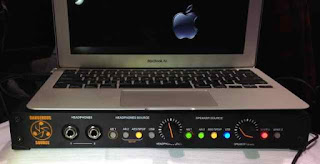
The always hi-quality Dangerous Music showed this cool monitor box. Sorry, but I lost the info on it. Wish I had one right now.
I had expected this to be a huge iPad show, expecting a ton of interfaces, peripherals and apps. There were a few, but not what I expected. The Alto Masterlink Live is a 16 channel mixer with an iPad dock. I understand that Mackie also introduced a similar product, but I never spotted it at the show.

Marshall showed a number of mics they claimed were designed for the iPad, and there were a number of devices that used the iPad as a controller, like this Pimitec personal monitor system.
This was also a headphone show. It seems like the Dr. Beats phones that have become so popular exposed a huge market that hasn't been serviced and every manufacturer now wants a piece, although it's probably now too late. Just like most mics come from one Chinese factory (737, which also had a booth at the show), I wouldn't be surprised if all the headphones came from the same place as well.
There were no shortage of blatant knock-off products at the show by Chinese manufacturers. Here's a box that looks like it comes from Shure, but they're all imitations.
And of course, so many companies believe that if they copy the look of a famous vintage microphone, that automatically makes them a "studio microphone."
One of the funniest conversations that I listened in on was with a used-car-style salesman from a new mic company relentlessly telling producer-engineer legend Ken Scott about how cheap his mics were and how much money Ken could make because the margin was so high. Ken, being the gentleman that he is, just allowed him to rant.
Tomorrow we'll look at some music instruments from NAMM.
You should follow me on Twitter for daily news and updates on production and the music business.
Don't forget to check out my Music 3.0 blog for tips and tricks on navigating social media and the new music business.
Today I'll concentrate on audio gear, Tuesday on music gear, and Wednesday on oddities. Let's get down to it.

Transaudio Group introduced the Sonodyne SM200Ak, a larger version of their already excellent 50 and 100 speakers. I've been using the 50's for about a month and I've got to say that it's one of the finest small desktop speaker that I've heard. Can't wait to hear the 200's for real.

Speaking of speakers, SE Munro showed studio designer Andy Munro's Egg 150 monitors. I've read a lot about the concept behind the speakers and I'm anxious to hear them for real. Unfortunately, NAMM is not the place.
Here's a company that I'm not familiar with at all, but their Airmotiv 6 monitors sounded terrific on the show floor. With so many speaker companies already in the game, it makes you wonder why another company would try to take a piece of a saturated market as well, but it seems like they may really have something here.
Speaking of speakers, you can't really hear them well unless you have some great stands, and the isoacoustics stands claim to be the best there is. I don't know about that yet, but they sure seem like they're the most adjustable.
Line 6 entered into the sound reinforcement business with an entire new line of products, including the Stagescape M20d, a mixer that has a new user interface that's almost entirely graphic. Could this be the future of consoles?The Stagescape L3T and L3M powered speaker system and sub have a tremendous amount of features that aren't readily apparent, but they sure sounded good with music played through them. It should be interesting to see what happens with these products in the future.
The always hi-quality Dangerous Music showed this cool monitor box. Sorry, but I lost the info on it. Wish I had one right now.
I had expected this to be a huge iPad show, expecting a ton of interfaces, peripherals and apps. There were a few, but not what I expected. The Alto Masterlink Live is a 16 channel mixer with an iPad dock. I understand that Mackie also introduced a similar product, but I never spotted it at the show.
Marshall showed a number of mics they claimed were designed for the iPad, and there were a number of devices that used the iPad as a controller, like this Pimitec personal monitor system.
This was also a headphone show. It seems like the Dr. Beats phones that have become so popular exposed a huge market that hasn't been serviced and every manufacturer now wants a piece, although it's probably now too late. Just like most mics come from one Chinese factory (737, which also had a booth at the show), I wouldn't be surprised if all the headphones came from the same place as well.
There were no shortage of blatant knock-off products at the show by Chinese manufacturers. Here's a box that looks like it comes from Shure, but they're all imitations.
One of the funniest conversations that I listened in on was with a used-car-style salesman from a new mic company relentlessly telling producer-engineer legend Ken Scott about how cheap his mics were and how much money Ken could make because the margin was so high. Ken, being the gentleman that he is, just allowed him to rant.
Tomorrow we'll look at some music instruments from NAMM.
----------------------------------
Help support this blog. Any purchases made through our Amazon links help support this website with no cost to you.You should follow me on Twitter for daily news and updates on production and the music business.
Don't forget to check out my Music 3.0 blog for tips and tricks on navigating social media and the new music business.
Labels:
iPad,
Ken Scott,
Line 6,
NAMM 2012,
Sonodyne,
Universal Audio,
Winter NAMM
Wednesday, January 18, 2012
A 48 Track DAW For The iPad
Createdigitalmusic.com recently posted an article on a full-blown 48 track DAW for the iPad that looks pretty awesome. The app comes from a new company called Auria, and isn't available quite yet, but it's features are very complete, as you can see from the following:
I expect this Winter NAMM show to be a big one for iPad apps, and as always, I'll report on everything I see. In the meantime, the Auria app is a good start.
You can read the entire article from createdigitalmusic.com here.
- "48 mono/stereo, 24-bit/44.1kHz tracks, with recording for up to 24 tracks (you’ll obviously need a USB audio interface that can do that.)
- 64-bit, double precision mix architecture (something that just came out in the latest version of Pro Tools)
- Full delay compensation
- “Vintage-inspired” channel strips, with a desktop-like UI and VU/RMS switching
- Plug-in support. Out of the gate, PSPaudioware, Overloud, Fab Filter and Drumagog all work. You need to do custom wrapping of plug-ins for this host; standard plug-ins won’t work. The format is based on VST, but it’s not VST in the traditional sense in that they have to be custom-wrapped for sale through the app.
- Dropbox, SoundCloud, AAF, MP3 export
- Advanced channel strips, EQ, expansion/compression and dynamic controls ready to go
- Convolution reverb. (This one blows my mind.)
- AAF import/export, making one definite application using this as a satellite for your desktop DAW"
I expect this Winter NAMM show to be a big one for iPad apps, and as always, I'll report on everything I see. In the meantime, the Auria app is a good start.
You can read the entire article from createdigitalmusic.com here.
Thursday, December 29, 2011
7 Music Production Predictions For 2012
It's time for some predictions for the new year. Here's what I see happening in 2012. The good part is that we'll see just how accurate I am on some of them by the end of January after the CES and NAMM shows. For a few others, we'll have to wait awhile. Here we go.
1. Tablets take off for music production. For such a relatively new class of products, tablets like the iPad have quickly become a must-have device. While we've had some great music software available for it in 2011 (Garageband is insanely good for only $5), 2012 brings us the serious I/O and accessories needed to take advantage of it's portability.
2. Plugins hit the wall. When DAWs and plugins were fairly new, pro engineers complained that they didn't sound like or as good as their hardware counterparts. I don't remember exactly when it happened, but it seemed like someone flipped a switch and the pro world not only accepted, but suddenly loved the latest batch of plugins with no reservations. Yes, plugins sound great these days but that's the problem. Where do you go from here? When all the great analog hardware is successfully digitally duplicated by multiple companies (and even surpassed in some cases), it's harder and harder to come up with something new. Add to that the fact that the market is saturated, and you'll see some software companies falling on hard times in 2012.
3. Pro Tools weathers the storm. Computers are really fast these days and Pro Tools can now operate natively and talk to hardware other than Avid's, which is why a chorus of "Why do we need Pro Tools anymore?' began to rise from DAW users everywhere in 2011. I have to admit that my new i7 iMac runs circles around my old HD1 rig for way less money. So while it may seem like this is the time when the Pro Tools hold on the audio industry is finally broken, let's not get too hasty. It's still the standard of the music and post business, and the pros (especially the big facilities) can't afford to make any changes now even if they wanted to (and they don't). If the pros use Pro Tools, than those aspiring to be pros must use it as well. We very well may see a new contender to the throne in 2012, but don't expect any big industry changes.
4. Studios make a comeback. In all the major cities, the number of major studios has dwindled in recent years to just a handful. Even these were just barely hanging on in 2010 and the beginning of 2011. That all changed during the summer, as major studios have been booked solid (and some even ahead a few months) ever since. There are a number of factors as to why this happened (some looser label budgets for one), but a big one is the re-found appreciation of what a real facility brings to the sound of project. There's just nothing like tracking and mixing in a real studio with tuned acoustics, and great mics and signal path. Finally gear owners everywhere are beginning to realize that just owning the gear isn't the key to great sounding music (although it can be if you know how to use it, so keep buying those books, please) and the benefits of recording in a real studio. Look for the trend to continue in 2012 with even some new facilities coming online.
5. SSD's are everywhere. I predicted this last year, but it was a bit premature. In 2012 you'll see the beginning of the end of the spinning mechanical hard drive and the inclusion of solid state memory in just about every newly designed piece of music gear. Add to that the fact that hard drives have actually gone up in price thanks to the recent floods in Thailand while SSDs (solid state drives) have continued to fall, and you'll find that you might have bought your last ever mechanical hard drive.
6. Apple gets into the television business. This isn't directly about music production, but it does apply in a round about way. It's been rumored for a while that Apple will be introducing their own branded television soon, and that seems inevitable at this point. The bigger rumor is the fact that the user interface is every bit as groundbreaking as just about every other Apple hardware or software product. As a result, the digital living room will finally come pass in 2012. Virtually every other product that the company has released has affected music production, from their desktops to the Macbook Pro to the iPod to the iPhone (have you heard some of the music recorded on it?) and iPad. I predict that elements of the user interface of the iTelevision (or whatever it's called) will find it's way into the gear that we use to produce music, making things simpler and easier in the process. And this will happen in 2012.
7. EDM breaks out in a big way. Electronic Dance Music is the biggest trend that the mainstream music world still doesn't know about, but not for long. 2012 will be the year that it finally breaks out, although the process started already in 2011 with the big time success of LMFAO.
Let's see how these predictions turn out. I'll have a review at the end of January to see just where we're at. In the meantime, have a happy, artistic, and musical New Year!
If you liked these predictions, you might want to check out my 12 music business predictions on my Music 3.0 blog as well.
You should follow me on Twitter for daily news and updates on production and the music business.
Don't forget to check out my Music 3.0 blog for tips and tricks on navigating social media and the new music business.
1. Tablets take off for music production. For such a relatively new class of products, tablets like the iPad have quickly become a must-have device. While we've had some great music software available for it in 2011 (Garageband is insanely good for only $5), 2012 brings us the serious I/O and accessories needed to take advantage of it's portability.
2. Plugins hit the wall. When DAWs and plugins were fairly new, pro engineers complained that they didn't sound like or as good as their hardware counterparts. I don't remember exactly when it happened, but it seemed like someone flipped a switch and the pro world not only accepted, but suddenly loved the latest batch of plugins with no reservations. Yes, plugins sound great these days but that's the problem. Where do you go from here? When all the great analog hardware is successfully digitally duplicated by multiple companies (and even surpassed in some cases), it's harder and harder to come up with something new. Add to that the fact that the market is saturated, and you'll see some software companies falling on hard times in 2012.
3. Pro Tools weathers the storm. Computers are really fast these days and Pro Tools can now operate natively and talk to hardware other than Avid's, which is why a chorus of "Why do we need Pro Tools anymore?' began to rise from DAW users everywhere in 2011. I have to admit that my new i7 iMac runs circles around my old HD1 rig for way less money. So while it may seem like this is the time when the Pro Tools hold on the audio industry is finally broken, let's not get too hasty. It's still the standard of the music and post business, and the pros (especially the big facilities) can't afford to make any changes now even if they wanted to (and they don't). If the pros use Pro Tools, than those aspiring to be pros must use it as well. We very well may see a new contender to the throne in 2012, but don't expect any big industry changes.
4. Studios make a comeback. In all the major cities, the number of major studios has dwindled in recent years to just a handful. Even these were just barely hanging on in 2010 and the beginning of 2011. That all changed during the summer, as major studios have been booked solid (and some even ahead a few months) ever since. There are a number of factors as to why this happened (some looser label budgets for one), but a big one is the re-found appreciation of what a real facility brings to the sound of project. There's just nothing like tracking and mixing in a real studio with tuned acoustics, and great mics and signal path. Finally gear owners everywhere are beginning to realize that just owning the gear isn't the key to great sounding music (although it can be if you know how to use it, so keep buying those books, please) and the benefits of recording in a real studio. Look for the trend to continue in 2012 with even some new facilities coming online.
5. SSD's are everywhere. I predicted this last year, but it was a bit premature. In 2012 you'll see the beginning of the end of the spinning mechanical hard drive and the inclusion of solid state memory in just about every newly designed piece of music gear. Add to that the fact that hard drives have actually gone up in price thanks to the recent floods in Thailand while SSDs (solid state drives) have continued to fall, and you'll find that you might have bought your last ever mechanical hard drive.
6. Apple gets into the television business. This isn't directly about music production, but it does apply in a round about way. It's been rumored for a while that Apple will be introducing their own branded television soon, and that seems inevitable at this point. The bigger rumor is the fact that the user interface is every bit as groundbreaking as just about every other Apple hardware or software product. As a result, the digital living room will finally come pass in 2012. Virtually every other product that the company has released has affected music production, from their desktops to the Macbook Pro to the iPod to the iPhone (have you heard some of the music recorded on it?) and iPad. I predict that elements of the user interface of the iTelevision (or whatever it's called) will find it's way into the gear that we use to produce music, making things simpler and easier in the process. And this will happen in 2012.
7. EDM breaks out in a big way. Electronic Dance Music is the biggest trend that the mainstream music world still doesn't know about, but not for long. 2012 will be the year that it finally breaks out, although the process started already in 2011 with the big time success of LMFAO.
Let's see how these predictions turn out. I'll have a review at the end of January to see just where we're at. In the meantime, have a happy, artistic, and musical New Year!
If you liked these predictions, you might want to check out my 12 music business predictions on my Music 3.0 blog as well.
----------------------------------
Help support this blog. Any purchases made through our Amazon links help support this website with no cost to you.You should follow me on Twitter for daily news and updates on production and the music business.
Don't forget to check out my Music 3.0 blog for tips and tricks on navigating social media and the new music business.
Labels:
Garageband,
iPad,
plugins,
predictions for 2012,
Pro Tools,
SSD
Tuesday, December 27, 2011
Looking At Last Year's Predictions
![]() |
| Dr. Beverly Crusher From Star Trek TNG |
1) The end of the mechanical magnetic hard drive. I believe that 2011 will be the tipping point for the decline of the hard drive. In 2010 we saw most computer manufacturers offer solid state drives as options, but what's most telling is the fact that both internal and external hard drive prices are dropping like a rock (you can get a 2G drive for less than 80 bucks right now), which means that the drive manufacturers can see the writing on the wall. Just watch what happens in the new year as people discover the beauty of solid state memory.
I missed on this one, but perhaps the prediction was just a bit premature. It's true that solid state drives (SSD's) made a big penetration into the market in 2011, but I think the big growth will actually happen in 2012, thanks to the recent flooding in Thailand which knocked out all of the plants make traditional mechanical drives. Tried to buy a hard drive lately? They're about twice as much as they were, which now makes SSD's a reasonable alternative. The high storage capacities aren't there yet, but it will be all over once that happens, with SSDs in all of our gear forever.
2) The tablet really takes off and becomes the predominant computing device. And speaking of solid state memory, I think the time has come for the whole idea of a tablet as a computer. You know what convinced me? I was watching an episode of vintage Captain Picard Star Trek Next Generation
I hit a home run on this one. Everyone who owns or uses a tablet computer (especially an iPad) doesn't know how they got along without one.
3) The connected TV will gain traction. I know, it's not looking too good right now, with Samsung's Google television looking like a bust and Apple TV
Okay, this one didn't happen either, and even took a step backwards in 2011. That doesn't mean that TVs won't eventually be connected. All it will take is the rumored Apple Television (the iTV?) to hit the stores and our living rooms will change forever.
4) 3D will have a big impact on the music business. Wait, I can't believe I'm saying that. Up until yesterday I was firmly convinced that 3D was surround sound all over again; basically a parlor trick that would never make it, at least until you didn't need glasses to view it. Yesterday I had my mind opened up, blown, and to put it bluntly, totally changed (how often does that happen?). The whole trick with 3D is that it has to be done technically well (something that doesn't occur that often, it turns out), and the production and post-production methods have to have a totally different approach. Yes, I've seen the future and I'll report more in depth on it as the new year dawns next week.
Boy, I was way off with this. I still believe that 3D will be a boon for music as soon as people are exposed to it. The rumored Apple Television is supposedly 3D as is the next iPad, and that might have a big bearing when all this happens. Trust me on this one - 3D will change how we enjoy music!
So one prediction came true and the other 3 we'll still have to wait and see about. All in all, it just makes looking forward to our electronic future that much better.
----------------------------------
You should follow me on Twitter for daily news and updates on production and the music business.
Don't forget to check out my Music 3.0 blog for tips and tricks on navigating social media and the new music business.
Tuesday, January 18, 2011
NAMM 2011 Report Part 3
Here we go with Part 3 of my Winter NAMM 2011 report. Once again, the order is totally random depending upon how the pictures came up.
OK, we've tried every other material for a guitar body, how about glass? That's just what this guitar is made out of. I'd be really afraid to drop it. Looked good though.
This was the year of the iPad and iPhone accessory as they were everywhere. While iRig seemed to get all the publicity, there were probably a couple of dozen similar devices like this one from Sonoma WireWorks, although you can plug a mic simultaneously with a guitar in to it.
For you guitar players who can't get enough of fingering practice, here's a mini-neck that you can take everywhere you go.
And speaking of mini, for you bass players that just have to have that SVT sound, here's an Ampeg Micro-SVT amp and cabinet
. It's small but packs a wallop with 200 watts into two 10 inch speakers.
This isn't a product, but I thought it was pretty cool. It's all 4 players of a band, each on their own individual display. It was so much more compelling than watching them all together on the same screen for some reason.
Paul Reed Smith came out with their own amp line, which sounded great in the demo. They also had one pulled apart on a bench in the their demo room. Take notice that it's point to point wiring, just the way the old Fenders and the like were made.
The pickguards on these guitars change design and color about every 5 seconds. Unfortunately, the video that I took didn't come out too well. I wonder how distracting that would be for the player or the audience?
This is actually a musical device. The Reactable is a new way to make electronic music by placing different sound and control blocks on the table. It gives you instant visual feedback, but I have no idea how long it would take to really be able to make music with it.
The last part of my report will be tomorrow, and it will contain at least one significant product that I previously overlooked.
OK, we've tried every other material for a guitar body, how about glass? That's just what this guitar is made out of. I'd be really afraid to drop it. Looked good though.This was the year of the iPad and iPhone accessory as they were everywhere. While iRig seemed to get all the publicity, there were probably a couple of dozen similar devices like this one from Sonoma WireWorks, although you can plug a mic simultaneously with a guitar in to it.
For you guitar players who can't get enough of fingering practice, here's a mini-neck that you can take everywhere you go.
And speaking of mini, for you bass players that just have to have that SVT sound, here's an Ampeg Micro-SVT amp and cabinet
This isn't a product, but I thought it was pretty cool. It's all 4 players of a band, each on their own individual display. It was so much more compelling than watching them all together on the same screen for some reason.
Paul Reed Smith came out with their own amp line, which sounded great in the demo. They also had one pulled apart on a bench in the their demo room. Take notice that it's point to point wiring, just the way the old Fenders and the like were made.
Tascam came out with their version of their groundbreaking Portastudio (complete with cassette tape) for the iPad. I wonder if it sounds as bad as the original?
The pickguards on these guitars change design and color about every 5 seconds. Unfortunately, the video that I took didn't come out too well. I wonder how distracting that would be for the player or the audience?
This is actually a musical device. The Reactable is a new way to make electronic music by placing different sound and control blocks on the table. It gives you instant visual feedback, but I have no idea how long it would take to really be able to make music with it.
The last part of my report will be tomorrow, and it will contain at least one significant product that I previously overlooked.
----------------------------------
You should follow me on Twitter for daily news and updates on production and the music business.
Don't forget to check out my Music 3.0 blog for tips and tricks on navigating the music business.
Help support this blog. Any purchases made through our Amazon links help support this website with no cost to you.
Labels:
iPad,
iPhone,
Paul Reed Smith,
Tascam,
Winter NAMM
Wednesday, December 29, 2010
4 Random Predictions For 2011
This is the week for predictions for the future, so I'll give you mine for 2011. These are rather random in that they're not all directly about music or production, but they are related in some way. Here we go.
1) The end of the mechanical magnetic hard drive. I believe that 2011 will be the tipping point for the decline of the hard drive. In 2010 we saw most computer manufacturers offer solid state drives as options, but what's most telling is the fact that both internal and external hard drive prices are dropping like a rock (you can get a 2G drive for less than 80 bucks right now), which means that the drive manufacturers can see the writing on the wall. Just watch what happens in the new year as people discover the beauty of solid state memory.
2) The tablet really takes off and becomes the predominant computing device. And speaking of solid state memory, I think the time has come for the whole idea of a tablet as a computer. You know what convinced me? I was watching an episode of vintage Captain Picard Star Trek Next Generation
the other night, and tablets played a big, yet subtle role. Everyone had one, they pass them back and forth to each other, and it's such a natural thing to have and use. So many of the most useful gadgets start out as elements of science fiction only to become reality when the technology catches up. Guess what, in the case of the tablet, it finally has. Watch as we leave our laptops behind.
3) The connected TV will gain traction. I know, it's not looking too good right now, with Samsung's Google television looking like a bust and Apple TV
selling well but not setting any records. But hear me out on this. The state of the cable set-top box is still seated so far in the 1990's that I'm honestly surprised that cable subscribers aren't rioting with pitchforks and Molotov cocktails outside the company headquarters. I'm on my fourth piece-of-crap box from "Un-Scientific Atlanta" that works so badly that they should be ashamed to even have it on the market. And the cable companies still treat any kind of interactivity as if it was some sort of science fiction. Wait a minute - it was - in 1979!! Believe me, people want their TV's to be connected. Just don't wait on the cable companies to figure it out though (that's a sure recipe for disaster). In 2011, someone (probably Apple) finally will.
4) 3D will have a big impact on the music business. Wait, I can't believe I'm saying that. Up until yesterday I was firmly convinced that 3D was surround sound all over again; basically a parlor trick that would never make it, at least until you didn't need glasses to view it. Yesterday I had my mind opened up, blown, and to put it bluntly, totally changed (how often does that happen?). The whole trick with 3D is that it has to be done technically well (something that doesn't occur that often, it turns out), and the production and post-production methods have to have a totally different approach. Yes, I've seen the future and I'll report more in depth on it as the new year dawns next week.
1) The end of the mechanical magnetic hard drive. I believe that 2011 will be the tipping point for the decline of the hard drive. In 2010 we saw most computer manufacturers offer solid state drives as options, but what's most telling is the fact that both internal and external hard drive prices are dropping like a rock (you can get a 2G drive for less than 80 bucks right now), which means that the drive manufacturers can see the writing on the wall. Just watch what happens in the new year as people discover the beauty of solid state memory.
2) The tablet really takes off and becomes the predominant computing device. And speaking of solid state memory, I think the time has come for the whole idea of a tablet as a computer. You know what convinced me? I was watching an episode of vintage Captain Picard Star Trek Next Generation
3) The connected TV will gain traction. I know, it's not looking too good right now, with Samsung's Google television looking like a bust and Apple TV
4) 3D will have a big impact on the music business. Wait, I can't believe I'm saying that. Up until yesterday I was firmly convinced that 3D was surround sound all over again; basically a parlor trick that would never make it, at least until you didn't need glasses to view it. Yesterday I had my mind opened up, blown, and to put it bluntly, totally changed (how often does that happen?). The whole trick with 3D is that it has to be done technically well (something that doesn't occur that often, it turns out), and the production and post-production methods have to have a totally different approach. Yes, I've seen the future and I'll report more in depth on it as the new year dawns next week.
----------------------------------
You should follow me on Twitter for daily news and updates on production and the music business.
Don't forget to check out my Music 3.0 blog for tips and tricks on navigating the music business.
Wednesday, November 17, 2010
Music And The iPad
Apple's iPad is still relatively new, but already there are a number of great music related apps available as recently outlined in an article on createdigitalmusic.com.
There were so many, in fact, that I would surely overlook a lot of worthy apps if I only posted some of them, so it's best to read the entire article yourself. Here's a summary of the iPad functions from the article.
-----------------------------------------
There were so many, in fact, that I would surely overlook a lot of worthy apps if I only posted some of them, so it's best to read the entire article yourself. Here's a summary of the iPad functions from the article.
-----------------------------------------
Computing is enough a part of our culture and life that it’s bound to be wrapped up in political, ideological, artistic, and economic issues. But let me be clear: many of the dimensions on which one would judge the iPad are as much technical and practical as they are anything else, and that includes what it does right. It’s already apparent from the above round-up what some of those things are that Apple does so well:
- Apple has exceptional UI tools. That includes the way the UI framework itself works, and how Apple has developers interface with it.
- Apple gets multitouch. Lawsuits aside, Apple’s technology just seems better implemented. Multi-touch supports five or more touch points, accuracy is extremely good, latency is low, the APIs work well — the whole thing just works, and that makes touch more expressive as input. I’m disheartened by Apple’s legal attack on its competitors, but I’m also frustrated that – for reasons apparently not legal-related – so many would-be competitors have managed to botch multi-touch input so that it isn’t expressive or even (often) functional. That’s a topic for another day, but there are a lot of pieces Apple puts together, from hardware to firmware to software to developer tools.
- Apple gets sound. I don’t actually think you need Core Audio or AU support or (often) even native code to make sound work. But the simple reality is that a lot of mobile devices can’t output the kind of audio performance that the iPhone platform can.
All platforms involve trade-offs, however, and it’s worth considering the limitations of the iPad, too. After all, $500 (or more) of your money, while not an enormous investment relatively speaking, is still an investment. And some of the restrictiveness of Apple’s platforms impacts music making on their device:
- Limited expansion and the lack of, say, a real USB port is a big tradeoff. Readers have already complained about the low-level audio output from the iPhone, even in the dock; I expect the same to be true of the iPad. While we’ll no doubt see some hardware specially-designed for iPad, the lack of standard I/O means you can’t, for instance, assume an audio input or MIDI interface will work with your app. That may not matter to the mass market, but it could matter to you, and you’re who matters.
- The iTunes app lockdown still limits appeal to open source developers, but that’s not the only problem. Even for proprietary apps, that can mean difficulty testing and delayed updates and bug fixes from developers.
- The hidden file system and iTunes-restricted syncing can make it harder to integrate the iPad with your workflow. Other devices with standard storage make managing your work and sharing it with your computer much easier. iPad apps, like the iPhone apps before them, are likely to have a variety of non-standard ways of exchanging files with your desktop. I’ve already been tipped off by early-adopter developers for iPad that there’s been some confusion about this. We’ll see how the final product works and if this stuff is addressed — it’s an area to watch.
----------------------------------
Follow me on Twitter for daily news and updates on production and the music business.
Don't forget to check out my Music 3.0 blog for tips and tricks on navigating the music business.
Wednesday, October 27, 2010
The Retractable Electronic Instrument
Here's a very interesting video of a new interactive and collaborative production tool for electronic music by Reactable. The instrument is a spin-off of some work done at Pompeu Fabra University in Barcelona, where the original concepts were developed.
While what you see in the video is a table-top model, iPad and iPhone apps are also available.
The instrument reminds me of some conceptual work done in the 80's between audio great George Massenburg and the now-defunct Amek Consoles. I can remember sitting with George at his studio The Complex with Graham Langley and Nick Franks of Amek as he outlined a vision he had for mixing on a light table console that seems eerily similar to what's seen in the video.
I don't know if that will ever be practical or usable (as with Reactable), but it certainly was ahead of its time. For more info on Reactable, click here.
While what you see in the video is a table-top model, iPad and iPhone apps are also available.
The instrument reminds me of some conceptual work done in the 80's between audio great George Massenburg and the now-defunct Amek Consoles. I can remember sitting with George at his studio The Complex with Graham Langley and Nick Franks of Amek as he outlined a vision he had for mixing on a light table console that seems eerily similar to what's seen in the video.
I don't know if that will ever be practical or usable (as with Reactable), but it certainly was ahead of its time. For more info on Reactable, click here.
----------------------------------
Follow me on Twitter for daily news and updates on production and the music business.
Don't forget to check out my Music 3.0 blog for tips and tricks on navigating the music business.
Thursday, January 28, 2010
Music And The iPad
The day after the big announcement, we've seen articles from industry pundits that have run the gamut from the number of people who will buy an iPad to the technical innovations within it. Surprisingly, there's been more naysayers about the product than Apple is used to having.
I think the trouble with the iPad is one of perception so far. It's the same problem that bedevils our President - good idea, bad explanation.
In my view, the iPad is an ebook reader that also happens to do a bunch of other stuff, which is a bonus. It's being explained as a unit that does a bunch of stuff, and also happens to be an ebook reader.
What does that have to do with music? The iPad won't be an innovation that spurs additional music sales because it won't be the type of machine that people buy primarily to use as a storage and listening device, like the iPod. What it does allow you to do is listen to music as you read, or as you search the web, or as you search the book store or app store. Music is ancillary to it's primary function, which is as a reader. This can change though, if any of the media packages meant to replace the album ever catches on.
The iPad won't make a significant dent on the music world as everything stands right now, but it will change the way we read. That's innovation enough.
I think the trouble with the iPad is one of perception so far. It's the same problem that bedevils our President - good idea, bad explanation.
In my view, the iPad is an ebook reader that also happens to do a bunch of other stuff, which is a bonus. It's being explained as a unit that does a bunch of stuff, and also happens to be an ebook reader.
What does that have to do with music? The iPad won't be an innovation that spurs additional music sales because it won't be the type of machine that people buy primarily to use as a storage and listening device, like the iPod. What it does allow you to do is listen to music as you read, or as you search the web, or as you search the book store or app store. Music is ancillary to it's primary function, which is as a reader. This can change though, if any of the media packages meant to replace the album ever catches on.
The iPad won't make a significant dent on the music world as everything stands right now, but it will change the way we read. That's innovation enough.
Subscribe to:
Posts (Atom)


