Last year I reported about how the US Department of Justice and the US Fish And Wildlife Service raided Gibson Guitars not once, but twice on the grounds that the company was using protected wood from overseas in the making of their guitars (you can read about it here, here, here and here). During the raids, not only were pallets of wood confiscated, but computers containing information about the wood as well.
The Justice Department claimed that Gibson somehow violated the 112 year old Lacey Act, which was originally instituted to regulate the trade in bird feathers for hats, but was amended in 2008 to include wood and plants, with the express intent of protecting certain species of wood from being over-harvested. Gibson claimed that any exotic foreign wood that they use in the creation of instruments came from certified Forest Stewardship suppliers, so there was never a violation.
After Tennessee Senator Lamar Alexander got involved, it seemed like everything was smoothed over; until now.
It seems that word has recently come down from the Justice Department that it's planning to raid summer concerts in order to seize what they deem to be illegal guitars made from banned tone woods. Another possibility is that guitars could be seized from musicians returning from out of the country tours at the border by Customs agents.
The governments actions seem to make no sense on so many levels.
1) Gibson seems to have presented adequate proof that the tone woods used were legally sourced.
2) Even if that's not the case, seizing an instrument from an end user that's unknowingly paid a good deal money in a purchase without any compensation is just wrong. Seize the guitars at the factory if you must, but don't treat the end users as criminals too.
3) Expand that to the concert scene. Imagine going to see an act that suddenly had their favorite instrument confiscated by the government. That's not going to help their performance any; one that you paid a lot of money to see.
4) It's an election year. This action can't possibly make many many friends for the administration, and will most certainly alienate a number of solid constituencies.
Come on, Justice Department. Let's concentrate on more important things. Everyone is for protecting endangered forests, but there's got to be a better way than this.
Here are a couple of tools that I've brought up before in other posts, but thought it was worth bringing them up again. The first is a learning tool and the second is a mixing tool.
The Audio Mixing Bootcamp Video Course
If your mixes aren't what you think they should be, or you're confused about how to get started, here's a video mixing course that I recently did for Lynda.com that will teach you the fundamentals of getting a strong, punchy mix regardless of the type of music.
The course covers every aspect of mixing, from setting up your listening environment, to setting up your mix, to how and when to use EQ, compression and effects, to the best way to balance a mix. There are over a hundred movies that describe every step of process of creating a mix, and you can see the full list here.
Lynda.com is one of the oldest online training portals and their production values are incredibly high. They have over 1500 courses in every type of software you can think of. The cost is $25 a month for as much as you can view, but click on this link for a free 7 day trial.
Here's a sample of a movie from the Audio Mixing Bootcamp course about setting up a compressor.
Delay Genie
About a year ago one of my publishers, Hal Leonard, asked me if I'd be interested in doing a phone app. If I was going to do one, I wanted it to be something that I would use myself, all the time, so I came up with the Delay Genie.
The Delay Genie basically replaces those time delay charts that most studios used to have so you could easily set the reverb predelay and delay times when you're mixing. While most delay plugins allow you to do some form of automatic timing, the Delay Genie is different because it will allow you to easily calculate dotted notes and triplets, which are time denominations that are essential to a good mix and one of the tricks of most top mixers (see this recent post).
You can calculate the time delay either by first entering the BPM of the song, or tapping it in where the app will calculate it for you. After the BPM is directly entered or tapped in, the Delay Genie will instantly display:
delays in 1/4, 1/8, 1/6, 1/32, 1/64 note time increments
delays in triplet time increments for 1/4, 1/8, 1/6, 1/32, 1/64 notes
delays in dotted note time increments for 1/4, 1/8, 1/6, 1/32, 1/64 notes
As a bonus, in the Live mode, the app also calculates the delay time from the stage to a delay speaker stack in a live sound reinforcement situation.
The Delay Genie app can be used for:
setting the delay time to make a track larger than life
setting the delay time so it fits better in the track
setting the delay time so it sticks out of the track
setting reverb pre-delay time
setting reverb decay time
What's more, the price is right. It's FREE, although it will cost $.99 if you want to remove the advert.
Give it a shot and let me know what you think. It's now available in the Apple iTunes App Store.
The release of legendary engineer/producer Ken Scott's memoir, entitled Abbey Road To Ziggy Stardust, is coming up soon on June 6, so I thought this was a good time for another excerpt. This one is from the first Supertramp chapter (there are 3) that outlines some of the unique recording methods used on their breakthrough album Crime of the Century.
--------------------
"One way of looking at how I approached Crime was that it started as Google Earth. I knew the overall shape of it, and as we went along it became more like the Street View as we slowly saw every nook and cranny. The fact was that I was actually bored with recording. I’d recorded drums, guitars, tambourines and everything else you can imagine so many bloody times and it was always the same. Since we were going all out on this record, I decided that we should try to make it as different as we can. I threw that concept at the band, and they just ran with the idea.
Like with the sound effects. Most times when sound effects were used on records back then, the engineer would go to the closet that had the sound effects records or tapes, and that’s what he’d use. Everyone used the same ones. I insisted, “If we’re going to do it, we’re going to do it properly and record our own, exactly like a movie,” so we rented a stereo Nagra portable recorder and recorded all of our own sound effects. For example, for the song “School”, I went down to a friends house that was two doors down from where my three daughters were going to school, just in time for the lunch break because I knew the kids would be out in the yard playing. I recorded for a half hour, then went off to the studio. Roger would then listen on headphones to try to find bits that might actually work in the song, and we’d go through it and finalize what we were going to use.
For percussion we tried to use different things that weren’t typical percussion instruments. On “Dreamer” there’s a part that under normal circumstances would have been a tambourine, but that would’ve made it so ordinary. In trying to get something different, I had the idea of getting Rick [Davies] to shake a pair of drum brushes. He started off doing it rather heavily, but all you could hear was a whistle from them. We got him to slow it down a bit and do it with more wrist than arm action and suddenly we got the effect that we wanted. There’s a kind of whistle there at the same time as the brushes go through the air, which makes it sound totally different than anything you’d expect but still fills the rhythmic need.
Probably one of the best examples of teamwork was when recording some tom overdubs, also on “Hide In Your Shell.” We wanted to get a change in pitch on each tom hit, so every time Bob [Siebenberg, Supertramp's drummer] hit a tom I changed the varispeed, speeding the tape up and then bringing it back to normal. When played back this makes the tom's pitch go down and then as it tails off it goes back up to normal. Bob had to hit the tom on beat with the tempo going all over the place, a feat he accomplished admirably as can be heard on the final product.
Everything but the kitchen sink went into this recording. Actually we got pretty close to a kitchen sink as well. The session percussionist extraordinaire and all around nice guy Ray Cooper had once told me of something which apparently was used a lot in horror movies - a water gong. You take a gong, hit it and then gradually lower it into water. This creates a strange, eery effect because as the gong is immersed the water makes its pitch change. We were working on the ending of “Crime of the Century” and for those that don’t know, “Crime” is in two parts. There’s the song and then it goes into a seemingly endless piano part during which it builds and builds with different instruments and lines coming and going throughout. We were at the point where the drums came in and we needed something to point out that something big was about to happen. Enter the water gong.
Now that name is slightly incorrect because it ended up that we didn’t actually use a gong; we used a piece of sheet metal instead, but it worked just as well. We rented a large fish tank and filled it with water and, at the appropriate time, Bob struck it and lowered it into the water, and it sounded amazing. What’s great is that if you hear it on its own with no other instruments and without any reverb, you actually hear the water bubbling. So cool. That effect actually became a pet thing for me as I used it in one form or another on a number of future albums as well. A word of warning however; the filling of the fish tank is slow but fairly easy to accomplish, one bucket of water at a time. But, once you’ve finished the recording you’re left with one hell of a heavy fish tank to empty and so you have to have a fair number of pretty hefty guys to get it to the kitchen or bathroom sink to empty it.
We went completely overboard on everything, which is why the album took close to six months, a very long time for an album back then. Once we were given that crucial go-ahead from the label, we had no real choice but to strive for perfection."
For more details on what's in the book and to pre-order it, go to abbeytoziggy.com. For more info on Ken, go to Ken-Scott.com.
Here's a song analysis of "Holocene" from the self-titled Bon Iver album, a band that won the Grammy for best new artist earlier in the year. "Holocene" was mentioned as one of the best songs of 2011 by a number of music magazines and was also nominated for a song of the year Grammy. The song was recorded and mixed by leader Justin Vernon at April Bay Studios, which was a remodeled veteranarians clinic in Fall Creek, Wisconsin. As with all song analysis, we'll look at the song from, the arrangement, the sound and the production.
The Song
"Holocene" is somewhat unique in that it's just a basic verse/chorus form with no bridge or other sections. It looks like this:
As with virtually all hit songs, this one works because of the tension and release brought about by the arrangement of the song rather than its form. It's lyrical content is also strong, discussing personal self-worth as well as describing the Wisconsin countryside. Unlike many songs, "Holocene" has a hard ending after the chorus.
The Arrangement
This is a very thick song in that there's a lot that's going on, yet it's kept interesting because of the introduction and exit of various instruments. For instance, the song begins with two acoustic guitars panned left and right, then is joined with what sounds to be like a 12 string, and half-way into the intro it builds to a false peak with the entrance of a slide guitar (maybe it's a steel guitar - hard to tell) and vibes.
On the first chorus, the bass, hand claps, and what sounds like an electric piano enter, and the acoustic guitar on the left becomes an electric.
On the 2nd verse, a snare drum and high hat appears on the left with another snare playing a slightly different figure on the right, along with a keyboard pad and a vibes-like sounds. During the second chorus, the bass becomes more active and an additional keyboard pad enters.
The 3rd verse opens with just the lead vocal by itself (there are additional harmony parts singing the melody throughout the song otherwise), along with two different horn loops panned left and right in the background, along with the acoustic guitars attenuated so they're just barely heard. As the verse progresses the pad, snare and guitars are gradually brought up in level until they peak just before the chorus. Then on the 3rd and last chorus, what sounds like an arpeggiated string sound, the harmony vocals, and a new pad enter, building the song to a peak.
As you can hear, the dynamics of the song are constantly altered by instruments entering and exiting the song, creating interest via tension and release.
The arrangement elements of "Holocene" are very different from most other modern songs in that the traditional rhythm section of bass and drums is replaced with the acoustic guitars instead, while the rhythm (the instruments that provide motion to the song) comes from the claps and snare drums as well as the acoustic guitars.
The arrangement elements are:
* The Foundation: Acoustic guitars, bass
* The Rhythm: Hand claps and snare drums, acoustic guitars
* The Pad: Keyboards
* The Lead: Lead and harmony vocals
* The Fills: None
The Sound
The sound of "Holocene" is pretty interesting in that there are a lot of stereo instruments and doubles, but they're not traditional at all. In most cases, instead of playing the same thing both times for a double, the second one is slightly different, giving the stereo part a moving effect. This is what happens with the acoustic guitars, the snare drums (with one played with a high hat on the left side and a naked snare on the right), and the horn loops in the third verse. The lead vocals are doubled traditionally, and panned left and right as normal.
You can't really hear the effects well, but there's a medium length reverb on most elements and what sounds like a very long delay on the horn loops in the last chorus.
The song is compressed, but it's not noticeable and breathes pretty well while subtly staying in your face.
The Production
The production on "Holocene" is beautiful by the way it creates a mood to accompany the lyrics and melody. As one of the comments on YouTube said, "It makes me happy and sad at the same time." The mix elements aren't made to be heard as instruments as much as individual elements of a mood. It's sometimes hard to pinpoint exactly what instruments you're actually hearing, but that's not important because it's more about how they make you feel.
The vocals are interesting in that there's a 3 part harmony on the melody throughout most of the song, but the harmony is way in the back of the mix so it doesn't call attention to itself. Then the way the mix elements are gradually faded into the mix on the 3rd verse almost makes it sound like a bridge while adding a peak to the song.
While the sound of the song is a little on the dark side without a lot of definition, that's all part of setting the mood. It's the perfect match for the song, which is why so many people love it.
I recently wrote a blog about the passion of audiophiles and how important that is in today's MP3/earbud world. Passion shouldn't be confused with foolishness, however, and sometimes an audiophile can be easily pushed over the edge of gullibility by fantastic claims from a manufacturer. I'm not sure if some manufacturers are blatantly trying to rip off some poor guy with too much money (audiophiles are almost always guys), or if they actually believe their own hype.
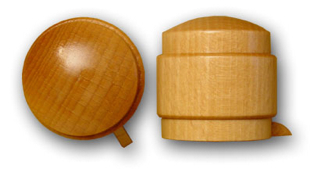
As far as rip-offs, this one takes the cake. It's a wooden volume knob for $485 from Silver Rock that supposedly dampens the "micro vibrations created by volume pots and knobs that find their way into the signal path and cause degradation." Take a look at the advertising copy.
"Dynamics are better and overall naturalness is improved. Here is a test for all you Silver Rock owners. Try removing the bakelite knobs and listen. You will be shocked by this! The signature knobs will have an even greater effect…really amazing! The point here is the micro vibrations created by the volume pots and knobs find their way into the delicate signal path and cause degradation (Bad vibrations equal bad sound). With the signature knobs micro vibrations from the C37 concept of wood, bronze and the lacquer itself compensate for the volume pots and provide (Good Vibrations) our ear/brain combination like to hear…way better sound!!"
Now to be fair, I couldn't find the actual website for the above as the link now provides an error message, but there's a lot of references to it around the Web so it appears not to be a fake or an April Fool's joke. With all the bad press, Silver Rock probably decided it was best to keep this one as a personal request product only. If anyone really wants one though, I can get you a wooden knob that performs way better for only $250.
With all of the mumbo jumbo that some manufacturers pour out about the analog world, I can only image what they say about the digital one, where it seems a lot easier to do nothing except psychologically imply that some big improvement is happening. Anyone have any examples?
On Friday I had the pleasure of sitting in on a meeting with 3 representatives from Apple at Oasis Mastering, as they briefed us on the latest info on the new "Mastered for iTunes" program. While there's already some info on the program currently available, it was good to finally get the most up-to-date details directly from the source. Here's the gist of the program.
"Mastered for iTunes" at is most basic is iTunes finally opening up to hi-res masters. This means a number of things:
1) iTunes now prefers that you supply the master audio files at 96kHz/24 bit, but any sample rate that's a 24 bit file will still be considered "Mastered for iTunes." Music files that are supplied this way will have a "Mastered for iTunes" icon (like on the left) placed beside them to identify them as such.
The reason why they're asking for 96/24 is so they can both start with the highest resolution source material for a better encode, but also for a bit of future proofing in the event that iTunes later converts to a better format or a higher encode resolution (it's now 256kbs, but more on this in a second).
2) "Mastered for iTunes" doesn't mean that the mastering facility does anything special to the master except to check what it will sound like before they (or the record label) submit it to iTunes, and then check it later once again. All encoding for iTunes is still done by Apple, not by the mastering houses, record labels, or artists.
The reason for this is to keep the encodes consistent and to prevent anyone from gaming the system by hacking the encoder, but also to avoid any potential legal problems that might occur when a mastering house sends the files directly to iTunes instead of the label without their permission, or uses different specs, etc.
3) As stated above, the mastering house doesn't do any encoding directly, but Apple has provided a number of tools that they can use to hear what the final product will sound like when it's encoded. That way they can make any adjustments to the master to ensure a good encode.
One unique aspect of "Mastered for iTunes" is something that's not been publicized called a "test pressing." When Apple finally encodes the file, they'll send a copy back to the label/engineer/artist to check. If they sign off on it, the song then goes on sale in the iTunes store.
Of the few mastering houses that are currently participating in the program (all of the major ones), it was surprising that most of the time a test pressing was rejected not because of the audio quality, but because it was the wrong master. Yes, as record companies seem to do, someone would actually send the un-mastered file or a completely different song or version. Luckily, the problem is now able to be caught in the test pressing stage.
4) Speaking of the sound quality, iTunes is now using a completely new AAC encoder with a brand new algorithm and the sound quality it produces is stunning. If provides an excellent encode if you use a few common sense guidelines (more on this in a bit), and if you do, the result is almost impossible to hear (at least on the music we listened to). I mean, there we were, mastering engineers Eddy Schreyer, Gene Grimaldi plus myself, listening in this fantastic listening environment, and we literally couldn't tell between the source and the encode most of the time. Now there were some where we could hear the difference too, but it wasn't that big a difference and certainly didn't sound anywhere near as bad as the typical MP3.
So what are the tricks to get the best sound quality from an iTunes encode? It turns out that the considerations are about the same as with MP3 encoding:
a) Turn it down a bit. A song that's flat-lined at -.1dBFS isn't going to encode as well as something with some headroom. This is because the iTunes AAC encoder outputs a tad hotter than the source, there's some intersample overs that happen at that level that aren't detected on a typical peak meter, and all DACs respond differently. Something that won't be an over on your DAC may be an over on another playback unit. If you back it down to -.5 or even -1dB, the encode will sound a lot better and your listener probably won't be able to tell much of a difference anyway.
b) Don't squash the master too hard. Masters with some dynamic range encode better. Masters that are squeezed to within an inch of their life don't. Simple as that. Listeners like it better too.
c) Although the new encoder has a fantastic frequency response, sometimes rolling off a little of the extreme top end (16k and above) can help the encode as well.
5) "Mastered for iTunes" is only an indication that a hi-res master was supplied; it's not a separate product. There will always be only one version of the song on iTunes at the same price as before. "Mastered for iTunes" doesn't mean you get to charge more, or that iTunes charges you more. Everything is like it was before, you just supply a hi-res master so it sounds better.
6) So how do you supply that hi-res master? This is where it gets a bit tricky. If you're signed to a major label, they've been contacted my their Apple reps and everything is in place, so no problem there. If you're with an indie label, insist that they contact their Apple rep for instructions.
If you use CD Baby or Tunecore, at the moment they'll tell you they don't take 24 bit or high sample rate masters. Insist that they contact their Apple rep and don't take no for an answer (this is what the Apple iTunes guy told us). Apple is greatly encouraging everyone to get with the program, so the more pressure you put on them, the quicker it will become a standard. Of course, if you can find out who your local Apple rep is (ask the local label), that could expedite things too.
The bottom line is that "Mastered for iTunes" is a great thing for digital music. As far as I can see, there's no downside to it (except maybe for the initial hassle you may go through as an indie), and you'll be giving your fans a much better sounding product as a result.
Here's a song that I've been getting requests to do a song analysis on for a while, and I have to admit that it's long been one of my favorites - Joe Walsh and Barnstorm's "Rocky Mountain Way" from the album The Smoker You Drink, The Player You Get.
Although Joe had achieved some measure of success with The James Gang, "Rocky Mountain Way" was the song that broke him as a solo artist, getting as far as #23 on the Billboard charts. In a round-about way, it also led to his eventual place as guitarist in The Eagles, since both were produced by Bill Szymscyk, although Szymscyk also produced the James Gang as well. The song was written by Walsh as a tribute to his new home in Colorada, having just moved from Cleveland, and is one of the first songs to use a talkbox on the guitar. As with all song analysis, we'll look at the song form, the arrangement, the sound and the production.
The Song
"Rocky Mountain Way" is really a pretty simple song in that it consists of only 3 parts - an intro/interlude/outro, a verse and a chorus. Like all hit songs, it's how it's put together that makes the difference. The song form looks like this:
Intro (guitar), Intro (guitar, bass and piano), Intro (full band with slide guitar), Verse, Chorus, Interlude, Verse, Chorus, Interlude, Solo (over an extended verse), Chorus, Outro
RMW is really just a blues shuffle, but regardless who's playing the shuffle or how it's played, it's a feel that we as listeners really like and always seems to be a winner.
The Arrangement
As stated above, RMW is a pretty simple song, but as always, the arrangement makes the difference. Take notice how things build in the intro, with the song beginning with a single guitar on the left, then adding a double on the right, then adding the bass and piano, and finally adding the drums.
There are a lot of dynamics at work in the verse as the piano drops out, the guitar play only the E-A blues riff, and the bass and drums alter their playing so it's more open. Then comes the chorus when the slide guitar and piano re-enter and the bass and drums change their patterns again to push both the feel and the level of the band, which continues into the Interlude.
The solo is interesting because the song strips down again. The clavinet enters (or "Funky C" as we used to call it) on the left and the talkbox solo guitar on the right as the rhythm section basically plays the verse feel. On the last 8 bars another rhythm guitar enters on the left to build up the tension as Joe continues his solo over the chorus and outro (which is basically the same as the interlude).
It's all tension and release. Start quiet with a few instruments, add more and build the level and tension up, then mute them and the tension turns into a release. Level up, level down, level up again by instruments and vocals entering and exiting.
* The Foundation: Bass and drums
* The Pad: None
* The Rhythm: Piano trills on the chorus and interludes, high hat on the verse, clavinet on the solo
* The Lead: Vocal and slide guitar
* The Fills: Slide guitar on the choruses
The Sound
Like almost everything from the 70's, "Rocky Mountain Way" is really big and natural sounding, and although it's compressed, it never sounds like there's too much. The most interesting thing to me about the song is the use of reverb. You hear a little of one reverb that's panned to the right on the Rhythm guitars, then another darker reverb just on the snare drum of the verse. This dark one is delayed and pretty deep and long, giving you the sort of a "grand canyon" feel.
There's also something happening to the vocal during the verses that I believe is an early analog delay. If you listen on headphones, the live vocal is on the left side, but it's also on the right side as well, only with a lot less high end. It's definitely a stereo effect but I can't say for sure what they were using since there weren't a lot of things that did that around in 1973 (it's too short to be a tape delay). When the song gets to the chorus, the vocal is doubled with a second voice which is panned up the center.
One interesting thing to listen for is what sounds like a bass overdub at 2:03 where the sound of the bass changes for a couple of beats. Sounds like it could have been a bass fix that happened later after the tracking session was over.
The Production
The art of production is making a song interesting, so you can say that Joe Walsh and Bill Szymscyk did their job well. This is basically a four piece band (Joe Vitale on drums, Kenny Passerelli on bass, Rocke Grace on keys and Walsh on guitars) with a few overdubs, but it's the overdubs and the change of feel that make the song.
The rhythm guitar is doubled with a lead guitar overdubbed, and how those guitars enter and exit the song makes it build. Same with the piano, then later the clavinet in the solo. Of course, a lot of credit has to be given to the rhythm section, which push the song along with a solid performance.
Once last thing - listen to how far behind the beat Joe Vitale's snare drum is. That's the perfect feel for this type of song (or any shuffle for that matter).
It would be great if every drummer hit every beat on the kick and snare with the same intensity, but unfortunately that doesn’t even happen with the best drummers on the planet. When the intensity changes from beat to beat, the pulse of the song feels erratic, since even a slight change in level can make the drums feel a lot less solid than they should be. Compression works wonders to even out those erratic hits and helps to push the kick and snare forward in the track to make them feel more punchy. Let’s take a look at how to do that with the drums.
The Compression Technique
Before we get into specifics, here’s the technique for setting up a compressor. Regardless of the instrument, vocal or audio source, the set up is basically the same.
1. Start with the attack time set as slow as possible, and release time set as fast as possible on the compressor.
2. Turn the attack faster until the instrument begins to sound dull (this happens because you’re compressing the attack portion of the sound envelope). Stop increasing the attack time at this point and even back it off a little so the sound stays crisp.
3. Adjust the release time so that after the initial attack, the volume goes back to at least 90 percent of the normal level by the next beat. If in doubt, it’s better to have a shorter release than a longer one.
4. The more wild the peaks, the higher the ratio control must be set, so increase it until the sound of the instrument or vocal is pretty much the same level throughout.
5. Bypass the compressor to see if there’s a level difference. If there is, increase the Gain or Output control until the volume is the same as when it’s bypassed.
Tracking Versus Mixing
Generally speaking, most engineers won’t compress much, if at all, during tracking, since anything you do while recording can’t be undone later. That said, some engineers like to limit the instruments a little (only by a dB or two) just to control the transients a bit. A compressor becomes a limiter when the ratio is set to 10:1 or more. If you choose to do this, make sure that the limiter kicks in on only the highest peaks. If it’s limiting constantly, it’s probably too much and you might regret it later since it can't be undone. Decrease the threshold control so it only limits on the occasional transient.
Compressing The Kick And Snare
The biggest question most engineers have when compressing either the kick or snare is “How much is enough?” This depends first and foremost on the sound of the drum itself and the skill of the drummer. A well-tuned drum kit that sounds great in the room should record well, and a reasonably good drummer with some studio experience usually means that less compression is needed because the hits are fairly even. Even a great drummer with a great sounding kit can benefit from a bit of compression though, and as little as a dB or two can work wonders for the sound. With only that amount, the setup of the compressor is a lot less crucial, especially the attack and release.
Sometimes you need the kick or snare to cut through the mix and seem as if it’s in your face, and that’s when 3 to 6dB or so does the job. It’s here that the setup of the compressor is critical because you’re imparting its sound on the drum. Make sure you tweak the attack and release controls as above, and even try a number of different compressors. You’ll find they all react differently, even with the same settings, so it’s worth the time to experiment. Remember: if the attack is set too fast, the drum will sound less punchy, regardless of how much compression you use.
Compressing The Room Mics
The room ambient mics are meant to add the “glue” to the sound of a kit, and can really benefit from a fair amount of compression, which means anywhere from 6 to 10dB. In fact, many mixers prefer the room sound to be extremely compressed, with way more than 10dB being the norm.
The problem is that the more compression you use, the more the ambience of the room is emphasized. That’s okay if you’re recording in a great sounding room, but if it has a lot of reflections and the ceiling is low, you may be emphasizing something that just doesn’t add much to the track. One trick is to actually set the attack time so it’s much shorter than usual to cut off the sound of the initial drum transient, then tuck the room tracks in just under the other drum tracks.
Note that regardless of how good the room mics sound, the more of them you use, the less space there will be for the other instruments in the track. The more instruments there are, the more you’ll have to back them off. Sad but true, but unfortunately, there’s only so much sonic space to any mix.
Here's a great video on how to use 3 simple Mac utilities to convert, reference and transfer audio files. I found it interesting because these utilities (XLD, VoxandCloudapp) can really save you some time, especially when it comes to making MP3s, testing them, then sharing them with others.
What I like about using the Vox utility is that it bypasses iTunes, an app that I personally dislike. XLD is cool because it's a great little conversion tool that handles just about any format. It's a lot easier than exporting multiple versions from your DAW. Best of all, they're all free.
It's now less than a month away from the release of Abbey Road To Ziggy Stardust, the memoir of the amazing life of the legendary producer/engineer Ken Scott published by Alfred Music Publishing that I was lucky enough to co-write.
The book will come out on June 6th, which happens to be the 40th anniversary of the release of David Bowie's seminal album Ziggy Stardust and the Spiders From Mars. In Ken's book, he dispels a number of myths surrounding some of the biggest acts he worked with, from The Beatles to Bowie to Elton John to Duran Duran (and many many more). In this excerpt, Ken speaks to the myth that Ziggy Stardust was a preconceived concept album.
--------------------------
"There’s always been this whole thing about Ziggy being a concept album, but it really wasn’t. There are only two rock albums that I would 100% consider concept albums; Tommy and Quadrophenia by The Who, and that’s because they were written as a complete piece, whereas Ziggy was just a patchwork of songs. Yes, they fit together very well and one can weave a story from some of them, but when you consider that “Round and Round” was originally there in place of “Starman,” it doesn’t make much sense as a concept. How does “Round and Round” ever fit into the Ziggy story? It’s a classic Chuck Berry song. How does “It Ain’t Easy” fit in with the Ziggy concept? That was taken from the Hunky Dorysessions. All this about Ziggy being Starman is bullshit. It was a song that was just put in as a single at the last minute at the record label’s insistence. So while it’s true that there were a few songs that fitted the ”concept”, the rest were just songs that all worked well together as they would in any good album.
Even David didn’t take the Ziggy concept too seriously at first (that would come later). He has told various stories of how the character came into existence. Supposedly, in one tale, the name Ziggy came from a London tailor shop (“Ziggy’s") that David had seen from the train, and in a later version he told Rolling Stone that Ziggy “was one of the few Christian names I could find beginning with the letter Z.” David has also been quoted in many interviews stating that the character Ziggy Stardust was based upon the Elvis impersonator Vince Taylor, an eccentric leather-clad Brit who achieved a level of stardom in England in the late 50’s before having a very public mental breakdown and winding up in a psychiatric institution. And just as an aside, many, like the Clash’s illustrious Joe Strummer, even considered the bizarre Mr. Taylor to be the beginning of British rock and roll.
"I met (Vince Taylor) a few times in the mid-Sixties and I went to a few parties with him. He was out of his gourd. Totally flipped. The guy was not playing with a full deck at all. He used to carry maps of Europe around with him, and I remember him opening a map outside Charing Cross tube station, putting it on the pavement and kneeling down with a magnifying glass. He pointed out all the sites where UFOs were going to land."
Bowie, from Golden Years; the David Bowie Story on BBC Radio 2, 18 March 2000
But as David and the band hit the stage after the album was complete, David began to become the Ziggy character and the the public ate it up."
You can find out more about the book and even preorder it at abbeytoziggy.com.
I once had a movie director tell me, "If you can get the viewer to laugh just once and cry just once in a movie, you'll have a hit." It seems like there's an analog to that in the music business as well, as indicated 20 years ago by British psychologist John Sloboda and verified in 2007 by John Guhn of the University of British Columbia.
Sloboda conducted an experiment where he asked listeners to identify passages in a song that register a strong emotion like tears or goose bumps. The listeners found 20 such passages which Sloboda then analyzed and found that 18 contained a writing device known as "appoggiatura."
An appoggiatura can be a passing note that clashes with the melody just enough to create a temporary dissonance, an entrance of a new voice, or song dynamics, all of which creates tension for the listener. As I mention on this blog and in all of my books, all art is based around tension and release. In art, it's black against white. In photography, its light against the shadows. In music, it's dissonance against harmony or quiet to loud. Tension and release makes things interesting. You can't have any kind of art without it.
When several appoggiaturas happen close to one another in a melody, it develops a constant state of tension and release, which makes the melody of a song more powerful and provokes an even stronger reaction from the listener.
One of the reasons why psychologists think that Adele was so successful with her album 21, was because of the strong use of appoggiaturas in songs like "Rolling In The Deep" and "Someone Like You." In "Someone Like You," the song starts with a soft repetitive pattern, then jumps an octave to a loud chorus (listen to the examples below, which came from a Wall Street Journal article on the subject).
It turns out that there actually is a formula for appoggiatura that's comprised of 4 elements:
Passages that go from quiet to loud
An entrance of a new instrument or harmony
A melody that suddenly expands its range
Unexpected deviations of melody or harmony.
All of these are great arrangement devices which we talk about here often, especially in song analysis, so none are new to us. The fact that there have actually been studies that verify what we've already known for ages is, however. One fact remains - surprises in volume level, melody, and harmony are what makes a listener's spine tingle. Remember to use them.


 "Dynamics are better and overall naturalness is improved. Here is a test for all you Silver Rock owners. Try removing the bakelite knobs and listen. You will be shocked by this! The signature knobs will have an even greater effect…really amazing! The point here is the micro vibrations created by the volume pots and knobs find their way into the delicate signal path and cause degradation (Bad vibrations equal bad sound). With the signature knobs micro vibrations from the C37 concept of wood, bronze and the lacquer itself compensate for the volume pots and provide (Good Vibrations) our ear/brain combination like to hear…way better sound!!"


