Get This Free Cheat Sheet Guaranteed To Help Your Next Mix

Sunday, May 18, 2014

New Music Gear Monday: Booty Shakers Floor Tom Isolator

Sometimes just the simplest invention can make a big difference in sound and here's a perfect example. It's the TnR Booty Shakers, an isolation mount for floor toms and snare that decouple the drums from the floor, thereby providing more of the true sound of the drum. These things are cheap too, with the floor tom version at $29.95 and the snare drum version at $19.95.

Here's a great video with Daniel Glass that shows what a floor tom sounds like with and without the Booty Shakers.


----------------------------------

Thursday, May 15, 2014

The Allman Brothers Band "Ramblin' Man" Isolated Rhythm Section

Here's a real treat. It's the isolated rhythm section for The Allman Brothers Band hit "Ramblin' Man," which was the band's first and only top 10 single, topping out at #2 on the Billboard Hot 100 chart. The song was featured on the 1973 album Brothers and Sisters. Here are some things to listen for.

1. Berry Oakley's bass part is littered with minor mistakes that we wouldn't leave in today, but were considered just fine for the time, not that anyone can easily pick them out with the rest of the parts playing.

2. The dual drums of Butch Trucks and Jai Johanny Johanson is interesting in that one plays straight time on the right channel while the other plays a doubletime feel on the left.

3. As with most dual drummer recordings, you're hard pressed to find the kick. This frequently happens, as the pulse of the song is taken by another instrument instead since the kick is somewhat nebulous.

4. Interestingly enough, this is one of the few songs were the guitars tuned up a half step instead of down (or they used a capo).

Thanks to my buddy Fred Decker for the heads up on this.


----------------------------------

Check Out The Latest Inner Circle Podcast

Bobby Owsinski's Inner Circle Podcast logo imageThe latest Inner Circle Podcast has just been posted, and this time the guest is 16 time Grammy Award-winning engineer Benny Faccone. Benny, who's won most of his Grammy's while working with Latin superstars like Mana and Ricky Marin, talks about the differences between American and Latin music, among other things.

Commentary includes a discuss on the need for the Rock and Roll Hall of Fame, and a look at some of the new recording consoles and why they don't include DAW control.

If you've missed other episodes of the podcast, they include:
  • Show #1 - Engineer Dennis Moody, who discusses the difference between mixing in the studio and live.
  • Show #2 - Omnia Media COO Thom Kozik, who talks all about making money on YouTube and Multichannel Networks.
  • Show #3 - LA session bassist Paul ILL, who discusses about what it takes to be a studio musician.
  • Show #4 - Publisher/producer Richard Feldman, who talks about how the world of publishing has changed because of digital music.
You can access the Inner Circle Podcast at either BobbyOInnerCircle.com or on iTunes.
----------------------------------

Wednesday, May 14, 2014

The 3D Printed Loudspeaker That Can Take Any Shape

If you've read this blog for any length of time, you know that I'm fascinated with speaker technology, primarily because it hasn't changed that much in a hundred years or so. That's beginning to change as research all over the world is coming up with both new transducer technology and new ways of looking at the old ones.

An interesting variation on the old with a completely new twist is a breakthrough from Disney Research at Carnegie Mellon University in Pittsburgh. It's a speaker that can be made by a 3D printer that can be created any shape. This is basically an electrostatic speaker using a thin conductive material and an electrode plate separated by a layer of air, but made via a 3D printer.

The big problem with this type of transducer is that it has virtually no low frequency response, but the fact that it can accept unusual shapes allows it be very directional. This might allow a super directional speaker that could be used in a museum, for instance, where the sound only emanates directly in front of a painting that you're looking at. The speaker can also emit ultrasonic frequencies, which can be coded to allow identification of the device, as you'll see in the video below.

The 3D printed loudspeaker probably won't be commercially available for 5 years or so, but it does illustrate that audio is breaking out from the norm of the last century into the future. You can't help but feel that the "big breakthrough" that leads to a more perfect transducer is right around the corner.

----------------------------------

Tuesday, May 13, 2014

6 Exercises To Help You Visualize Your Mix


Visualize your mix image
The essence of mixing is the balance between instruments or mix elements. No matter how good you are at other aspects of the mixing process, if you don’t get the balance right, you don’t have a mix. Here are some questions to ask yourself as well as 6 exercises taken from my Audio Mixing Bootcamp book that will help you visual your mix before you begin.

"Most mixers can hear some version of the final product in their heads before they get too far into the mix. This is because they’ve heard rough mixes of the song many times before during production, but even if a mixer is brought in just for the mix, they listen to all the elements several times before they really get down to mixing.

If you’re just starting out mixing, you might think, “How can I hear the final product before I’ve even begin?” That’s a fair enough question. Until you have a certain amount of experience, you need a few questions to help mold your vision a bit, and the way to do that is to go back to the six mix elements and ask yourself:
  • How do I hear the final balance?
  • How do I hear the instruments EQed”
  • How do I hear everything panned?
  • How do I hear everything compressed?
  • How do I hear the ambience in the track?
  • What do I hear as the most interesting thing in the track?
If you can answer these questions, you may still not have a full picture of your final mix, but you’ll have at least a general idea, which is the first step to a great mix.

Keep in mind that the producer and musicians have a say in the mix as well, and your version of the mix can suddenly take a wide left turn with their input. That’s okay, because after you’ve gotten everything to the point where you hear it in your head (or even beyond), a left turn should be easy.

1: Either listen to a rough mix of the song you’re working on, or quickly just push up all the faders for a rough balance to the song you’re about to mix. Let’s think about the balance.
   A) How loud do you hear the drums in the final mix? The bass?
   B) Do you hear the vocals out in front, or back in the track?
   C) How loud do you hear the primary musical elements that carry the song?
   D) How loud do you hear the secondary elements like percussion and background vocals?

2: Now let’s think about the frequency response of the various instruments.
   A) Is there an instrument or two that sounds particularly dull?
   B) Is there an instrument or two that sounds overly bright?
   C) Is there an instrument that has too much bottom end?
   D) Is there an instrument that has no bottom end at all?

3: Now let’s think about the panning.
   A) How do you hear the drums panned? Wide or narrow?
   B) How do you hear the panning of any instruments that were recorded in stereo?
   C) Do you hear any instruments panned extreme wide left and right?
   D) What instruments do you hear panned up the middle?

4: Now let’s go to compression.
   A) Is there an instrument or vocal that has wild dynamic shifts that needs compression?
   B) Is there an instrument or vocal that you’d like to change the sound by using compression?
   C) Is there an instrument or vocal that needs to sound a little more punchy?

5: Let’s think about the ambience.
   A) What instruments were recorded with room ambience or reverb?
   B) Do you hear ambience on the drums or snare?
   C) What instruments do you hear rather dry and in your face?
   D) What instruments do you hear further away from you?

6: Lastly, it’s time to thing about the interest.
   A) What’s the most important element in the mix?
   B) If there isn’t one yet, how can I create one?
   C) What’s the next most important element in the mix?
   D) What’s the next most important element in the mix?

These aren’t all the questions that you can ask yourself about a mix, but you get the idea. Remember, there are no right or wrong answers. It’s as you visualize it in your head."

----------------------------------

Monday, May 12, 2014

Memphis: What A Town Part 2 - Beale Street and Stax

Yesterday I wrote about hanging out in Memphis and going to the Blues Music Awards and Ardent Studios, today I want to give you an idea of a couple of other must-see music parts of Memphis.

Memphis Beale Street image

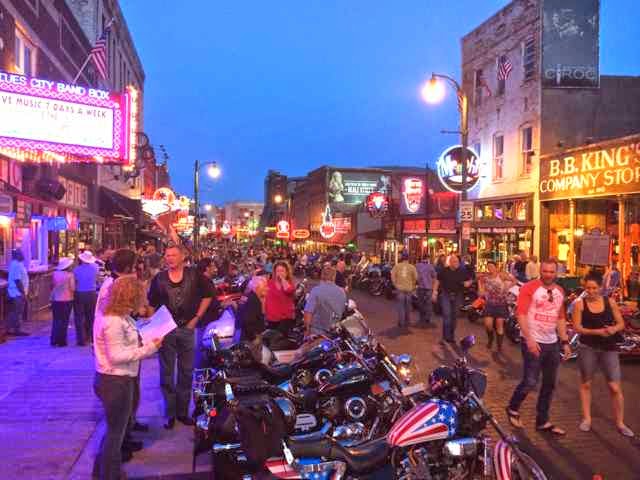
First up is Beale Street, which is about 5 blocks of bars on either side of the street, virtually all of them with music. People can buy a drink at the numerous outside mini-bars and carry it with them down the street, which is helpful to maintaining the party atmosphere.

Memphis Beale Street Bike Night image


Beale Street feels very much like the French Quarter in New Orleans, except the music is a bit grittier and bluesier. Every Wednesday night (which was the night I was there) it's motorcycle night and both sides of the street were lined with magnificent rides. I can't image what the weekend must be like if it was this crazy on Wednesday.


Stax Record Company image
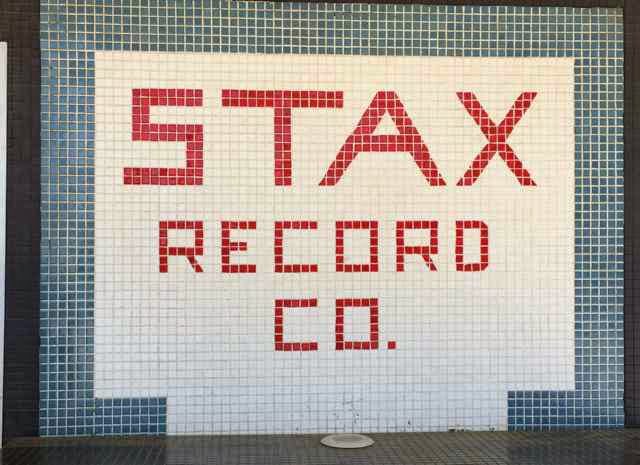
Next up is the Stax Records Museum, which operates at the very same site as the famed record label. On the same location but in a different building is the Stax Academy, which helps underprivileged kids become the next generation of soul musicians. A noble cause if there ever was one. The legendary Stax producer/writer/guitarist Steve Cropper also gives advanced lessons there.


Stax Recording Console image


The museum features all the gear that the studio used to make those great Sam & Dave, Otis Redding, and Booker T and the MGs records. Here's the 20 channel Audiotronics console (with Spectrasonics mic amps and EQs) that the studio used.


Stax tape machines image


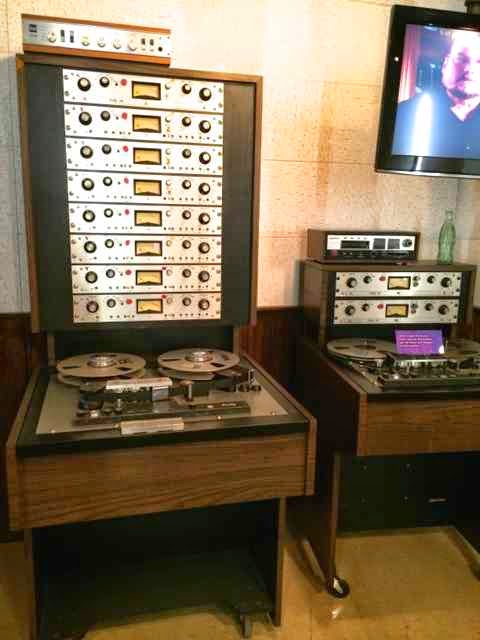
Here's the 8 track and 2 track Scully recorders that captured the Stax magic. This is also the combination that I learned on as well. Once you learn how to make a record on 8 track, anything else is easy!


Stax playback monitor speaker image


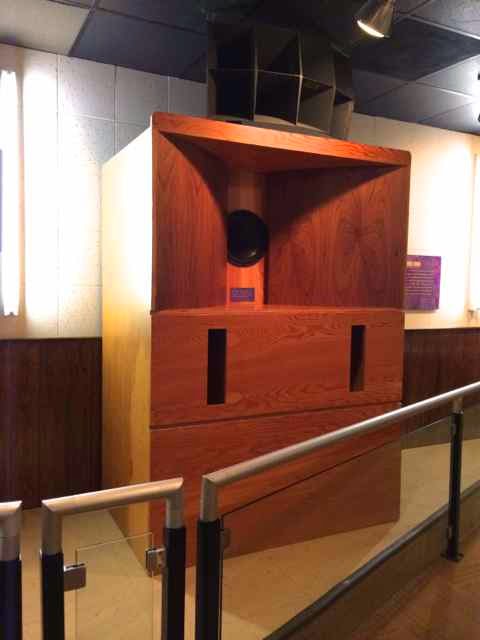
Stax was built around an old theater and the studio utilized some of the movie playback gear as well. Here's one of the Altec A-5 monitors that they used. This is quite huge and about twice the size of the more typical A-7.


Stax Studios tracking room image


Here's the original tracking room of Stax. It's a pretty good size with a very high ceiling. As you can see, it now has relics of the studio band on display, including Steve Cropper's Telecaster, Duck Dunn's Precision bass, Booker T's Hammond M3 organ, and Al Jackson's Rogers drum kit.


Isaac Hayes gold-plated Cadillac image

There's so much more to the museum as well, from clothing to records to contracts, but my favorite is Isaac Hayes' gold-plated Cadillac. Just off his Hot Buttered Soul hit in 1972, Isaac splurged a bit an bought this Caddie. It came complete with a television and refrigerator - in 1972!

This is just the tip of the iceberg for Memphis and the Stax museum. If you're into music history, this is definitely a place you don't want to miss.

----------------------------------

Sunday, May 11, 2014

Memphis: What A Music Town!

Bobby Owsinski, Adrianna Marie and guitarist LA Jones image
Yours truly, Adrianna Marie and guitarist LA Jones
I spent a few days in Memphis last week and if you're a musician, that's one place you have to put on your bucket list. The town is filled with music history, and the best part is that, unlike many other bastions of musicality, so much of it is preserved for the world to enjoy.

I was actually in town for the Blues Music Awards and to give a clinic at the Visible Music College (thank you Tommy Lozure for your hospitality), mostly at the behest of Best New Artist Nominee Adrianna Marie and her Groovecutters. Adrianna is a terrific singer and interpreter of 40's style blues, and I was lucky enough to work on her album last year.

The Groovecutters on the big screen at the Blues Awards show


  First of all, if you're into the blues, the Blues Music Awards is one show that you must attend at least once. It truly is the blues at it's best. I agree that blues can be boring sometimes unless an artist is really great, but this show was 5 hours of greatness and excitement. 

To me, some of the best performances of the evening came from the solo performers like the great Rory Block, Doug MacLeod and Beth Hart. This was not your typical 12 bar blues but something on a completely other level. Of course, Adrianna and her Groovecutters opened the show with the power that only a horn section can bring, and also not your typical 12 bar.

Big Star drummer Jody Stephens and Bobby Owsinski at Ardent
Big Star drummer Jody Stephens and Bobby O at Ardent

But back to Memphis - I can't believe how much there is to see there. My first stop was at the famous Ardent Studios where general manager Jody Stephens showed me around. Jody is music royalty in that he's the drummer and an original member of Big Star, one of the most influential bands to ever come out of that part of the country.


Ardent Studio A = Magic!


Ardent is a magic place. When I walked into the tracking room of Studio A, it just felt like home. I'm doing my best to have a project to go back to record there. I want some of it to rub off.

The control room of Studio A featured a 60 input Neve VR.


Ardent Studio C

Studio C at Ardent was interesting in that it felt more like a room in LA from the 80s, which actually made sense since it was built around that time. That said, studio still had that vintage Ardent feel. This room was equipped with an SSL Duality.


Ardent Vintage Outboard Gear image
Ardent Vintage Outboard Gear


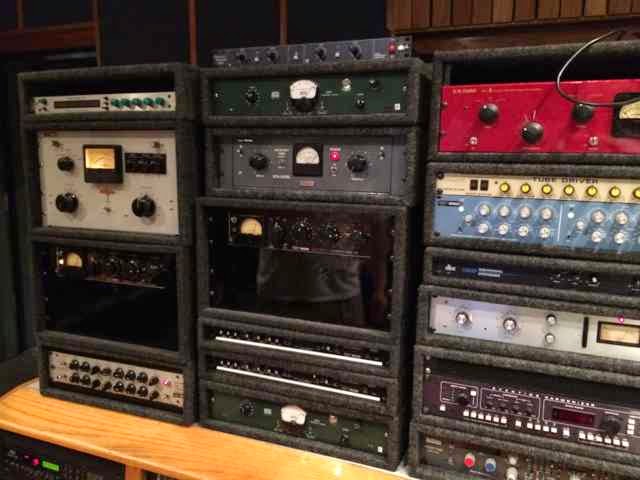
Both rooms had plenty of interesting old outboard gear. It was nice to see real working versions of an Eventide 949, Lexicon Prime Time, ADR scamp rack, Marshall Time Modulator, Fairchild 660 and 670 and lots more.


Scamp Rack at Ardent Studios image
When was the last time you saw a Scamp Rack?


Former Stax mastering engineer Larry Nix and Bobby O
Another treat was getting to hang with Larry Nix, the mastering engineer who did all of the Stax material that we know and love, as well as 78 gold and platinum records, 14 Grammy winners and 2 Oscars (and ZZ Top too). Larry's vintage Neumann V72 lathe is cutting records every day.

Tomorrow, much more Memphis, including the Stax Museum and Beale Street.

----------------------------------

Thursday, May 8, 2014

Michael Jackson's "Billy Jean" Demo

A few weeks back I posted Michael Jackson's amazing home demo of "Beat It." That was based solely around Michael's singing with no instrumental backing at all.

Here's a demo of his breakthrough hit "Billy Jean" that's the complete opposite in that it's thoroughly produced. In fact, it sounds so close to the final record that it seems like all they did was clean it up and give it a great mix.

Does anyone know if any of the tracks on the demo where used in the final mix?


----------------------------------

Wednesday, May 7, 2014

The Amazing Pyroboard Visualizes Audio With Fire

Musicians seem fascinated by fire. On stage, we use lighting as a stand-in for it, but you can bet if the fire laws weren't as strict as they are, a lot of shows would be burning more than candles. Here's an example of music and fire taken to the extreme.

This video features what's known as a Rubens Tube 2D "pyro board" that translates audio waves into flame. The basic device was invented in 1905 by German physicist Heinrich Rubens as a way of demonstrating acoustic standing waves.

The pyro board takes the idea to the next level, with the pressure variations of the sound waves affecting the flow rate of the flammable gas, which then affects the height and color of the flames. Pretty cool, especially when music plays at around 3:30.


----------------------------------

Tuesday, May 6, 2014

The 5 Types Of Studio Time

Music Producer image
Many first-time music producers are unaware that there's many more responsibilities required to complete a project that go beyond the music. One of those responsibilities is often booking studio time, but there's usually a bit more to it than that. Here's an excerpt from my Music Producer's Handbook that describes the 5 types of studio time required on most projects.

"A fairly large project usually has numerous rentals of both long and short term. The trickiest long term rental is always the studio, since if you don’t complete what’s needed on time, then you’ll have to move somewhere else if the studio has booked time after your booking has run out. This can be a royal pain, since it means tearing everything down and setting up again, loosing some time and momentum, and your sound, in the process.

Studio time is broken into 5 categories:
  • Preproduction - This is the time to work material out before hitting the hi-priced studio. It can be in a garage, a bedroom or a rehearsal room and can last from as little as a day to a couple of months (more on preproduction in Chapter 7). It should be said that a long preproduction schedule is usually a function of working with artists or bands that write their own songs and are early in their careers since the songs and arrangements usually require a fair amount of tweaking. Artists and bands later in their careers usually have a great sense of arrangement and have become sophisticated enough musically to keep the preproduction phase to a minimum. There is no preproduction for commercials, movie or television scores since the composer/arranger has it pretty well worked out and the musicians are skilled enough to learn or read it on the spot.
  • Tracking - Sometimes called “basic tracks,” tracking usually consists of recording just the rhythm tracks, although in certain situations it could mean the entire band as well. The rhythm tracks can be comprised of only the drums, only bass and drums, or only drums, bass, guitar and/or keyboards, and can last anywhere from a single day to months, if there’s no preproduction (more on tracking in chapter 9).
  • Overdubs - Overdubs usually consist of recording at least the lead vocals and/or any kind of solos and lead lines that the song requires, but could also mean overdubbing layers of guitars, keyboards, horns, strings, percussion and background vocals. The overdub phase can last anywhere from a day (in very rare cases) to months or even years (again in extremely rare cases). Overdubs may take place in the same studio as tracking, but in these days of smaller budgets, it’s now common to go to a smaller, cheaper facility (or a free one owned by the producer, engineer, or band member). This is also the most difficult portion of the project to gauge the time, since it can vary widely (more on overdubs in chapter 10).
  • Mixing - It used to be that mixing was a pretty easy part of the schedule to determine how much time was required. A day to a day and a half per song was pretty much a standard measurement, especially if you used an A-list mixing engineer. Now with recall and automation on mixing consoles, and mixing “in-the-box” in your DAW, it’s easy to bring back a mix exactly to where you left it. While that seems like it should lead to faster fixes, it seems that more time is spent mixing than ever, a result of trying to get every last tweak possible. It’s still best to figure a couple of days per mix if you’re mixing in a studio with an analog-style console (more on mixing in chapter 12).
  • Mastering - The mastering phase is the easiest to gauge since it’s usually only a half to a full single day for an entire album, regardless of the number of songs. In rare cases (and big budgets), mastering can turn into a multiple day affair or even use different mastering houses, but that’s not usually the norm."
You can read additional excerpts from the Music Producer's Handbook and my other books on the excerpts section of bobbyowsinski.com.
----------------------------------

Monday, May 5, 2014

Introducing The Bobby Owsinski Inner Circle Podcast

Bobby Owsinski Inner Circle podcast image
I'd like to introduce you to my new weekly podcast called Bobby Owsinski's Inner Circle.

The Inner Circle podcast will feature the latest in music industry and production news and analysis, as well as an in-depth interview with a variety of guests from all different parts of the music business.

The first 3 episodes are now live and have some exciting guests and topics, including:
Episode 1: Engineer Dennis Moody, who's the engineer of choice for drum gods like Dave Weckl and Steve Gadd as well as a world-traveling live sound engineer, discusses the differences between mixing live and in the studio. Commentary includes why Apple's Carplay is such a big deal,  and a condition where some people actually can't enjoy music. 
Episode 2: Thom Kozik, COO of Omnia Media, a YouTube multichannel network catering to music, talks about making money from your videos. Commentary includes why streaming may become more lucrative than you think, and how Guitar Center has been financial engineered to where it might be difficult to stay in business. 
Episode 3: Los Angeles session bassist Paul ILL discusses how the mindset of a session musician is different from a gigging musician. Commentary includes a look at the music industry sales numbers from last year and how CDs are still a bigger seller than most people know, and some tips on how to charge for your services.
Some of my upcoming guests include:
  • EveAnna Manley discussing how Manley Labs started and the surprising level of care that goes into each product.
  • Grammy-winning producer and former president of the AIMP Richard Feldman gives a broad overview of today's publishing business.
  • 15 time Grammy-winning engineer Benny Faccone on the differences between Latin and American music.
  • Jingle producer David Campos talks about modern day jingle production.
And many more.

So join me every Thursday for the latest edition my Inner Circle podcast


I hope you enjoy it! If you dig it, please leave a comment on iTunes, and please send me your comments and requests about it as well.
----------------------------------

Sunday, May 4, 2014

New Music Monday: The Mi.Mu Music Glove

Musicians are always looking for new ways to control their instrument, with many over the years being attracted to the simplicity of the way the theremin works. Wouldn't it be great if you could control your music just by a wave or gesture of your hand?

Now that dream might be closer at hand thanks to Grammy-winning artist Imogene Heap and a team of designers from NASA and MIT.

The Mi.Mu Music Glove is equipped with the latest wearable sensor technology that tracks the motion of your hands, senses postures, detects sharp movements like drum hits, and enables customized gestures tailored to your style of music.

The wireless gloves are fitted with lights and vibration motors to provide sensory feedback to the user. Utility software integrates the gloves to the software of your choice.

A Kickstarter campaign for final glove design and production fell short of the 200,000 British pounds (about $337,000) goal, but had more than 600 backers, so many recognize how useful a controller like this can be.

This thing is very cool. I hope they raised enough money (almost $225k) for it to come to fruition.


----------------------------------

LinkWithin

Related Posts Plugin for WordPress, Blogger...