Get This Free Cheat Sheet Guaranteed To Help Your Next Mix

Monday, February 6, 2012

10 Most Expensive Speaker Systems

Sometimes people who love audio have more money than sense, and that's why the audiophile business thrives. When you have people paying 700 bucks for a wooden knob and multiple thousands for a speaker cable, you have to admit that there's some psychological voodoo involved.

But that's nothing. How would you like to spend a cool $2,000,000 on home playback system? Here's a great article that lists the top 10 most expensive speaker systems. I've only listed 5 here, but you can see the entire article at the whatuwantnow blog.


"When its music, debate, rock party, wedding or even a religious occasion, speakers are the most important concern to look, and to make one occasion perfect, people love to have good quality speakers,
1. ULTIMATE by Transmission Audio
Can you imagine a speaker can cost $2,000,000? Yes, this is the one, the most expensive speaker of the world, which wants 31,000 Watt to be listened. It has four aloof dipole subwoofers, and every subwoofer carries 10 fifteen inches subwoofers. This is not enough; every dipole plate has 24 eight inches unit channels, and 2 dipole MF on each channel along with one HF Channel plate of 68 meters ribbon.
ULTIMATE by Transmission Audio from Bobby Owsinski's Big Picture production blog
2. Grand Enigma by Kharma
Second most expensive speakers of the world costing you around $1,000,000, you can’t imagine the beauty of these speakers which are found in a Building in Belgium. They are totally enigmatic and loud with advance stereo system launched after complete test.
Grand Enigma by Kharma from Bobby Owsinski's Big Picture production blog
3. Infinite Wisdom Grande Loudspeaker by Wisdom Audio
Third most expensive speakers of the world costing around $7, 00,000, are really astonishing speakers built like a tower of 23 length with 2 tons of the weight, perhaps suitable for big ground parties.
Infinite Wisdom Grande Loudspeaker by Wisdom Audio from Bobby Owsinski's Big Picture production blog
4. MBX 10.9s46 by California Audio Technology
Another most expensive speaker of the world costs $560,000, are two guitar shaped attractive speakers in red color, each weighing 1 ton and height of 12 feet.
MBX 10.9s46 by California Audio Technology from Bobby Owsinski's Big Picture production blog
5. Sphäron Excalibur by Acapella Audio Arts
Another most expensive speaker of the world costs $380,700 and is uniquely has identical columns created of eight, thirty inch of subwoofers, and this speaker has buzzes of twelve square meters.
Sphäron Excalibur by Acapella Audio Arts from Bobby Owsinski's Big Picture production blog

How do these stack up? Can't say as I've never heard any of them, but I'd venture to say that they'd all be improved by Carl Tatz's Phatom Focus System.


Read the entire article here.

----------------------------------
Help support this blog. Any purchases made through our Amazon links help support this website with no cost to you.


You should follow me on Twitter for daily news and updates on production and the music business.


Don't forget to check out my Music 3.0 blog for tips and tricks on navigating social media and the new music business.

Sunday, February 5, 2012

Facebook's Massive Media Storage

Perhaps you recently bought a few terabyte hard drives and are feeling that you're pretty well covered for storage. A terabyte, of couse, is a 1,000 gigabytes. The next increment is a petabyte, which is 1,000 terabytes.

So consider for a moment just how big a petabyte is.
  • Just 1 petabyte equals 20 million 4-drawer filling cabinets filled with text.
  • 1 petabyte equals 13.3 years of HD video.
  • 20 petabytes was the total hard drive space manufactured in 1995
  • 50 petabytes is the equivalent of the entire written works of mankind, from the beginning of recorded history, in all languages.
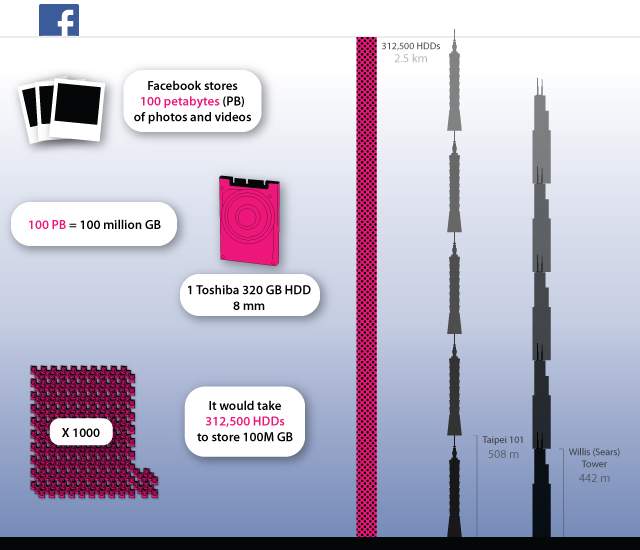
That's why the recent IPO filing from Facebook is so amazing. In it they state that they already store over 100 petabytes of photos and videos from their 850 million users.

Having trouble wrapping your head around that number? Maybe the following infographic will help.


Facebook Storage Chart image from Bobby Owsinski's Big Picture production blog

Obviously technology has moved into the realm of super-storage, and what once seemed quite large is now small. Welcome to the world we now live in.

----------------------------------
Help support this blog. Any purchases made through our Amazon links help support this website with no cost to you.


You should follow me on Twitter for daily news and updates on production and the music business.


Don't forget to check out my Music 3.0 blog for tips and tricks on navigating social media and the new music business.


Thursday, February 2, 2012

David Guetta "Turn Me On" Song Analysis

This week's song analysis is #2 on the Ultimate Chart and is at the tip of a trend in music that's starting to snowball. The song is "Turn Me On" by French DJ David Guetta, featuring singer Nicki Minaj.

Electronic dance music has been a huge underground scene for a number of years now, and we've seen flashes of it on the top 40 charts, but now it's beginning to break through in a big way and David Guetta is leading the charge by adding star vocalists to what was once purely electronic music.

Guetta was one of the first to join this trend on his 2009 album One Love, which included the hit singles "When Love Takes Over" (featuring Kelly Rowland), "Gettin' Over You" (featuring Chris WillisFergie and LMFAO) and "Sexy Bitch" (featuring Akon). The last song hit the top five in the United States and all three reached #1 in the UK. The album also featured another internationally known single called "Memories" (featuring Kid Cudi), which became a top five hit in many countries. 

Guetta has sold over three million albums and 15 million singles worldwide and is currently one of the most sought-after producers in the music business.

As with all song analysis, we'll look at the song form, the arrangement, the sound and the production.

The Song
"Turn Me On" is a very basic song form with one twist in the prechorus. The form looks like this:

Intro, Verse, B Section, Interlude, Chorus, Verse, B Section, Interlude, Chorus, Bridge, Chorus

Every section is 8 bars long except for the Interlude (the "Oh" part before the chorus) which is only 4 bars, and that's the only thing that changes the song up a bit form-wise.

The Arrangement
There aren't a lot of elements or layers to the song by the very nature of electronic dance music. Instead of a drum kit and bass, the rhythm element is made up of a huge kick drum and bass sound, which take up so much sonic space that's it's difficult to fit additional foundation instruments in.

What's very interesting in "Turn Me On" is the way the claps and high hat are used to develop the song. Usually a song is developed by adding additional arrangement elements or additional instrument or vocal layers. On this song percussion is used to accomplish the same thing. Here's how it's done:

In the first verse you only hear the kick and bass sounds, but doubled claps in stereo are used to develop the B section. In verse 2 the claps continue, but a hat sound is used to develop the 2nd B section.

Here's what the arrangement elements look like:

  * The Foundation: Bass and kick sounds

  * The Rhythm: Arpeggiated synth line, claps from the first B section onward, hat sound in the second B section.

  * The Pad: A synth in the bridge

  * The Lead: The vocal

  * The Fills: Background vocal line at the end of the chorus, arpeggiated synth in the choruses, vocal answers in the first half of the bridge

The Sound
Another function of electronic dance music is the fact that distortion is normally viewed as something to be embraced and not rejected. There's plenty of it here that's a big part of various sounds, but even the vocal (which you'd expect to be clean) has a lot of distortion.

There's a slight ambience sound on most of the syths, but most of the layering on both the syths and vocals comes from timed delays that are long enough to hear and fill in the holes between phrases.

A couple of cool things are the way the the vocal is manipulated in the Interludes by panning from left to right channel and back again, all the while modulating it gradually into full distortion at the end. I also loved the use of the stereo claps that enter in the first B section.

The Production
I think a big reason why this song is a hit is its excellent dynamics. The song goes from a whisper to a roar and back again several times during the song, which keeps your attention on a rather uninteresting song form.

Want an example? Listen how the song starts off quiet, gets a bit bigger during the first verse, a bit more during the B section, then comes down to just a vocal (over a gurgling synth) during the interlude, then smacks you over the head on the chorus. The same happens during the second verse, B, interlude and chorus, then again from the bridge to the last chorus. The tension and release is why it remains interesting.

Send me your song analysis requests here.


----------------------------------
Help support this blog. Any purchases made through our Amazon links help support this website with no cost to you.


You should follow me on Twitter for daily news and updates on production and the music business.


Don't forget to check out my Music 3.0 blog for tips and tricks on navigating social media and the new music business.

Wednesday, February 1, 2012

Are You Ready For Smart Headphones?

smart earbuds image from Bobby Owsinski's Big Picture production blog
Headphones are a pretty mundane piece of audio gear, which is precisely why it's time to smarten them up a bit. I don't know about you, but one of the things about phones that always bothers me is when the the cups get mixed up where the right and left one are reversed. Thanks to a bit of technology, that may not be a problem that much longer.

Researchers at the Igarashi Design Interface Project recently developed a set of "universal headphones" that are so smart that they can do the following:
  • Sense when you've placed an earbud or headphone on the wrong ear, then change the channels to accomodate. 
  • Sense when two people are sharing earbuds and change the channels so each earbud contains both the left and right channels (and even allow each listener to hear different tracks at the same time).
  • Automatically pause and resume play depending if the phones are on or off your ears.
The way the development team came up with right/left ear sensing is by attaching a proximity sensor to one of the earpieces to measure the distance from the ear. When placed in the right ear, the sensor detects the ear behind it. If it's then placed in the left ear, it knows that the distance has changed and then signals a on-board processor to switch channels.

It's so cool when old technology like speakers, mics and headphones get a new technological twist. Although these updates aren't available in a commercial product yet, expect to see them soon.

----------------------------------
Help support this blog. Any purchases made through our Amazon links help support this website with no cost to you.


You should follow me on Twitter for daily news and updates on production and the music business.


Don't forget to check out my Music 3.0 blog for tips and tricks on navigating social media and the new music business.


Tuesday, January 31, 2012

Jeff Beck's Guitar Collection

Here's one for all of the guitar players that read this blog. Jeff Beck is one of the most revered guitar players ever (and rightfully so), but you don't see him interviewed very often. In the video below Jeff talks about his main guitars and how they came into his possession, so you get two for one - an interview plus some guitar talk. Note how many were given to him by fans. That's what happens when you're a guitar god, I guess.


----------------------------------
Help support this blog. Any purchases made through our Amazon links help support this website with no cost to you.


You should follow me on Twitter for daily news and updates on production and the music business.


Don't forget to check out my Music 3.0 blog for tips and tricks on navigating social media and the new music business.


Monday, January 30, 2012

"Here Comes The Sun" Lost Guitar Solo

Here's a real gem. It's the parts of George Harrison's famous "Here Comes The Sun" from The Beatles famous Abbey Road album that didn't make the final mix. I don't know how long this will stay up before the EMI sends a take down to YouTube, so enjoy it while you can.


----------------------------------
Help support this blog. Any purchases made through our Amazon links help support this website with no cost to you.


You should follow me on Twitter for daily news and updates on production and the music business.


Don't forget to check out my Music 3.0 blog for tips and tricks on navigating social media and the new music business.

Sunday, January 29, 2012

Ken Scott Answers Your Questions

Ken Scott and Bobby Owsinski at Total Access Recording from Bobby Owsinski's Big Picture production blog
Ken Scott and yours truly at Total Access Recording last week
You may remember that I asked for questions for the legendary producer/engineer Ken Scott last week for our presentation at the Alfred Music Publishing booth at NAMM. Of course, Ken worked with everyone from The Beatles, David Bowie, Supertramp, Mahavishnu Orchestra, America, Devo, Kansas, The Tubes, Missing Persons, Duran Duran and many many more, so whenever he speaks about the studio you find some pearls of wisdom. As promised, here are the questions and  along with the answers, as well as a little bonus towards the end.


Bob from Vancouver asked: How do you ensure that you have a balanced frequency spectrum in your mix? As in the right balance between lows, mids, and highs...
First of all, what is a balanced frequency spectrum? It should sound the way you want it to sound, and sometimes that means there’s going to me more high end and sometimes more low end. Take Reggae records, for example. It would seem they’re completely out of wack frequency-wise, but that’s exactly what people loved about them. As long as you’re using good monitors and get it sounding the way you want it, it's cool.


Fred Decker asked: What suggestions would you offer to a band to make their pre-production efforts most effective? Any comments on arrangement, song-structure or how to make the music groove? 
How to make it groove is don’t use Pro Tools to put everything on the bloody grid. I don’t like a click track that’s the same tempo from beginning to end because musicians frequently speed up when it comes to the chorus. I’ve always felt that you get things to groove more when using a click if I nudge it up slightly for the choruses and bring it back down again afterwards.

In preproduction you're just getting to know the material, but not to the point where when you go in the studio and something doesn’t quite work, you don't have the ability to move on and change what doesn’t work. You’re not stuck trying and trying to make it work because sometimes it doesn’t work when you get into the studio and listen under a microscope.

Also go through and make sure that everyone is playing the same thing. Listen to the parts and make sure they work together.


Bruce Alger asked: I would like an overview of how KS mixed Supertramp's Crime of the Century (and his methods of doing the vocals on that one).
We weren’t afraid to try things on that album. Different vocal effects were things like having them sing from different distances away from the mics. That was important especially with the two vocalists when they were answering each other. We experimented with different planes where one was right in your face while the other one had some distance on it. We weren’t afraid to experiment is the easiest way to explain the overview.


David King's question was: From your experience working with The Beatles. Do you believe they would have achieved success without the involvement of George Martin in their career?  (I tend to believe that he played as critical a role in their success as did any individual member of the band.)
Probably not, because in the early stages he was exceedingly important in guiding them in song structure and arrangements and that kind of thing. It eventually reached the point where they were going full-tilt on their own and he was less important, but in the early stages he was definitely needed, so there is a strong chance that they wouldn’t have done it without him.


Chuck Sims wanted to know: Ringo had left the band when they recorded "Back in the USSR." It's often been reported that the drums are a composite track, with John, Paul and George all contributing. Do you have any recollections about the sessions for that song? (There's a bass VI and a lot of debate about various instrumental roles on that selection). 
To answer this question, Ken asked me to use an excerpt from his upcoming book Abbey Road To Ziggy Stardust (it will be out in May).
“By the time “Back In The USSR” was recorded, Ringo had temporarily quit the band. It wasn’t that he was in the studio and stormed out, it was more like he just didn’t turn up one day. The sessions were undisciplined enough that whatever any of the others felt like doing at any given time is what they did, so he never knew if he was going to be playing or not. He didn’t feel needed or wanted and he was tired of waiting around, so he just decided not to show up anymore.
I don’t remember the incident being spoken about too much at the time, and the whole thing was treated just as a “Ringo’s not here today” kind of thing, so we just carried on as usual. We recorded the basic track of “Back In The USSR” first with Paul playing drums, George on lead guitar, and John on bass, but there were parts of Paul’s drum track that just weren’t good enough, so we recorded a second drum track. This time the drums were played by both George and John at the same time on the same kit, one of them playing kick and snare while the other played the cymbals and toms, or something like that. Between the two tracks, we got one solid drum track, so we mixed them all together and that’s the drum track that you hear on the record. I never got a chance to record Paul playing drums well, although I know he did do it on a few of the songs on the album that were recorded outside of EMI.
In the end, Ringo returned a week or so later, and George H had the entire Number 2 studio decked out with flowers and a banner that said, “Welcome Back, Ringo.” He was happy to be back, and they were extremely happy to have him back.”


Chuck asked another: David Bowie’s Ziggy Stardust is one of the greatest rock LPs ever... when working on it did you or the band have any idea that it would be such a defining moment, or was it just 'another' album? 
They’re never just “another album.” Hopefully they’re not, anyway. We never knew that we’d be talking about it in 40 years time; absolutely not. We were making records that if people were still talking about them 6 months later, then we’d done our jobs properly. 40 years later we had no idea whatsoever.


Chuck asked still another: Are there any favourite moments or tracks on Ziggy for you?
"Moonage Daydream" is my favourite.


Stay tuned for more info and excerpts on Abbey Road To Ziggy Stardust as they become available.

----------------------------------
Help support this blog. Any purchases made through our Amazon links help support this website with no cost to you.


You should follow me on Twitter for daily news and updates on production and the music business.


Don't forget to check out my Music 3.0 blog for tips and tricks on navigating social media and the new music business.

Thursday, January 26, 2012

The Difference Between Vintage And Current Instruments

Ultimate Guitar Tone Handbook cover image from Bobby Owsinski's Big Picture production blog
During a long discussion about vintage instruments in the studio this week, it prompted me to think about this excerpt from The Ultimate Guitar Tone Handbook (written with writer, composer and good buddy Rich Tozzoli) that describes some of the intangible factors that went into manufacturing Gibson humbucking pickups in the 50's and 60's. As you'll see, there are a lot of external factors that went into making a pickup back then, and those factors can pretty much be applied to all instruments in one way or another.
-------------------------

"As if the known factors in building a pickup weren’t enough, consider the many intangible factors as well. For instance, most pickups loose their magnetic strength over time because of environment and electrical interference. Pickups can become weakened or demagnetized completely by leaning your guitar against an amplifier with large transformers, or even from taking your guitar too close to the train motor of a subway (as happened with Andy Summers of The Police).

Another intangible is the fact that tolerances of just about every component were much looser until the 90’s. While the difference was indeed subtle, add enough components at the edge of their tolerances together and you suddenly get a pickup that sounds different even though it’s made the same.
Manufacturing intangibles are a whole other story and for that we’re going to go a bit into the history of the Gibson humbucker.


The Changes In The Humbucker
The first humbucking pickups on the 1957 models of Gibson guitars had a sticker on them saying “Patent Applied For” as the design was in the review cue before being granted a patent (see Figure 3.27). These became known as PAF pickups (“Patent Applied For”) and have become highly sought after today for their great sound. The problem is that most PAFs sound different from one another due to manufacturing process of the time.
Gibson PAF Humbucker image from Bobby Owsinski's Big Picture production blog
Figure 3.27 A Gibson PAF Humbucker

Until 1961 when Gibson standardized the selection process, they randomly used different strength magnets (grade 2 through 5) in their pickups, which accounts for some of the reasons for the different sounds. To make matters worse, sometimes a shorter magnet was selected (mostly seen in gold-plated guitars for some reason), which decreased the power of the magnet as well. In July of 1961, Gibson consistently began to use all short Alnico 5 magnets, although occasionally a few Alnico 2’s showed up. In 1965, Alnico 5’s became standard in all pickups, which finally brought about a bit of consistency to the process and the sound.

If that weren’t enough, the number of windings on the pickup varied enormously as well, especially in PAFs. The early coil winding machines didn’t have an auto shut-off so the workers would shut off the machine when the bobbin looked full, which was at about 5000 turns. As a result, no two pickups were ever the same.

Even when Gibson bought a winder with an auto-stop, there continued to be problems even though the pickups became more consistent. The stop mechanism was controlled by a fiber wheel which would wear out and break, at which point the workers would approximate the number of winds by timing the wind, which resulted in more inaccuracies.

Since the humbucker is made up of two coils, sometimes the windings of each coil were different even though the total number of turns were correct. This would cause certain mid-range frequencies to stand out and give it more bite.
Gibson Patent Number Pickup image from Bobby Owsinski's Big Picture production blog
Figure 3.28: A Gibson Patent Number Pickup
By mid-1962, the patent for the humbucker was granted and Gibson changed the sticker to read “PATENT NO 2,737,842” which was actually the patent number for Les Paul’s trapeze tailpiece. No one knows for sure if printing the wrong number was merely a mistake or a way to throw off the competition. From 1963 to 1975, these “Patent number” pickups are very consistent, as are the ones thereafter when new, more precise winding machines were used (see Figure 3.28).

In the 1990’s, Gibson further refined their manufacturing and began to manufacture pickups based on the original PAF design. Thanks to precision modern manufacturing techniques, these pickups are remarkably consistent, which also means that a “magic” pickup made as a result of loose tolerances is no longer possible to get. That being said, most experts agree that you can now get 90% of the way there sound-wise for 10% of the cost of a vintage PAF."

----------------------------------
Help support this blog. Any purchases made through our Amazon links help support this website with no cost to you.

You should follow me on Twitter for daily news and updates on production and the music business.

Don't forget to check out my Music 3.0 blog for tips and tricks on navigating social media and the new music business.


Wednesday, January 25, 2012

Is this Mackie Video Any Good?

Here's an "interesting" video on the Mackie DL1608, the new 16 channel live sound mixer built around the iPad than the company just released at the NAMM show.

I'm not sure how I feel about it personally. Is it brilliant advertising? Is it condescending to potential buyers and users? Is it funny or not? Where all these guys on acid when they created it? Maybe some of this, or none of it, I can't decide. One thing it does do is grab your attention and make you talk about the product, which is what advertising is intended to do.

What do you think?

Thanks to my buddy Steve Harvey for giving me the heads-up on this video.


----------------------------------
Help support this blog. Any purchases made through our Amazon links help support this website with no cost to you.

You should follow me on Twitter for daily news and updates on production and the music business.

Don't forget to check out my Music 3.0 blog for tips and tricks on navigating social media and the new music business.


Tuesday, January 24, 2012

A Look At NAMM 2012 - Part 3

Here's the last of my NAMM 2012 overview, and this time it's more about some of the odd or unusual things that I spied during my all-too-fast gallop around the show. I was actually at NAMM for 2 entire days, but the problem was that I was involved in meetings most of that time, so my floor time was actually pretty limited. Sometimes that's for the best though, since you tend to see the big picture a little better as you race through the 4 giant halls, the basement, and 2nd and 3rd floors (yes, NAMM is pretty big). Let's see what we have.

Molecule Drums image from Bobby Owsinski's Big Picture production blogFirst up is a rather interesting drum kit from Molecule Drums. As you can see they have this round bulb on the bottom where the bottom head should be. Surprisingly, they actually sounded really good for the brief bit that I heard.


LED drum head image from Bobby Owsinski's Big Picture production blog


Speaking of drums, this company puts blinking LED overlays on drums, heads and guitars. You can't see them blink here, but it probably looks pretty good on stage.


Stained Glass Drum Head/Speaker Cabinet Grills image from Bobby Owsinski's Big Picture production blog


Here's a company that makes stained glass drum heads and speaker cabinet grills. This is definitely a case where image wins over audio quality, but if that's important to you, contact revampedglassdesign.com.


Footbass image from Bobby Owsinski's Big Picture production blog


With Mumford And Sons so big at the moment, having a guitar player also play a rhythm instrument has become an important musical element. This piece (I think it's a "Footbass") is just the thing for that acoustic act that needs a heartbeat.
NAMM hats image from Bobby Owsinski's Big Picture production blog


If you want to be cool, you need a hat. What better place to buy one than at NAMM?


Slaperoo NAMM 2012 image from Bobby Owsinski's Big Picture production blog


Here's an interesting instrument called a "Slaperoo" that's a combination upright bass and percussion instrument. I can actually see this going somewhere as it seems to have some real possibilities in the right hands.


Hand-Built Piano Co. NAMM 2012 image from Bobby Owsinski's Big Picture production blog

Just won the lottery and want to buy the fanciest piano known to man? The Hand-Built Piano Company can help you out. I don't know what they sound like, but they sure are ornate.


Grand Illusion Piano Shell image from Bobby Owsinski's Big Picture production blog

Want everyone to think that you're playing a real grand piano onstage instead of your synth? Time to get a Grand Illusion piano shell. This looks like the real thing from every angle except that of the player.


Unique Piano NAMM 2012 image from Bobby Owsinski's Big Picture production blog


Okay, imagine you're playing playing in a piano bar in Afganistan and you want to keep the Taliban away. What better way to do it than to make them think that you have a Predator drone at your disposal. Yes, this really is a real grand piano.


string keyboard device NAMM 2012 from Bobby Owsinski's Big Picture production blog

Let's say you're a piano player that never could get the hand of guitar fingering, this device let's you use what's familiar.
Big City Music organ NAMM 2012 from Bobby Owsinski's Big Picture production blog


Believe it or not, this is really an organ with 5 white keys on the left hand and 5 on the right. The songs aren't great but the sounds are good. It was found at Big City Music.

NAMM 2012 sound police image from Bobby Owsinski's Big Picture production blog


And finally, the sound police were out in force at NAMM. Here one regular sound cop and one undercover one check the sound level of a dobro player with a Radio Shack meter and an iPhone app. At the same time, none could be found around the various drum, brass and amplifier booths.

That was NAMM 2012 through my eyes. The other stuff you can read on any blog or website, but you have to come here for the cool stuff.

----------------------------------
Help support this blog. Any purchases made through our Amazon links help support this website with no cost to you.

You should follow me on Twitter for daily news and updates on production and the music business.

Don't forget to check out my Music 3.0 blog for tips and tricks on navigating social media and the new music business.


Monday, January 23, 2012

A Look At NAMM 2012 - Part 2

While yesterday we looked at what's new in audio at the Winter NAMM 2012 show, today we'll look at lots of guitars and amps. Keep in mind that I'm not noting what may be the hottest things at the show, only the things that stood out to me. Let's get down to it.

Orange Micro Terror image from Bobby Owsinski's Big Picture production blogA big trend at NAMM this year was small amps like this Orange Micro Terror. Not only were these amps low-wattage, but they were small as well. The problem with most of these kinds of amps is that they didn't have a case around them (although the Micro Terror at least has a metal cage around the tubes). Highly impractical for gigging, although that seems to be the hot thing, for this year.


Four Force amp image from Bobby Owsinski's Big Picture production blog

 There were more amps than you could shake a stick at (see my video of how many guitars and amps there were back during the 2009 NAMM show for an idea), but I happened to like this particular design from Four Force. Sounded pretty good too.


Milbert GaGa amp image from Bobby Owsinski's Big Picture production blogPerhaps the most unique amplifier at the show was this Milbert GaGa (yes, that's the name). It weighs only 12 pounds, uses any type of tube that you care to put into it, and still puts out 90 watts. Supposed to be a new type of circuit design that can even power your pedals directly from the amp! Sounded pretty good, but I only listened for a minute. I'd like to find out more about it.


 Over to the guitars, when 7 strings just won't do, here's an 8 string for you.


girl body guitar NAMM 2012 image from Bobby Owsinski's Big Picture production blog


When your band is so bad that you can't pick up chicks, a least you can simulate having one close to you when you play.

3 neck guitar image from Bobby Owsinski's Big Picture production blog


Here's an interesting triple neck guitar. OK, I can see a 6 and a 12 string, but I can't see the need for the 2nd 6 string, unless maybe it had single coil pickups instead of humbuckers like the other. Uh, this one doesn't.
6 foot guitar NAMM 2012 image from Bobby Owsinski's Big Picture production blog


 When big just isn't big enough, how about a 6 foot guitar?


knobs galore NAMM 2012 image from Bobby Owsinski's Big Picture production blog


These are all guitar and amp knobs. Every kind, shape, make, model, you name it. And there were 2 more cases just like this.

pickups galore NAMM 2012 image from Bobby Owsinski's Big Picture production blog


Here's a case with nothing but pairs of pickups, and it wasn't Seymour Duncan (hint: they're from that  country that makes everything cheaply).
tone woods NAMM 2012 image from Bobby Owsinski's Big Picture production blog


Want to build your own guitar from scratch? I mean, really from scratch? Why not buy a brick of wood and route it yourself. There were actually a number of companies that sold guitar tone woods at the show, which I find incredibly cool.


video in guitar NAMM 2012 image from Bobby Owsinski's Big Picture production blog

And finally, when your playing just isn't enough, how about adding an iPad in the body?

If you think some of these were odd, tomorrow we'll look at yet another side of NAMM that most don't bother to look for.


----------------------------------
Help support this blog. Any purchases made through our Amazon links help support this website with no cost to you.

You should follow me on Twitter for daily news and updates on production and the music business.

Don't forget to check out my Music 3.0 blog for tips and tricks on navigating social media and the new music business.

Sunday, January 22, 2012

A Look At NAMM 2012 - Part 1

Another Winter NAMM show has been left behind, and once again it's time to reflect on what we've seen and heard. This year one of the things that really stood out was the enthusiasm of the exhibitors and crowd, both of which seem to indicate that the economic doldrums that we've suffered through recently may finally be in the past and better days are ahead. Most companies that I spoke with indicated that they had a solid 2011and 2012 was getting off to a better than expected start. Let's hope that continues.

Today I'll concentrate on audio gear, Tuesday on music gear, and Wednesday on oddities. Let's get down to it.

Universal Audio Apollo image from Bobby Owsinski's Big Picture production blog
 Maybe the most talked-about item at the show for those involved in audio was the Universal Audio Apollo, a multi-channel interface that also happens to come filled with all that great UA plugin DSP, as well as a rare Thunderbolt option.


Sonodyne SM200Ak NAMM 2012 image from Bobby Owsinski's Big Picture production blog
Transaudio Group introduced the Sonodyne SM200Ak, a larger version of their already excellent  50 and 100 speakers. I've been using the 50's for about a month and I've got to say that it's one of the finest small desktop speaker that I've heard. Can't wait to hear the 200's for real.


SE Munro Egg image from Bobby Owsinski's Big Picture production blog

Speaking of speakers, SE Munro showed studio designer Andy Munro's Egg 150 monitors. I've read a lot about the concept behind the speakers and I'm anxious to hear them for real. Unfortunately, NAMM is not the place.


Emotiva monitors image from Bobby Owsinski's Big Picture production blogHere's a company that I'm not familiar with at all, but their Airmotiv 6 monitors sounded terrific on the show floor. With so many speaker companies already in the game, it makes you wonder why another company would try to take a piece of a saturated market as well, but it seems like they may really have something here.


Isoacoustics speaker stands image from Bobby Owsinski's Big Picture production blogSpeaking of speakers, you can't really hear them well unless you have some great stands, and the isoacoustics stands claim to be the best there is. I don't know about that yet, but they sure seem like they're the most adjustable.


Line 6 Stagescape M20d image from Bobby Owsinski's Big Picture production blogLine 6 entered into the sound reinforcement business with an entire new line of products, including the Stagescape M20d, a mixer that has a new user interface that's almost entirely graphic. Could this be the future of consoles?

The Stagescape L3T and L3M powered speaker system and sub have a tremendous amount of features that aren't readily apparent, but they sure sounded good with music played through them. It should be interesting to see what happens with these products in the future.


Dangerous Music monitor controller image from Bobby Owsinski's Big Picture production blogThe always hi-quality Dangerous Music showed this cool monitor box. Sorry, but I lost the info on it. Wish I had one right now.


Masterlink Live image from Bobby Owsinski's Big Picture production blogI had expected this to be a huge iPad show, expecting a ton of interfaces, peripherals and apps. There were a few, but not what I expected. The Alto Masterlink Live is a 16 channel mixer with an iPad dock. I understand that Mackie also introduced a similar product, but I never spotted it at the show.


Marshall iPad mics image from Bobby Owsinski's Big Picture production blog
Marshall showed a number of mics they claimed were designed for the iPad, and there were a number of devices that used the iPad as a controller, like this Pimitec personal monitor system.

Pivitec iPad personal monitor image from Bobby Owsinski's Big Picture production blog


cheap headphones image from Bobby Owsinski's Big Picture production blog

This was also a headphone show. It seems like the Dr. Beats phones that have become so popular exposed a huge market that hasn't been serviced and every manufacturer now wants a piece, although it's probably now too late. Just like most mics come from one Chinese factory (737, which also had a booth at the show), I wouldn't be surprised if all the headphones came from the same place as well.

Chinese Shure mic knockoffs from Bobby Owsinski's Big Picture production blog


 There were no shortage of blatant knock-off products at the show by Chinese manufacturers. Here's a box that looks like it comes from Shure, but they're all imitations.


Studio Mics?? image from Bobby Owsinski's Big Picture production blog
And of course, so many companies believe that if they copy the look of a famous vintage microphone, that automatically makes them a "studio microphone."

One of the funniest conversations that I listened in on was with a used-car-style salesman from a new mic company relentlessly telling producer-engineer legend Ken Scott about how cheap his mics were and how much money Ken could make because the margin was so high. Ken, being the gentleman that he is, just allowed him to rant.

Tomorrow we'll look at some music instruments from NAMM.


----------------------------------
Help support this blog. Any purchases made through our Amazon links help support this website with no cost to you.

You should follow me on Twitter for daily news and updates on production and the music business.

Don't forget to check out my Music 3.0 blog for tips and tricks on navigating social media and the new music business.

LinkWithin

Related Posts Plugin for WordPress, Blogger...