Get This Free Cheat Sheet Guaranteed To Help Your Next Mix

Showing posts with label PSP Audioware. Show all posts

Monday, January 4, 2016

Gear Review: PSP 2445 Reverb Plugin

PSP 2445 Reverb Plugin imageFor the last few years on this blog, Mondays have been dedicated to previewing recently released gear. This year we're going to change it up a bit with some mini-gear reviews. The first one is on PSP's new 2445 reverb plugin.

Overview
The PSP 2445 is an emulation of both the EMT 244 and 245 digital reverbs. The 244 was intended to be a simpler version of the famous EMT 250 (which was the first digital reverb ever released, way back in 1975). A few years later EMT released the 245, which had a slightly different reverb algorithm and added predelay and first reflection controls.

PSP's 2445 is a dead ringer for both in that it has the sound and the look of the original 245, complete with the level meter, predelay, reflection, time (reverb decay), low frequency boost (at 100Hz) and high frequency roll-off (at 6kHz) switches, and algorithm selection (244, 245 or both).

The 2445 augments these parameters with input level, output level, and output mix controls, plus a hidden panel that provides access to several other tweaks. These include output channel assignment for each reverb engine, a high pass filter, low reverb time and high reverb time controls, width and balance of the reverb signal.

In Use
As you'll hear in the video, the 2445 sounds great even with it's default setting. This is because the original 244 and 245 were essentially very dark sounding reverbs due their 16 bit convertors and 18kHz (yes, that's right) sample rate. The result is a smokey sounding reverb that blends into almost any track.

In reality, it's difficult to make this plugin sound bad not matter what the setting. That said, I found that it does something very well that most other reverb plugins just can't keep up with, and that's a very short bright room.

Short bright rooms work especially great for electric guitars and for snare drums, but that's where most digital reverbs fall short. While a reverb might sound pretty good at a medium or long decay setting, if you back the decay time down to its lowest, you'll often find a boing or hollow feedback-type sound that's pretty unusable. This is were the 2445 shines though, as it only gets better as you back the decay time down and crank up the Reflections control. Check out the video below for more.

The PSP 2445 is available in VST, AAX and RTAS formats for Windows, and AudioUnit, VST, AAX and RTAS formats for Mac. It's currently available at an introductory price of $99 until January 9th when the price will return to $129.

Find out more on PSP's 2445 page. This is my new favorite reverb and well worth checking out.


By the way, if you want to learn more about my 101 Mixing Tricks Program, go to bobbyowsinskicourses.com.

Monday, April 27, 2015

New Music Gear Monday: PSP L'otary Leslie Simulator Plugin

PSP L'otary Leslie simulator plugin image
I'm a B3 player from way back and I know the sound of a Leslie speaker intimately, so believe me when I say that the new PSP L'otary is the best Leslie simulator that I've come across. All PSP plugins are killer to begin with, but the company might have surpassed itself with this one.

L'otary is based on the sound and operation of the two most famous Leslies, the 122 and 147, and provides ultimate control over just about any parameter you can think of, making it extremely versatile. That said, the presets sound great and might be all that anyone ever needs.

What I especially liked is the handle that changes the sound from chorale (slow spin) to fast, which also allows the user to select any speed in between. That said, a push button underneath provides the traditional slow to fast switching.

There's also a visual look at both the horn and drum speed provided which helps to lock in the right speed for the song.

One of my favorite aspects of L'otary is the the different simulated mic positions, as well as the motor and wind noise when it's set to fast. Just like the real thing!

The PSP L'otary is a bargain at only $99 and is available in VST, AAX and RTAS formats for both Mac and Windows. Check it out for yourself with the video below.


Wednesday, June 25, 2014

My Top 10 Most Used Plugins

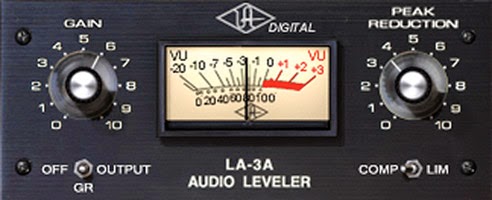
Universal Audio Teletronix LA-3A plugin image
It seems like a lot of you enjoy reading what kind of gear I like to use, as evidenced by the views for my top 10 mics, mic preamps, EQs and compressors. I'm going to continue the series with my "Top 10 Most Used Plugins."

Keep in mind that I use a lot of other plugs by other manufacturers, but these are the ones that I find are used somewhere on almost every mix that I do. Also, I'm a Pro Tools user, so some plugs are PT-centric.

1. Pro Tools 7 Band EQ: I love this plugin because it sounds pretty good, doesn't eat up any system resources, and has hi and low pass filters. Sometimes I'll just use it for the filters only (like on effects), but I always find a lot of these sprinkled across a mix in many other places.

2. Universal Audio 1176LN: My go-to compressor in most cases. UA has a lot of different variations in their Classic Limiter bundle, but this is the one that works best for me. I find it can just about work on anything if you adjust the attack and release times, but I'll almost always use it on bass for sure, toms, and probably vocals (although the UA LA-2A works great there as well).

3. PSP Vintage Warmer: Everything I use this on just sounds better, especially the mix buss. I rarely use much of it, but it makes a big difference on the glue of a final mix.

4. Lexicon PCM Native Hall: I love all the Lexicon reverbs, but I find I use the PCM Hall almost all the time, mostly for things that need depth like strings and pads. The Lexicon PCM Plate is a close second, but the Pro Tools D-Verb can be surprisingly good in many places as well.

5. Universal Audio Teletronix LA-3A: Back in the hardware days I always used these on electric or acoustic guitars, since I've never found anything better on those instruments. It's no different with the plugin. It's also good on keys.

6. Soundtoys MicroShift: I looked around for a long time for a plugin with that old Harmonizer sound. The MicroShift is the first plug that I found that really does it (although you can also now get the same sound from the Eventide Ultrachannel). It's dead easy to use and provides that extra presence or smoothing like nothing else.

7. Universal Audio Precision Limiter: There are other great limiters (like the Waves L series and the Slate Digital FG-X), but this is my favorite for the stereo buss to just take care of those nasty peaks that result in overs. I don't use much of it (a dB or 2), and it's very transparent already, so you don't hear it while it does the job.

8. TT Dynamic Range Meter: This is an excellent plugin that tells you when you're squashing the mix too much. It provides precision output metering, plus that great dynamic range meter, and its FREE. Let's keep the hypercompression out of music. Use this meter.

9. Pro Tools Long Delay: There are other great delay plugs (Soundtoys Echoboy and the PSP 42 and 85 come to mind), but this is the one I reach for all the time. It's not as versatile as many plugins, but it's fast to set up, and once again, takes up virtually no system resources (which can be important on a large mix). I alter it with a previously mentioned PT 7 Band EQ ahead of it to get the sound I need and keep it out of the way of the vocal.

10. Sample Magic Magic AB: This is one of my new favorites. It provides an instant AB against any audio file. You can load up to 9 sources to AB against, and easily match the level between them all for a tight comparison. Plus you can even loop a section if you want. It's great for making sure your mix is really in the ballpark.

Like I said before, there are a lot of other great plugins that I use by a variety of companies, and there are many that I haven't tried yet, but these are the ones that I use on every single mix that I do.

What are your favorites?
----------------------------------

Sunday, September 16, 2012

New Musical Instrument Monday: Auria iPad DAW

Auria iPad DAW app image from Bobby Owsinski's Big Picture blog
For those of you who love your iPad and want to do more actual audio work on it, here's an amazing digital audio workstation app by WaveMachine Labs called Auria. It's easy to take a mere iPad app lightly when it comes to some heavy duty audio lifting, but Auria can play back up to 48 mono or stereo channels at up to 96kHz/24 bit, and can record up to 24 tracks at the same time, as well as having a feature list that can rival many widely used DAWs.

The Auria DAW has both a full channel strip and master strip package designed by the clever guys at PSP Audioware (thanks, Antoni, for turning me on to this gem). It's excellent in both look and function, and sounds great, just like all PSP plugins. I only wish that they were available as a plugin for Pro Tools as well.

But the Auria is not only a full-on mixer, it's an editor too, just like your favorite computer-based DAW. It's a little clunkier to do with your finger and a touch screen, but you can always use an Apple wireless mouse for more precision if needed.

The Auria iPad DAW is available from the App Store for only $49. There's a variety of approved interfaces that work with it (some a little easier than others), but just about anything will work as long as it works with Core Audio and doesn't require a driver.

Check out the video.


----------------------------------

You should follow me on Twitter for daily news and updates on production and the music business.

Don't forget to check out my Music 3.0 blog for tips and tricks on navigating social media and the new music business.

LinkWithin

Related Posts Plugin for WordPress, Blogger...